Click on the image for a larger view.
Showing posts with label beats. Show all posts
Showing posts with label beats. Show all posts
Sunday, April 08, 2012
Tuesday, January 11, 2011
generation refusing the label of "lost"
New York Times Magazine
November 16, 1952
"This Is the Beat Generation"
A 26-year-old defines his times.
By CLELLON HOLMES
 The wild boys of today are not lost. Their flushed, often scoffing, always intent faces elude the word, and it would sound phony to them. For this generation conspicuously lacks that eloquent air of bereavement which made so many of the exploits of the Lost Generation symbolic actions. Furthermore, the repeated inventory of shattered ideals, and the laments about the mud in moral currents, which so obsessed the Lost Generation does not concern young people today. They take it frighteningly for granted. They were brought up in these ruins and no longer notice them. They drink to "come down" or "get high," not to illustrate anything. Their excursions into drugs or promiscuity come out of curiosity, not disillusionment.
Only the most bitter among them would call their reality a nightmare and protest that they have indeed lost something, the future. But ever since they were old enough to imagine one, that has been in jeopardy anyway. The absence of personal and social values is to them, not a revelation shaking the ground beneath them, but a problem demanding a day-to-day solution. How to live seems to them much more crucial than why. And it is precisely at this point that the copywriter and the hot-rod driver meet, and their identical beatness becomes significant, for, unlike the Lost Generation, which was occupied with the loss of faith, the Beat Generation is becoming more and more occupied with the need for it. As such, it is a disturbing illustration of Voltaire's reliable old joke: "If there were no God, it would be necessary to invent Him." Not content to bemoan His absence, they are busily and haphazardly inventing totems for Him on all sides...
In the wildest hipster, making a mystique of bop, drugs and the night life, there is no desire t shatter the drugs and the night life, there is no desire to shatter the "square" society in which he lives, only to elude it. To get on a soapbox or write a manifesto would seem to him absurd.... Equally, the young Republican, though often seeming to hold up Babbitt as his culture hero, is neither vulgar nor materialistic, as Babbitt was. He conforms because he believes it Is socially practical, not necessarily virtuous. Both positions, however, are the result of more or less the same conviction -- namely that the valueless abyss of modern life is unbearable.
In the photo above, Clellon Holmes is standing at far left.
November 16, 1952
"This Is the Beat Generation"
A 26-year-old defines his times.
By CLELLON HOLMES
 The wild boys of today are not lost. Their flushed, often scoffing, always intent faces elude the word, and it would sound phony to them. For this generation conspicuously lacks that eloquent air of bereavement which made so many of the exploits of the Lost Generation symbolic actions. Furthermore, the repeated inventory of shattered ideals, and the laments about the mud in moral currents, which so obsessed the Lost Generation does not concern young people today. They take it frighteningly for granted. They were brought up in these ruins and no longer notice them. They drink to "come down" or "get high," not to illustrate anything. Their excursions into drugs or promiscuity come out of curiosity, not disillusionment.
Only the most bitter among them would call their reality a nightmare and protest that they have indeed lost something, the future. But ever since they were old enough to imagine one, that has been in jeopardy anyway. The absence of personal and social values is to them, not a revelation shaking the ground beneath them, but a problem demanding a day-to-day solution. How to live seems to them much more crucial than why. And it is precisely at this point that the copywriter and the hot-rod driver meet, and their identical beatness becomes significant, for, unlike the Lost Generation, which was occupied with the loss of faith, the Beat Generation is becoming more and more occupied with the need for it. As such, it is a disturbing illustration of Voltaire's reliable old joke: "If there were no God, it would be necessary to invent Him." Not content to bemoan His absence, they are busily and haphazardly inventing totems for Him on all sides...
In the wildest hipster, making a mystique of bop, drugs and the night life, there is no desire t shatter the drugs and the night life, there is no desire to shatter the "square" society in which he lives, only to elude it. To get on a soapbox or write a manifesto would seem to him absurd.... Equally, the young Republican, though often seeming to hold up Babbitt as his culture hero, is neither vulgar nor materialistic, as Babbitt was. He conforms because he believes it Is socially practical, not necessarily virtuous. Both positions, however, are the result of more or less the same conviction -- namely that the valueless abyss of modern life is unbearable.
In the photo above, Clellon Holmes is standing at far left.


Monday, November 15, 2010
Hotel Wentley Poems
 I admire and am often mesmerized by the poems of John Wieners because they presuppose a music exhilirated--made absolutely alive--by deprivation and, at times, by self-destructiveness. They are "the score of a man's struggle to stay with what is his own."
 The Hotel Wentley Poems, Wieners's first book (1958), are available online--all of them. This is a book that should be read in one sitting, and it offers a powerful reading experience. Not quite Beat (although he was feeling beat--out of it, not beatific--and he was in San Francisco at the time he wrote these poems in successive days) and not quite Black Mountain, the poems can be placed in their time and aesthetic context with some pleasure taken by the placer; but they do really well as more generally "New American" or, frankly, contextless, or in the similar/different context of love poetry across the literary ages. I have two favorite passages. One is the seventh and final section of "A poem for painters" and the other is a passage near the end of "A poem for museum goers." The latter movingly situates the speaker (a writer--the author of these very poems) both in the history of art (the art of lovers leaving lovers) and in the desolate present room at the Hotel Wentley, the room of the poem.
Lover leaves lover,
1896, 62 years
later, the men
sit, paws and
jagged depths
under their heads,
Now the season of
the furnished room. Gone
the Grecian walls & the
cypress trees,
plain planks and spider
webs, a bed
only big enough for one,
it looks like a
casket.
The speaker didn't want this but he knows how keenly and well the depression has provoked these poems. They're his way out but also his deathbed.
The seventh section of "A poem for painters" needs little explanation. Another magnificent poem about the poem, it puts itself in the tradition of the defense of poesy, by first enumerating what the present poem lacks. Otherwise, the section serves the same purpose as the passage quoted above:
At last. I come to the last defense.
My poems contain no
wilde beestes, no
lady of the lake music
of the spheres, or organ chants,
yet by these lines
I betray what little given me.
One needs no defense.
Only the score of a man's
struggle to stay with
what is his own, what
lies within him to do.
Without which is nothing,
for him or those who hear him
And I come to this,
knowing the waste, leaving
the rest up to love
and its twisted faces
my hands claw out at
only to draw back from the
blood already running there.
Oh come back, whatever heart
you have left. It is my life
you save. The poem is done.
PennSound makes available a recording of Wieners reading of "A poem for painters" (in a pre-published version). The recording of this and other poems was made by Robert Creeley, probably at a Berkeley poetry conference, probably in the summer of 1965.
Wednesday, September 01, 2010
Sappho-Dickinson hybrid with a Beat sensibility
 Tony Trigilio has been working this past year on an edited collection of poems and fragments from Elise Cowen's only surviving notebook. This edition will reproduce the notebook poems themselves, as they were written in Cowen's hand. Cowen's surviving family generously granted the rights to Tony to edit the book. The project, which is still looking for a publisher, will include many never-before-seen Cowen poems and will correct those that had been mis-transcribed in the past. The book is taking shape as an intriguing Sappho-Dickinson hybrid with a Beat sensibility -- an odd mixture, perhaps, but an accurate description of Cowen's varied influences.
For years I've taught Elise Cowen in my modern/contemporary American poetry course (English 88) and once created a modest Cowen web page here. Here's more about Tony.
Monday, January 04, 2010

Saturday, December 26, 2009

Tuesday, December 22, 2009
black daisy chain of nuns
Your
     Frankenstein
What is the word from  Deberoux Babtiste
the Funambule   I
Desnuelu (who's he?)  to choke you
Duhamel    and you
De brouille   Graciously
Deberaux   Take me by the throat
Decraux
Barrault
Deberaux
Delicate
French logic
Black daisy chain of nuns
Nous sommes tous assasins
Keith's jumping old man in the waves
  methadrine
 morning dance of delicacy
 "I want you to pick me up
  when I fall down"
 That's part of a poem by Elise Cowan. Cowen, though dead more than a quarter century, is in many ways more present than many of the other so-called "Beat women." She is alive in the pages of Joyce Johnson's Minor Characters and in the memories of many of Beat survivors whom she deeply impressd with her generous friendship. Janine Pommy Vega, with whom Elise lived for a time, says, "I still think about her every day. She was the smartest person I knew." More...
At right: Allen Ginsberg and Elise Cowan.
Thursday, August 13, 2009
angry middle-aged editor meets Kerouac
James Wechsler's memoir is titled Reflections of an Angry Middle-Aged Editor. In one chapter, "The Age of Unthink," Wechsler recalls a frustrating encounter with Jack Kerouac during a symposium on "the Beat generation" at Hunter College in 1958. Here is the text of the entire chapter.
Here's the moment when Wechsler first encounters Kerouac:

There it is: "You ruined my sentence." One writer's half-attentive opening remark to another.
Here's the moment when Wechsler first encounters Kerouac:

As I walked a trifle uncomfortably down the center aisle to the stage, I got my first view of the leader of the Beat Generation. He was attired in a lumberjack shirt unadorned by tie, but there was nothing especially ostentatious about his lack of dress. A little more flabbergasting was the discovery that he was holding what proved to be a glass of brandy, and throughout the evening he made several trips to the wings for a refill. Kerouac acknowledged my arrival by observing, "You ruined my sentence," and then resumed a discourse which I am obliged to describe as a stream of semiconsciousness.
There it is: "You ruined my sentence." One writer's half-attentive opening remark to another.
Tuesday, July 28, 2009

Friday, April 17, 2009
sock it to him, sweet Tito
 Lawrence Felinghetti's "Baseball Canto" sits in the (I'm imagining April) sun, early-season baseball, schmoozing with the left-field bleacher-bound grungy populace. And makes the presences of blacks and Chicanos on the S.F. Giants into a reason for associating the limitations of the Anglo-Saxon poetic tradition and Poundian modernism and American conformity (the latter imposed by Irish umpires). Its aesthetic and ideological oppositions are all hilariously confused. Does Larry F. know that the pitcher, although Caribbean and thus blessed, is not likely to hit a home run as his means of out-performing the white players? It's a mess but I love it all the same. Yes, that's Lawrence Felinghetti's Baseball Canto. (I also have made available a RealAudio recording of F. performing the poem.)
Friday, November 14, 2008
Jack on Long Island
 Last year, the folks at poetryvlog.com went out to Northport, Long Island, where Jack Kerouac lived from 1958 through 1964. In a 5-minute video, one of the two poetryvlog producers, George Harris, takes us on a tour of the town, which was in the midst of a community celebration at the time. A general holiday it was, into which honor due Jack fits as a small part in the municipal unconscious. (Ah, Long Island.) Here's your link to the the video and here's the link to the blog entry.
Wednesday, October 29, 2008
beat girl migrates to Venice
 Howard K. Smith did a news report on "the Beat revolution" in 1960. Smith intended to be even-handed, although today his commentary and questions (in interviews) will strike us as amazingly condescending. These poor deluded children. Charming, but oh how misguided. My favorite moment in the report is a 56-second segment from what must have been a longer, perhaps much longer discussion with a teenaged girl - who had fled her square suburban parents and had migrated to Venice, CA. Listen to her. I'm entranced by her utterly sincere critique of American conformity, in the high sweet tone that anticipates the classic flower child of seven or eight years later.
Sunday, August 17, 2008
the territorio libre of baseball
 I'm not a huge fan of Lawrence Felinghetti's poems but I've always admired and enjoyed the early figure he cut. The poetry, especially later, is schticky. Well, if you're going to do irreverent liberationist schtick, why not turn the glance at baseball and modernism at once.
 In "Baseball Canto" Ferlinghetti runs through a crude analogy between the racial and class undersides of baseball and the kind of poetry and poetics that might stand against the exclusivist epic-oriented modernism inherited from Ezra Pound. The analogy only works in a superficial political sense: Tito Fuentes and Willie Mays, beloved by the grungy populace in San Francisco's bleachers, surely hate usury. Poundian modernism becomes an imperialism. It's fast and, as I say, very rough. But funny and fun.
I've made a RealAudio recording of Ferlinghetti reading this poem. If you don't have a RealPlayer on your computer, I apologize. (You can donwload one from Real.com.)
Click here to listen. And here's the poem's text:
Watching baseball, sitting in the sun, eating popcorn,
reading Ezra Pound,
and wishing that Juan Marichal would hit a hole right through the
Anglo-Saxon tradition in the first Canto
and demolish the barbarian invaders.
When the San Francisco Giants take the field
and everybody stands up for the National Anthem,
with some Irish tenor's voice piped over the loudspeakers,
with all the players struck dead in their places
and the white umpires like Irish cops in their black suits and little
black caps pressed over their hearts,
Standing straight and still like at some funeral of a blarney bartender,
and all facing east,
as if expecting some Great White Hope or the Founding Fathers to
appear on the horizon like 1066 or 1776.
But Willie Mays appears instead,
in the bottom of the first,
and a roar goes up as he clouts the first one into the sun and takes
off, like a footrunner from Thebes.
The ball is lost in the sun and maidens wail after him
as he keeps running through the Anglo-Saxon epic.
And Tito Fuentes comes up looking like a bullfighter
in his tight pants and small pointy shoes.
And the right field bleechers go mad with Chicanos and blacks
and Brooklyn beer-drinkers,
"Tito! Sock it to him, sweet Tito!"
And sweet Tito puts his foot in the bucket
and smacks one that don't come back at all,
and flees around the bases
like he's escaping from the United Fruit Company.
As the gringo dollar beats out the pound.
And sweet Tito beats it out like he's beating out usury,
not to mention fascism and anti-semitism.
And Juan Marichal comes up,
and the Chicano bleechers go loco again,
as Juan belts the first ball out of sight,
and rounds first and keeps going
and rounds second and rounds third,
and keeps going and hits paydirt
to the roars of the grungy populace.
As some nut presses the backstage panic button
for the tape-recorded National Anthem again,
to save the situation.
But it don't stop nobody this time,
in their revolution round the loaded white bases,
in this last of the great Anglo-Saxon epics,
in the territorio libre of Baseball.
Monday, July 21, 2008
how truly "neat" could it be?
For the blockbuster special Esquire issue on the 1950s (June 1983), Frank Conroy contributed a piece called "America in a Trance." Here is a passage:
The Beats were just beginning, Kerouac, et al., and we greeted them with a certain amount of suspicion, convinced that art was not that easy. Our standards were rather high, I think. The New Critics had filled us with an almost religious awe of language. We read Leavis, Edmund Wilson, and Eliot as well, taking it all very seriously, worrying over every little point as if Truth and Beauty hung in the balance. The conservatism that colored so much of our experience did not evaporate when we dealt with literature. We defended literary art as if it were a castle under siege, in imminent danger of being destroyed by the vulgarians. In every college or university I knew anything about the most hated course was Social Science, as much a result of the incredibly rotten prose of the text as it was of our disinterest in things social.... We were neat, very neat, and sloppiness of any kind irritated us.
 Most of this will strike readers of this blog as unremarkable since so many chroniclers of and generalizers about "the fifties" set alleged Beat easiness against the rigors demanded by New Criticism. And the New Critics' hatred of Social Science seems to have persuaded aspiring young literati to join the crusade against sociological (and social-psychological) interpretation. And yet, when one steps even further back, one sees that the most influential social science - epitomized by Daniel Bell's End of Ideology - formed a great political alliance with New Critical formalism. In the former case, we're talking about conservatives (of Ransom's and Tate's and Donald Davidson's stripe) coming on as centrists; in the latter case - that of sociologists like Bell (shown at right) - we're talking about left-liberals moving rightward to the post-ideological center. In that context (and perhaps only that context) Conroy's recollection of being pro-New Criticism and anti-Social Science seems odd, and only points up the passion (I would say it comes from an exhaustion with political interpretation) with which the young generationally-unselfconscious writers of that day embraced aesthetics. But--again--this embrace was a function of an urge to gain distance from the merge of aesthetics and politics that had gotten so many in an earlier self-conscious generation into trouble.
The result is the advocacy of "neat" and a distrust of "sloppy." Yet "neat" derived from victory after a very sloppy battle defending the castle against vulgarians. Think about how truly neat that could be.
The Beats were just beginning, Kerouac, et al., and we greeted them with a certain amount of suspicion, convinced that art was not that easy. Our standards were rather high, I think. The New Critics had filled us with an almost religious awe of language. We read Leavis, Edmund Wilson, and Eliot as well, taking it all very seriously, worrying over every little point as if Truth and Beauty hung in the balance. The conservatism that colored so much of our experience did not evaporate when we dealt with literature. We defended literary art as if it were a castle under siege, in imminent danger of being destroyed by the vulgarians. In every college or university I knew anything about the most hated course was Social Science, as much a result of the incredibly rotten prose of the text as it was of our disinterest in things social.... We were neat, very neat, and sloppiness of any kind irritated us.
 Most of this will strike readers of this blog as unremarkable since so many chroniclers of and generalizers about "the fifties" set alleged Beat easiness against the rigors demanded by New Criticism. And the New Critics' hatred of Social Science seems to have persuaded aspiring young literati to join the crusade against sociological (and social-psychological) interpretation. And yet, when one steps even further back, one sees that the most influential social science - epitomized by Daniel Bell's End of Ideology - formed a great political alliance with New Critical formalism. In the former case, we're talking about conservatives (of Ransom's and Tate's and Donald Davidson's stripe) coming on as centrists; in the latter case - that of sociologists like Bell (shown at right) - we're talking about left-liberals moving rightward to the post-ideological center. In that context (and perhaps only that context) Conroy's recollection of being pro-New Criticism and anti-Social Science seems odd, and only points up the passion (I would say it comes from an exhaustion with political interpretation) with which the young generationally-unselfconscious writers of that day embraced aesthetics. But--again--this embrace was a function of an urge to gain distance from the merge of aesthetics and politics that had gotten so many in an earlier self-conscious generation into trouble.
The result is the advocacy of "neat" and a distrust of "sloppy." Yet "neat" derived from victory after a very sloppy battle defending the castle against vulgarians. Think about how truly neat that could be.
Sunday, May 04, 2008
even ecstasy is a made thing
 The first "lesson" people seem to learn about Allen Ginsberg's "Howl" is that it is spontaneous, follows the rule of "first thought, best thought," and all this talk about its natural language leaves one with the impression (intentionally enhanced by the poem's own rhetoric) that it was composed in a white heat, a burst, and then left to be its now-canonical self.
 When I teach the poem I use the first (mis)impression to my advantage (I mean, as a teacher who wants to convey, among other things, that there is no such thing as a poem consisting of natural language--that poems are made things). A lesson simple enough. After a while--after a discussion of the students' sense that the poem was composed in a flash of "inspiration" and ecstasy--I show them the marked-up typescript. You see a page below. If you click on the image, it will enlarge just enough for you to be able to see some of the careful revisions Ginsberg made as he worked this poem toward perfection--toward the impression of natural speech he wanted to create.
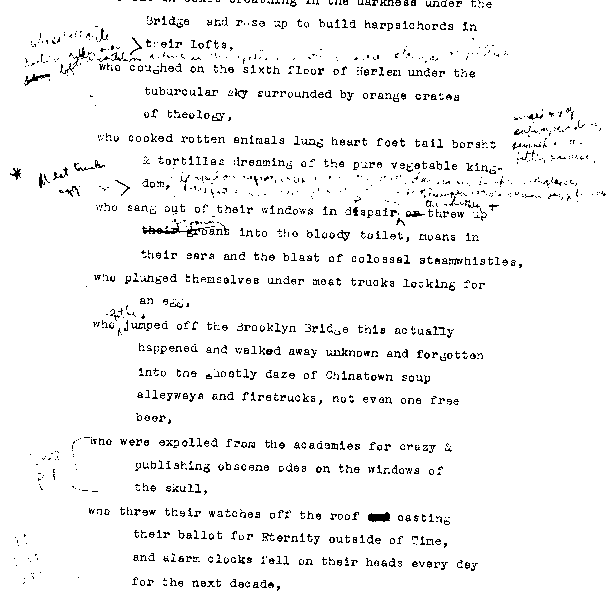
[inserted between lines 1 and 2] who sat all nite rocking & rolling over lofty incantations which in the yellow morning were stanzas of gibberish
[inserted in the left margin near line 9] * Meat truck egg
[inserted by line 10] lunged out of subway windows, jumped in the filthy Passaic, leaped on negroes, Cried al over the street, danced on broken wineglasses barefoot smashed their phonograph records of European 1930's German jazz finished the whisky &
[inserted in line 11] groaning
[inserted in line 15] got hi [canceled]
[inserted in left margin by lines 20-21] See p 1 [Ginsberg is proposing a shift here to page 1]
[inserted in left margin by lines 23-26] After free Beer [Ginsberg is proposing to move this so that it follows "not ever one free beer" above]
Thursday, February 14, 2008
howl my valentine
 The March 1956 recording of Ginsberg reading Howl in Berkeley, it turns out, was not the first tape of it made. A month earlier AG and Gary Snyder had hitched up to Reed College (Snyder has grown up in Portland and attended Reed) where Snyder had arranged for some readings. Only recently did some folks at Reed find a box with a reel-to-reel tape marked "Snyder Ginsberg 1956," played it and heard a decent-quality 35-minute recording.
 The date of the reading, at a student hostel called "the Anna Mann Cottage," is February 14 - Valentine's Day 52 years ago.
Here's an article about the find.
Wednesday, February 13, 2008
beat novel written by Karl Marx
 Mike Hennessey was browsing used books and came across John Clellon Holmes' 1952 novel - sometimes said to be the "first Beat novel" - Go, opened it up and found graffiti scrawled by someone - presumably a young man - named Brian Zimmerman. Perhaps Brian was required to read Go in high school? "What Would Patton Say?" he asks (rhetorically) in one outburst. At right is a close-up; below, at left, you can see the title page as Brian, incensed by the obviously communist propaganda, has written over and through it.
 Unlike Brian, the novel says: "I actually yearn for life to be easy, magic, full of love."
 And elsewhere: "You know what I just dreamed? I dreamed about everybody I know.... I honestly never realized how many people I know. Too many goddamn people. You know what I mean?"
O Brian, dream such a dream.
It was to Holmes that Kerouac once said, "You know, this is really a beat generation." Jack in turn had gotten the term from Herbert Huncke.
In 1958 Holmes published The Horn, which is considered by many to be the definitive jazz novel of the beats.
I've written about Holmes here before.
Wednesday, January 23, 2008
journalists follow beatnik invasion
 For my 1960 blog (no, not the 1960s - the year 1960) I've been reading dozens and dozens of newspaper articles and magazine pieces about "beatniks." By then the phenomenon was four or five years old, in the public consciousness, at least, and yet 1960 seems to be the year when it really hit Time and Newsweek and began to receive the usual scoffing afforded such trends in the New Yorker. Legit beat hangouts were invaded by journalists asking regulars and proprietors to make distinctions between real beatniks, part-time beatniks, tourist beatniks, and gawkers at beats who happened themselves to be bearded or carrying bongos for non-beat purposes. My most recent blog entry quotes from a New Yorker "Talk of the Town" piece that resulted from a visit to Cafe Figaro in the Village. Click here to see it.
Saturday, January 19, 2008

Tuesday, January 15, 2008

Subscribe to:
Posts (Atom)


 "I teach horizontally, meaning that while I might begin with a fixed idea of what I'm going to teach that day, I let it drift rhizomatically way off topic, often pulling it back when it gets too far. I rely on non-fixed materials to teach this way; the whole world is at my fingertips. Should I go off on a tangent about John and Rauschenberg and their love relationship as expressed in Rauschenberg's bed, an image of that bed is always a click away. From there, we can head anywhere into the non-fixed universe, be it film, text or sound. And of course, that always takes us elsewhere. As Cage says, 'We are getting nowhere fast.'"

 that anyone has yet got the imaginative measure of that terrifying day six years ago. Certainly our Tolstoy has not crawled out of the rubble. The closest we have, Don DeLillo, succeeded as an essayist-journalist ("In the Ruins of the Future: Reflections on Terror and Loss in the Shadow of September,” Harper’s, December 2001) but, to my mind, failed as a novelist ("Falling Man"). One reason, perhaps, is that the remembered emotion was instantly buried under a pile of cultural junk.' - Tod Gitlin in his review of Susan Faludi's The Terror Dream (written for