Thursday, February 13, 2014
Pierre Joris on Paul Celan's Shoah
New PennSound podcast: 20-minute excerpt of my discussion with Pierre Joris on Paul Celan's experience of the Shoah: https://jacket2.org/podcasts/pierre-joris-celan-and-shoah-20-minutes


Paul Auster recording
Paul Auster at PennSound performs the first two pages from "The Book of Illusions": http://media.sas.upenn.edu/pennsound/authors/Auster/Auster-Paul_03_1st-2-pgs-Bk-of-Illusions_UPenn_4-11-01.mp3

Wednesday, February 12, 2014
Goldsmith says Shia LaBeouf isn't a good plagiarist
http://entertainment.time.com/2014/02/12/shia-labeouf-plagiarism-performance-art-scandal/#ixzz2tAVkA6Uq - Shia LaBeouf Isn’t a Very Good Plagiarist, Says the Plagiarist He’s Been Plagiarizing. MoMA poet laureate Kenneth Goldsmith: "If he were in my class, he would have gotten a very bad grade."

Tuesday, February 11, 2014
student responses to Elie Weisel's "Night"
Here are excerpts from two students’ responses to reading Elie Wiesel’s Night in my course called “Representations of the holocaust”:
I guess my frustration comes from my confusion about what my relationship should be towards this book. I feel a little out of sorts as a reader. I think of a memoir as closer in relationship to a novel than a textbook, and so I’ve been expecting of it some of the attention and creativity of form that a novel shows. But is that wrong of me? Is a holocaust memoir addressing something too sacrosanct to employ the same devices that a novel or creative memoir about another topic does? I really don’t know, and I feel disappointed with myself for feeling disappointed by the form of the narrative.
Some events initially seemed too perfectly metaphorical to be reality. But I had to remind myself that such things did happen. In such extreme circumstances, there is no metaphor and there is not the unimaginable—we are forced to accept that it is reality and we are forced to imagine the unimaginable, as terrible as it is, for that is the only way we can attempt to empathize.
I guess my frustration comes from my confusion about what my relationship should be towards this book. I feel a little out of sorts as a reader. I think of a memoir as closer in relationship to a novel than a textbook, and so I’ve been expecting of it some of the attention and creativity of form that a novel shows. But is that wrong of me? Is a holocaust memoir addressing something too sacrosanct to employ the same devices that a novel or creative memoir about another topic does? I really don’t know, and I feel disappointed with myself for feeling disappointed by the form of the narrative.
Some events initially seemed too perfectly metaphorical to be reality. But I had to remind myself that such things did happen. In such extreme circumstances, there is no metaphor and there is not the unimaginable—we are forced to accept that it is reality and we are forced to imagine the unimaginable, as terrible as it is, for that is the only way we can attempt to empathize.
Monday, February 10, 2014
experimental radio host/producer featured in new podcast
Benjamen Walker featured in new Kelly Writers House podcast: https://jacket2.org/commentary/benjamen-walker-and-year-sound . Part of the University of Pennsylvania's "year of sound."


Sunday, February 09, 2014
PennSound roundtable on Tuesday Feb 11 at noon
PennSound roundtable - noon - Tuesday, Feb 11. in the Meyerson Conference Center, 2nd floor of Van Pelt Library, Penn. http://humanities.sas.upenn.edu/13-14/dhf_pennsound.shtml

video of Jackson Mac Low's 75th
The Jackson Mac Low 75th Birthday Festschrift, September 20, 1997 - video of the event - has now been added to PennSound's Jackson Mac Low page: http://writing.upenn.edu/pennsound/x/Mac-Low.php

Rachel Blau DuPlessis with her new book
Rachel Blau DuPlessis with her new book, "Interstices": http://www.amazon.com/Interstices-Rachel-Blau-Duplessis/dp/1930068646

Monday, January 13, 2014
Dottie Lasky on Sylvia Plath, a poem

Tuesday, December 17, 2013

Monday, December 02, 2013
this holiday season, help me help kids get two weeks at camp next summer

My five decades of experiences at Frost Valley have
taught me pretty much everything I know how to do – to be a patient
parent, to be an attentive citizen, to be a teacher who cares personally
about his students, and indeed to do whatever is in my power to preserve
what Frost Valley does for kids.
I’ve seen Frost Valley make the lives of kids better in
just two weeks. Seriously. I’ve seen it. Many times. Probably you’ve
heard me tell these stories. No space for those stories here, but click on
this video
and take a good look at these kids’ expressions – and you’ll
easily be able to imagine – or, from your own experience, remind yourself
of - the impact of this place on children and families. I’m
totally committed to it.
To kids whose families cannot afford two weeks at camp
in the summer, we at Frost Valley make $650,000 available annually. It’s
our goal never to say no to a family who wants to send their child
to camp – no matter the family’s economic status, nor the child’s ability
or disability.
We need to raise the funds to make this financial aid –
“camperships” – possible. My goal is to raise $10,000 before December 31,
2013. Will you please help me help these kids? Thank you so much for
considering it. Just click this link
and you'll see my Frost Valley web page, my goal, etc. Click
on "GIVE NOW" and make a donation. Thank you so much!
I'm personally very grateful for your help. Please help
me help these kids whose families cannot afford to send their children to camp.
This kind of support has been no less than life-changing and indeed life-saving
for some.
- Al
Monday, November 04, 2013


Thursday, June 20, 2013
diorama of "In a Station of the Metro"
Madeleine Wattenbarger, an intern at Poets House, has created a
diorama of Ezra Pound's "In a Station of the Metro," which will be used,
in part, to teach that poem to children. Here are two views.


Monday, May 27, 2013
praise for PennSound
Happily received by email today:
"I'd like to take a moment to thank you & everyone else involved for PennSound & all related to it; I'm a performer & composer working in contemporary music in the UK, & I discovered PennSound while I was researching Olson, Niedecker, Cage & others during my Composition PhD. I think it's fair to say that it has changed my life, both in that it introduced me to poets who now are essential to me, & in that their work has been & continues as a constant inspiration for my own work, pushing me to think much harder & more creatively about form, score space & a host of other elements in the music I write. I also learnt to sing Jerry Rothenberg's Horse Songs (with his encouragement), which was fun."
"I'd like to take a moment to thank you & everyone else involved for PennSound & all related to it; I'm a performer & composer working in contemporary music in the UK, & I discovered PennSound while I was researching Olson, Niedecker, Cage & others during my Composition PhD. I think it's fair to say that it has changed my life, both in that it introduced me to poets who now are essential to me, & in that their work has been & continues as a constant inspiration for my own work, pushing me to think much harder & more creatively about form, score space & a host of other elements in the music I write. I also learnt to sing Jerry Rothenberg's Horse Songs (with his encouragement), which was fun."
Saturday, May 11, 2013
Fall 2013 ModPo webcast schedule
Fall 2013 ModPo webcast schedule:
(Note: these sessions are live but
video recordings are available immediately afterwards.)
1. Monday, September 9, noon (eastern
time)
2. Wednesday, September 18, 9 PM (eastern time)
3. Wednesday, September 25, 10 AM (eastern time)
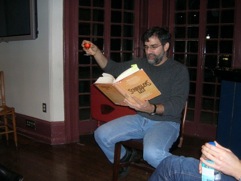
4. Wednesday, October 2, noon (eastern time) [a discussion of Stein's "Tender Buttons" with three poets]
5. Tuesday, October 8, 9 PM (eastern time)
6. Wednesday, October 16, 10 AM (eastern time)
7. Wednesday, October 23, noon (eastern time)
8. Tuesday, November 5, noon (eastern time) [live webcast session of PoemTalk on Whitman's "Out of the Cradle Endlessly Rocking"]
9. Wednesday, November 6, 9:30 AM (eastern time) [Please note that Daylight Savings Time ends on November 3.]
10. Thursday, November 14, noon (eastern time) [with invited guests from among the chapter 9.3 poets: Mike Magee, Tracie Morris, Kenneth Goldsmith]
11. Monday, November 18, noon (eastern time) [final words]
2. Wednesday, September 18, 9 PM (eastern time)
3. Wednesday, September 25, 10 AM (eastern time)
4. Wednesday, October 2, noon (eastern time) [a discussion of Stein's "Tender Buttons" with three poets]
5. Tuesday, October 8, 9 PM (eastern time)
6. Wednesday, October 16, 10 AM (eastern time)
7. Wednesday, October 23, noon (eastern time)
8. Tuesday, November 5, noon (eastern time) [live webcast session of PoemTalk on Whitman's "Out of the Cradle Endlessly Rocking"]
9. Wednesday, November 6, 9:30 AM (eastern time) [Please note that Daylight Savings Time ends on November 3.]
10. Thursday, November 14, noon (eastern time) [with invited guests from among the chapter 9.3 poets: Mike Magee, Tracie Morris, Kenneth Goldsmith]
11. Monday, November 18, noon (eastern time) [final words]
For an overview of this free, non-credit, 10-week course on modern and contemporary American poetry, click here.
To enroll, click here.
Sunday, April 28, 2013
ModPo expands the contemporary poetry community
Three wonderful ModPo people - they indeed met through ModPo last fall - converged on the Goldsmith-sponsored multi-room multi-poet reading at MoMA the other day. Kathleen Matson Blurock, Kent Ekberg, and Mónica Savirón. Kenny Goldsmith reports that he met a bunch of ModPo people at the event. Needless to say, I'm delighted that the contemporary poetry community has expanded in this way.


Wednesday, April 17, 2013
Monday, April 15, 2013
Thursday, April 04, 2013
Wallace Stevens, "The Poem That Took the Place of a Mountain"
There it was, word for word,
The poem that took the place of a mountain.
He breathed its oxygen,
Even when the book lay turned in the dust of his table.
It reminded him how he had needed
A place to go to in his own direction,
How he had recomposed the pines,
Shifted the rocks and picked his way among clouds,
For the outlook that would be right,
Where he would be complete in an unexplained completion:
The exact rock where his inexactness
Would discover, at last, the view toward which they had edged,
Where he could lie and, gazing down at the sea,
Recognize his unique and solitary home.
- -
Audio recording of Stevens performing this poem: MP3.
Link to PennSound's Wallace Stevens page: LINK.
Wednesday, April 03, 2013
Anthony DeCurtis interviews Loudon Wainwright III (video)

Loudon Wainwright III interviewed by Anthony DeCurtis - the 2013 installment of our Blutt Singer-Songwriter Symposium at the Kelly Writers House. You can watch a video recording of the complete program by clicking here.
Sunday, March 31, 2013
new Writers House podcast: Roger Angell

LISTEN TO THE SHOW
Friday, March 15, 2013
ArtsEdge year-long residency sponsored by Kelly Writers House

We are now accepting applications for the ARTSEDGE RESIDENCY PROJECT, a joint venture of the Kelly Writers House and Penn's Facilities and Real Estate Services: http://writing.upenn.edu/wh/involved/awards/artsedge/. DEADLINE: Tuesday, April 30, 2013 (at midnight).
The ARTSEDGE PROJECT offers a one year residency for an emerging writer. The residency includes an apartment at 40th and Chestnut, studio/writing space in the AIR Space artistic nexus, and close affiliation with Penn's writing communities.
During the course of the residency, the ArtsEdge writer will be encouraged to develop at least one project at the Writers House or the Rotunda. Past residents have produced staged readings (http://writing.upenn.edu/wh/calendar/0109.php#22), organized panel discussions (http://writing.upenn.edu/wh/calendar/0310.php#25), performed readings at Writers House (http://writing.upenn.edu/wh/calendar/1110.php#2), and coordinated other projects (http://writing.upenn.edu/wh/calendar/1009.php#15).
Visit the ArtsEdge website for more information and details about the project: http://writing.upenn.edu/wh/involved/awards/artsedge.
TO APPLY, please submit materials below to residencyproject@writing.upenn.edu:
(1) letter of interest, (2) CV or resume, (3) writing sample (maximum 30 pages), (4) personal contact information (phone & email), and (5) contact information for three professional references.
*** SUBMIT ALL MATERIALS AS ONE DOCUMENT (Word or PDF preferred). ***
And please help us out by forwarding this announcement far and wide!
ADDRESS ALL QUESTIONS to: residencyproject@writing.upenn.edu.
Monday, March 11, 2013
Jacket2 in Publishers Weekly

Wednesday, March 06, 2013
Wall Street Journal article about MOOCs
 |
| WSJ home page, 3/6/13 |
Saturday, February 23, 2013
the university in the city

Page 73 of Judith
Rodin's book on urban universities (I was the first among Penn's faculty/staff
to use the mortgage incentive plan to buy a house in West Philadelphia). I have
*loved* living here the 15 years since, raising my kids here (this diverse
& arts-lively part of the city has had such a positive effect on them)
& finding myself involved in & learning about the concerns of the
neighborhood - not to mention being able to walk or bike to work, and easily go
back to campus at night to meet with students & attend their events.
Tuesday, February 19, 2013
New York Times editorial on online courses
"The online revolution offers intriguing
opportunities for broadening access to education. But, so far, the
evidence shows that poorly designed courses can seriously shortchange
the most vulnerable students." - NY Times editorial today.
Yes, poorly designed courses (online or otherwise) are bad. Thank you.
Yes, poorly designed courses (online or otherwise) are bad. Thank you.
Friday, February 15, 2013
Loudon Wainwright III

Loudon Wainwright visited the Kelly Writers House last night for our annual Blutt Singer-Songwriter Symposium, an event that included an interview conducted by Anthony DeCurtis. Here is a video clip of Loudon singing "White Wino," in response to Anthony's questions about Loudon's mother.
Thursday, February 14, 2013
travel grant
The Terry B. Heled Travel Grant at the Kelly Writers House
http://writing.upenn.edu/wh/involved/awards/heled
purpose
As a way of memorializing her mother, Terry B. Heled - and of honoring the students of her alma mater in gratitude for the encouragement her own research and writing received while she was at Penn - Mali Heled Kinberg (C'95) has created this endowed fund at the Kelly Writers House that, each summer, enables a student to travel for the purpose of conducting the research that will lead to a significant writing project.
the grant
The winner of the Heled Travel Grant will receive $2,000 toward the costs of summer travel, for a researched writing project requiring archives, facilities, people (e.g. those to be interviewed), materials, and/or terrain that can only be found at a travel destination or destinations. Applicants who can describe such resources in detail will be at an advantage. Think expansively. Priority will be given to those proposing longer trips, especially travel beyond North America, but any travel plan -- to any place, of any length -- will receive serious consideration based on the quality of the project. Paddle down the Mississippi to study American literary history firsthand. Track down the surviving members of the "Ghost Army" of World War II to learn about alternative, theatrical warfare. Travel to Greece or Vienna or Japan to research and write about your linguistic roots.
The proposed research experience should lead specifically to a writing project of some kind. (Students researching topics in non-humanities subjects are welcome to apply, but note that the result of the research should be a significant and creative piece of writing.)
who is eligible?
Any currently matriculated University of Pennsylvania junior, sophomore or freshman is eligible.
after the summer
After the summertime travel, the Heled Grant recipient will present the results of his or her research in a program at the Kelly Writers House. The format of the session at the Writers House is wide open; the purpose of the event is to create a sense of excitement about students traveling for research as well as, of course, to give the winner of the grant a forum for showing off his or her achievement and telling the story of the trip.
how to apply
The deadline for all applications is Wednesday, March 6, 2013. Candidates should include:
* a cover letter giving a very brief summary of the project and a description of relevant experience (coursework as well as non-academic);
* a detailed two-page description of the project - the research trip and the proposed writing;
* an estimate of all costs associated with the trip;
* a current resume that includes, as an appendix, a complete list of relevant courses taken, heavily annotated to give descriptions of projects and papers prepared for each course;
* a writing sample, no longer than 15 pages.
Applications should be emailed to Mingo Reynolds at mingo@writing.upenn.edu.
http://writing.upenn.edu/wh/involved/awards/heled
purpose
As a way of memorializing her mother, Terry B. Heled - and of honoring the students of her alma mater in gratitude for the encouragement her own research and writing received while she was at Penn - Mali Heled Kinberg (C'95) has created this endowed fund at the Kelly Writers House that, each summer, enables a student to travel for the purpose of conducting the research that will lead to a significant writing project.
the grant
The winner of the Heled Travel Grant will receive $2,000 toward the costs of summer travel, for a researched writing project requiring archives, facilities, people (e.g. those to be interviewed), materials, and/or terrain that can only be found at a travel destination or destinations. Applicants who can describe such resources in detail will be at an advantage. Think expansively. Priority will be given to those proposing longer trips, especially travel beyond North America, but any travel plan -- to any place, of any length -- will receive serious consideration based on the quality of the project. Paddle down the Mississippi to study American literary history firsthand. Track down the surviving members of the "Ghost Army" of World War II to learn about alternative, theatrical warfare. Travel to Greece or Vienna or Japan to research and write about your linguistic roots.
The proposed research experience should lead specifically to a writing project of some kind. (Students researching topics in non-humanities subjects are welcome to apply, but note that the result of the research should be a significant and creative piece of writing.)
who is eligible?
Any currently matriculated University of Pennsylvania junior, sophomore or freshman is eligible.
after the summer
After the summertime travel, the Heled Grant recipient will present the results of his or her research in a program at the Kelly Writers House. The format of the session at the Writers House is wide open; the purpose of the event is to create a sense of excitement about students traveling for research as well as, of course, to give the winner of the grant a forum for showing off his or her achievement and telling the story of the trip.
how to apply
The deadline for all applications is Wednesday, March 6, 2013. Candidates should include:
* a cover letter giving a very brief summary of the project and a description of relevant experience (coursework as well as non-academic);
* a detailed two-page description of the project - the research trip and the proposed writing;
* an estimate of all costs associated with the trip;
* a current resume that includes, as an appendix, a complete list of relevant courses taken, heavily annotated to give descriptions of projects and papers prepared for each course;
* a writing sample, no longer than 15 pages.
Applications should be emailed to Mingo Reynolds at mingo@writing.upenn.edu.
3805 Locust Walk in 1953

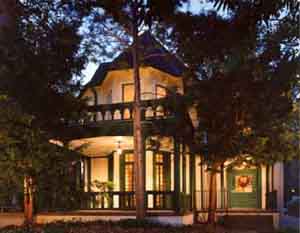
This photograph was taken on May 29, 1953, on the 38th block of Locust Street in West Philadelphia. The photographer was looking east toward the center of the University of Pennsylvania. Today, from this vantage, one would see Locust Walk (not Street), and in the distance one would see the street go upward over the 38th Street pedestrian bridge. Along the right side of this view today one would see the edge of Harnwell House ("High Rise East") and then, further away, the front edge of the Class of 1920 Commons. The Samuel Sloan-designed house at 3805 Locust Walk - now the Kelly Writers House - is not visible here (as it is set back from the street), but near where we've placed a red dot is the street-side path that leads to the porch and front door of the house. For more information about this photograph, click here.
Sunday, February 10, 2013

Thursday, February 07, 2013
homecoming weekend celebration to mark the 15th anniversary of the Kelly Writers House
This is a video recording of the 15th anniversary celebration of the Kelly Writers House, held during homecoming weekend that year. Three of my own former students, and KWH's first Director, Kerry Sherin Wright, presented their work. But before they did that, I gave a high-speed talk on the founding of the Writers House three times in succession: first a "conservative" narrative of KWH, then a liberal narrative, and finally a radical narrative.
Sunday, February 03, 2013
tech apps for saving long-form nonfiction
This video is an excerpt from "pitch night" for our "Entrepreneurial Jounalism" class taught by Sam Apple. These two student presentations proposed new applications to address current trends and problems in long-form nonfiction writing and publishing. You can watch the complete video - with all the student pitches - here. This program was sponsored by our Creative Ventures program.
Thursday, January 31, 2013
Friedman's hope: Ines and Daniel, ModPo people
Thomas Friedman's column on the MOOC phenomenon - a follow-up to an earlier piece he published last spring - expresses great optimism: "LORD knows there’s a lot of bad news in the world today to get you down,
but there is one big thing happening that leaves me incredibly hopeful
about the future, and that is the budding revolution in global online
higher education." He mentions ModPo without identifying it clearly, but Ines Cifuentes, a ModPo student, explains further in her comment in response to the Friedman article.


Thursday, January 24, 2013
material is difficult, but spirit of curiosity produces good results

University of Pennsylvania professor Al Filreis, who teaches Modern & Contemporary American Poetry, says that teaching online has given him his “most extraordinary pedagogical experience” in 30 years of teaching. “The course is rigorous and fast-paced, and the material is difficult, but the spirit of curiosity and investigation among the students produced very good results,” he says. “Several eminent poetry critics joined the course to rate the quality of the students' critical writing and came away very impressed -- and surprised. We discovered that a qualitative, interactive humanities course can indeed work in the MOOC format."
Quoted from "Learning From MOOCs," by Andrew Ng.
Wednesday, January 02, 2013

Friday, September 07, 2012
audio introduction to week 1 of ModPo
Here is the audio introduction to the first week of ModPo: MP3 (12 mins.)
There's still time to enroll in this free online course on Modern & Contemporary American poetry: enroll here.


Thursday, May 31, 2012


Monday, May 28, 2012
Fussell and Metcalf at Penn

In my imagination (I never met him), Fussell had always been what an English professor should be: erudite, frank, worldly, unworldly, acerbic: library and cosmopolis unto himself. When, out of the blue, I was asked to adjunct a nonfiction writing class at Penn, I said yes, even though, as the crow flies, the gig made absolutely no sense. Every week I headed down to Philly on Amtrak, and every week I faced down the same revelation: that instead of the runnels of blood-strewn ditches, my prose is filled with pita chips, iced coffee, Facebook, and procrastination. Nonetheless, we front our losses as they come. I taught my class as honestly as I knew how; I loved my students; and every week, autumn falling over West Philly, I threw the black bag back over my shoulder, still blessedly heavier than itself, and the sum of its contents.
(Here is the course Steve Metcalf taught for us.)
Subscribe to:
Posts (Atom)


 "I teach horizontally, meaning that while I might begin with a fixed idea of what I'm going to teach that day, I let it drift rhizomatically way off topic, often pulling it back when it gets too far. I rely on non-fixed materials to teach this way; the whole world is at my fingertips. Should I go off on a tangent about John and Rauschenberg and their love relationship as expressed in Rauschenberg's bed, an image of that bed is always a click away. From there, we can head anywhere into the non-fixed universe, be it film, text or sound. And of course, that always takes us elsewhere. As Cage says, 'We are getting nowhere fast.'"

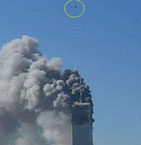 that anyone has yet got the imaginative measure of that terrifying day six years ago. Certainly our Tolstoy has not crawled out of the rubble. The closest we have, Don DeLillo, succeeded as an essayist-journalist ("In the Ruins of the Future: Reflections on Terror and Loss in the Shadow of September,” Harper’s, December 2001) but, to my mind, failed as a novelist ("Falling Man"). One reason, perhaps, is that the remembered emotion was instantly buried under a pile of cultural junk.' - Tod Gitlin in his review of Susan Faludi's The Terror Dream (written for