Showing posts with label fiction. Show all posts

Monday, January 12, 2009

with a bag of frozen peas on her head


Today we launched a new Kelly Writers House podcast. It features a 20-minute excerpt from the longer interview I conducted with Grace Paley as a Writers House Fellow in the spring of 2000. Here's your link to the audio. You can also subscribe to KWH podcasts by going to your iTunes Music Store; just search for "Kelly Writers House" in the searchbox. Bag of frozen peas? Yes, listen to the podcast and you'll hear about that.

Friday, December 12, 2008

Cynthia Ozick


My hour-long discussion with novelist Cynthia Ozick is now available as a downloadable mp3 recording. Cynthia came to the Writers House as a "Fellow" in 2006. Our conversation took place on March 21.

Saturday, December 06, 2008

my chat with David Sedaris


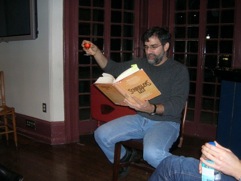
Back in March of 2001 I spent an hour talking with David Sedaris. A downloadable audio recording of that discussion is now available. Here's a direct link to the mp3. Be sure to check out our Sedaris page for some context, and if your machine runs RealVideo (if you have a "RealPlayer") click here and watch the same convo. The night before my conversation with him, Sedaris read selections from his stories and essays. The photo here was taken in the Arts Cafe of the Kelly Writers House.

Thursday, December 04, 2008

the people

In 1999 I helped bring out a new edition of a fabulous noir-ish novel by Ira Wolfert, called Tucker's People (1943). Now Google Books has made the text of this book - including my introduction - available on the web. Go here and read. One of the novel's ideas: the underside of the American economy is fascist. (See an earlier post.)

Wednesday, May 21, 2008

the Roth-Obama presidency

"I always joke," Barack Obama told Jeffrey Goldberg for Goldberg's new piece in the Atlantic, "that my intellectual formation was through Jewish scholars and writers, even though I didn’t know it at the time. Whether it was theologians or Philip Roth who helped shape my sensibility...."

Philip Roth helped shape Barack Obama's sensibility.

In yesterday's Slate Cultural Gabfest the three hyper-articulate gabbers noted, half-jokingly, that if Bill Clinton was our first black president, perhaps Barack Obama will be our first Jewish president.

Goldberg has written this: "Obama told me that his sensibility was partially shaped by the books of Philip Roth. This obviously has profound implications for American foreign policy, and for shiksas, as well. And so, a reader contest. In a couple of pithy sentences, tell us what the first 100 days of a Roth-influenced Obama presidency would look like."

Andrew Sullivan in "The Daily Dish" blog creates an entry called "The Obama-Roth Presidency."

Back in February here's what Roth had to say about Obama:

Roth: I’m interested in the fact that he’s black. I feel the race issue in this country is more important than the feminist issue. I think that the importance to blacks would be tremendous. He’s an attractive man, he’s smart, he happens to be tremendously articulate. His position in the Democratic Party is more or less okay with me. And I think it would be important to American blacks if he became president.

SPIEGEL: Is Barack Obama black enough?

Roth: I know this discussion goes on, but I think it will disappear if he gets the nomination. The reality of his running will wash that away. Anybody who’s half white and half black is considered black anyway. That’s one drop of blood.

Wednesday, May 07, 2008

beware the art student at war for wrong reasons

Oh conventional, well-adjusted American students of art, thwart your attraction to Gauguin, don't sign up for a Pacific troop transport and fight World War II for the wrong (namely, aesthetic) reasons. There can be only one right, well-adjusted reason to fight in the Pacific circa 1944. Aesthetic obsession ain't it. To me, this is the gist of Raditzer, Peter Matthiessen's third novel (1961). Click here to go to my 1960 blog, and read a bit more about the American named Stark who drift inexorably into his aesthetic heart of darkness.

Thursday, March 27, 2008

drive, she said

The novelist and essayist Lynne Sharon Schwartz visited the Writers House recently as a "Writers House Fellow." She read from her 9/11 novel The Writing on the Wall on Monday evening; an mp3 is available, and so is streaming QuickTime video. The next morning she was back, and this time I interviewed her and led a discussion with an audience of about 50 people gathered at the House. This to can be heard and also viewed as video.

During the interview we talked in part about her essay called "Drive, She Said," which is a mostly implicit rejoinder to Robert Creeley's "I Know a Man":

drive, he sd, for
christ's sake, look
out where yr going.

Lynne is somewhat afraid of driving recklessly or fast; her father was the master of the road and she wants his inheritance, but she drives cautiously and slow and cannot get over the fear that a cop will pull her over, ask her to roll down the window and will say, "You're not your father's daughter." She seeks counsel from her therapist, but she neglects to say the most important thing about her driving anxiety--that it's founded entirely on a fear of her father's driving and her incapacity at the thought of being disconnected from him as a timid driver. The therapist preaches the therapeutic gospel of a communalist road, where we share interests even while driving our separate ways. Lynne would like to believe that, but she can't. Nor can she end the essay. She is after all her father's daughter. She's more Creeley-like than not, in the end, because her essay-memoir talks on and on and meanders until finally she's driving the essay forward in the mode of which she thinks she's afraid. To me it constitutes an interesting feminist response to the Creeley of that early Guy Talk/On the Road poem.

Wednesday, February 13, 2008

beat novel written by Karl Marx

Mike Hennessey was browsing used books and came across John Clellon Holmes' 1952 novel - sometimes said to be the "first Beat novel" - Go, opened it up and found graffiti scrawled by someone - presumably a young man - named Brian Zimmerman. Perhaps Brian was required to read Go in high school? "What Would Patton Say?" he asks (rhetorically) in one outburst. At right is a close-up; below, at left, you can see the title page as Brian, incensed by the obviously communist propaganda, has written over and through it.

Unlike Brian, the novel says: "I actually yearn for life to be easy, magic, full of love."

And elsewhere: "You know what I just dreamed? I dreamed about everybody I know.... I honestly never realized how many people I know. Too many goddamn people. You know what I mean?"

O Brian, dream such a dream.

It was to Holmes that Kerouac once said, "You know, this is really a beat generation." Jack in turn had gotten the term from Herbert Huncke.

In 1958 Holmes published The Horn, which is considered by many to be the definitive jazz novel of the beats.

I've written about Holmes here before.

Monday, January 28, 2008

Jennifer Egan

Jennifer Egan read from her novel The Keep at the Writers House on September 14, 2006. She was introduced by Sam Donsky, a poet who was then an undergraduate. In the video clip above Jenny responds to Sam's introduction. Here are links to an audio recording of the whole reading and to Sam's introduction. And here is a video recording of Sam's intro.

Sunday, January 06, 2008

Wideman homecoming

John Edgar Wideman visited KWH in April of 2000. He'd been away from Penn quite a while and relations between John and Penn had been--for various reasons--a bit frosty, despite continued admiration for John from long-time Penn people such as Peter Conn. My students and I were ga-ga over John's then-new book, Two Cities, which I've re-read twice since '00 and still think is one of the best postwar U.S. novels. I highly recommend it. So John's return to Penn was a homecoming of sorts, a chance for many of us to say directly to him how much we value him and missed having him a part of the Penn scene. He was touched. The Penn baseball cap my students gave him he wore around all the next day. At one of the receptions we held at 3805 Locust for him, nearly all the basketball players and the coach, Fran Dunphy, showed up and gathered round him to hear stories of the Penn team of the early to mid-60s.

Last night we released a new Writers House podcast which features a 20-minute excerpt from our conversation with John from that 2000 visit. Here is the link directly to the podcast mp3.

And here's the link to the whole visit.

Friday, September 28, 2007

Rumsfield as Stein

The narration of The Writing on the Wall, Lynne Sharon Schwartz's novel about 9/11, includes bits and pieces of mid-September speechfiying, as a kind of background blather. At one point the two main characters see and hear Donald Rumsfield on TV saying this:

What this war is about is our way of life, and our way of live is worth losing lives for.

After hearing this, Schwartz's narrator, Renata, thinks: "The secretary of defense, channeling Gertrude Stein."

Not fair to Stein, but very funny nevertheless.

Tuesday, September 11, 2007

"has not adopted a minority tone"

Saul Bellow's review of Invisible Man praised Ralph Ellison for his independence from what was then called Negro writing. What he meant, among other things, was that Ellison was consciously not Richard Wright and that he would resist whatever ideological training had been (as Bellow imagined it, partly from his reading of the novel's narrator's experience) forced upon him.

I've made the entire review available in my 1950s site. Here are two salient passages:

Negro Harlem is at once primitive and sophisticated; it exhibits the extremes of instinct and civilization as few other American communities do. If a writer dwells on the peculiarity of this, he ends with an exotic effect. And Mr. Ellison is not exotic.

I was keenly aware, as I read this book, of a very significant kind of independence in the writing. For there is a way for Negro novelists to go at their problems, just as there are Jewish or Italian ways. Mr. Ellison has not adopted a minority tone. If he had done so, he would have failed to establish a true middle-of-consciousness for everyone.

Friday, August 31, 2007

Jack was language

"Time being of the essence in the purity of speech, sketching language is undisturbed flow from the mind of personal secret idea-words, blowing (as per jazz musician) on subject of image." That's Jack Kerouac.

My Jack is the writer and voicer of babbleflow, e.g.

Aw rust rust rust rust die die die pipe pipe ash ash die die ding dong ding ding ding rust cob die pipe ass rust die words-- I'd as rather be permiganted in Rusty's moonlight Rork as be perderated in this bile arta panataler where ack the orshy rosh crowshes my tired idiot hand 0 Lawd I is coming to you'd soon's you's ready's as can readies by Mazatlan heroes point out Mexicos & all ye rhythmic bay fishermen don't hang fish eye soppy in my Ramadam give--dgarette Sop of Arab Squat

--not the novelist of themes (wanderlust, national anti-identity, discovery of the true self). So it baffles me a little, or anyway bores me, when celebrations or indeed criticism of Kerouac focus on the new teen generation's response or indifference to On the Road.

This past year was the 50th anniversary of the publication of that book. We at the Writers House staged a marathon reading of the novel from start to finish. I participated, reading a passage for a half hour or so. As I read myself, and listened to others, I could hear how right I and others have been to conceive of this project as most interestingly a wordy, languagy thing.

What's important about this half-century is the scroll Jack used in composition--a single flow of paper, a means of thwarting the stop that coming to the end of 11 inches of dried pulp encourages.

What's important is language's own performance--its thingness.

But then there are the journalists, "covering" this 50th. And of course form doesn't sell newspapers.

I'm sure that when the Philadelphia Inquirer's reporter interviewed Erin Gautsche, our amazing Program Coordinator, she told him all kinds of things about the sound of the language, about the experience of reading the novel aloud as a community. But the reporter's angle was the usual topical thing, and in this passage he's writing about how and why today the book doesn't quite have the grip it once did. Here's a passage (and here's the whole article):

These days, though, kids don't react the same way. "They're more detached from the book and its message than students before," [Hilary] Holladay [director of the Kerouac Center for American Studies at the University of Massachusetts, Lowell] said. They are not gripped by the romantic notions that fevered Kerouac's brain. Could that spell an end to On the Road's relevance?

Certainly, the political incorrectness of the writing seems dated to today's young readers. For others critical of the book, there is a sense that it has been overrated through the years, and that there are better novels with better stories to tell.

To today's readers, parts of the book seem immature, even ridiculous, said Erin Gautsche, program coordinator of Kelly Writers House, a literary arts organization housed at the University of Pennsylvania.

The group did its own celebration of the book's 50th anniversary earlier this year.

"When you read Kerouac's descriptions of sharecroppers in the South and people in Mexico, he has an old-fashioned idea of race: that of the noble savage."

Kerouac saw poor minorities and other impoverished types as holy innocents untouched by the "dirtiness" of capitalist culture, Gautsche said. "They were shown as peaceful, happy, simple people," she added.

Also, as some readers have learned in dismaying second reads, a good deal of the book is simply about boorish guys looking for sex from disturbingly young, poor girls.


Here's Clark Coolidge on the topic of Kerouac's babbleflow.

Saturday, August 25, 2007

Grace Paley

I've been away (in the mountains) without newspapers and with little in the way of internet connectivity, so the sad news of Grace Paley's passing came to me late and indirectly. Very sad, indeed. She wrote her stories very slowly but those of us who awaited them learned to be patient. The new one almost inevitably seemed a part of a whole relevant fiction--a world. The Little Disturbances of Man in the late 50s, Enormous Changes at the Last Minute in the early 70s, and finally Later the Same Day in '85. There were other stories--and poems--after that but these three formed the whole I mean. Each story rewarded separate interest but together they were a life of love, personal flaws and self-criticism, and passionate ethical commitments.

I had taught Grace's stories since the early 80s when in 1999 I created "the Writers House Fellows"--a program whereby, each spring, I've hosted visits of eminent writers at the Writers House. For the year 2000, I invited John Edgar Wideman, Robert Creeley, as well as Grace. What a line-up.

Grace's visit was perfect. The students loved her and she loved the Writers House. Well, nearly perfect. There was one problem.

As Grace and I walked through the garden (such as it was then) into the back door of the House, she missed the step up and fell - hitting her forehead on the ground. She immediately cried out as one of her characters would: "I'm dead! I've died! Where am I?" and turned to me: "Are you real? I'm dead, aren't I? Oh my, oh my, oh my, my head hurts!" I brought her into office 109 and we sat there with Kerry and that year's Fellows coordinator, Adam Kaufman. We asked her what she needed. She said, "Do you have a bag of frozen peas?" We did! She put that bag on the bruised forehead and sat some more. We had maybe 20 minutes before the interview/discussion/live webcast was to start. She and I had gotten along beautifully the day before--during the class and the dinner. But now she suspected I was a dangerous official, pushing his guest to embrace his "show must go on" ideology, and she began to like Adam more and more. If
Adam left the room, Grace would call out, "Adam? Adam? Where's Adam?" Finally Adam persuaded her to let him escort her through the kitchen, dining room, living room and into the Arts Cafe. I went ahead and was waiting for her when she arrived and sat down in the comfy chair we had waiting for her, whereupon she turned to me and whispered: "Okay. I'm ready."

If you watch the video recording of the Tuesday morning interview, you'll notice two things: first, that Grace was superb--witty, ascerbic, political and completely responsive to my questions; second, that she spends some of the time holding a bag of peas to her forehead: writing.upenn.edu/~whfellow/paley.html.

A member of the Writers House community--who in those days was our chef for Fellows visits--remembers Grace this way:

her visit coincided with valentines day. the house was warm and cozy. i was in the kitchen, tucked out of sight as i liked to be, but with the doors wide open for those who would venture in, and for the occasion cooking by roses and candlelight. she ventured in, stirred the soup, and said something small and sweet that i now forget, but i took to be a blessing on the meal and the event. i was struck by how tiny she was and this gesture of inclusive kindness to someone whom i think she took to be a servant of sorts.

lots of people stopped into the kitchen during my years as house cook--students/house staff to talk out their ideas and sometimes to chop or (usually) to be fed, and fellow professors would sometimes come by after a meal to swap recipes/talk cooking shop, but no guest ever did what grace paley did--come to be alone with me for a
moment in the midst of an event to commune as two women, two caretakers, cooks, unspoken but understood friends.

Monday, July 09, 2007

a novel of blowtorch intensity

I edited and brought out a new edition of a relatively unknown novel, Ira Wolfert's Tucker's People. The new edition was published by Illinois with my introduction. When Tucker's People was published in 1943 it was praised by the New York Times: "Wolfert's blowtorch intensity, his subtle shadings of character and meaning, his distinctive and even poetic style and his terrifying clarity of vision lift his first novel bodily above the run of the mill. Tucker's People is an important work." H. G. Wells called it "a great book by a really talented author" when it was published in Great Britain. The book was subsequently translated into many languages, including French, Italian, and Russian. Tucker's People examines the 1930s takeover of the New York City numbers racket by a gangster modeled after the notorious mobster Dutch Schultz. It is "a penetrating, sympathetic novel of frustration and insecurity, a story of little people, many of them decent people, battling against forces they are too feeble to resist and too simple to understand," according to the Saturday Review of Literature. Originally rejected for publication by Little, Brown on the grounds that Wolfert had been branded a Communist, Tucker's People was published only after Angus Cameron, a well-known editor, approached more than twenty publishers in a personal attempt to see the book in print. Within a month of its publication, the book was in its third printing. "Wolfert's blowtorch intensity, his subtle shadings of character and meaning, his distinctive and even poetic style and his terrifying clarity of vision [make] Tucker's People an important work." -- The New York Times