Showing posts with label Charles Bernstein. Show all posts
Showing posts with label Charles Bernstein. Show all posts
Thursday, March 03, 2011
Sunday, January 23, 2011
poem in English & Chinese by Yanrong
The Chinese poet Yanrong performs his poem, "Prophecy and Carnival," in Chinese, while Charles Bernstein reads an English translation. On December 9, 2010, a group of poets from Wuhan, China, visited the Writers House: Liang Biwen, Liu Yishan, Chen Ying-Song, Tian He, Wang Xinmin, Ke Yumin, Li Ming, Hu Xiang, Liu An. Several American poets read their work in English and listened while the visiting poets read their poems in Chinese.


Wednesday, December 15, 2010
Bruce Andrews
from BRUCE ANDREWS: LINEBREAK
with Charles Bernstein
New York City, 1995
CHARLES BERNSTEIN:
One way that your work, overall, but, say, especially the work since the Reagan years, defies normal generic categorizations as poetry is the range of kinds of language and sources that you use. Not that no other writing has ever used that, not even that no other poetry has used some of it, but still, the scope, almost the encyclopedic scope of the social reference in your work seems to break down conceptions of poems, not even the lyric poem, but even other types of poetry.
BRUCE ANDREWS:
But think of how poignant that sounds even as you read back the transcript, I mean, just the idea that somehow having a desire for an encyclopedic range of possibility and reference and content and social bits of matter in your work would automatically seem odd that it would be poetry, that somehow what we think of as poetry or literary writing is supposed to accept the fact that it can operate happily with such a shrunken range of reference, meanwhile everybody in the world is confronted with this increasingly exploding range of reference that they embody in their own personal lives. I mean, if you are walking down the street, admittedly—I've lived in urban an area for twenty years—mass-culture, television, whatever your range of information is, you're being bombarded with this stuff all the time. And to somehow think that poetry is a place where you can't, unlike all these other areas in your personal life, have this come to life, seems so sad.
with Charles Bernstein
New York City, 1995
CHARLES BERNSTEIN:
One way that your work, overall, but, say, especially the work since the Reagan years, defies normal generic categorizations as poetry is the range of kinds of language and sources that you use. Not that no other writing has ever used that, not even that no other poetry has used some of it, but still, the scope, almost the encyclopedic scope of the social reference in your work seems to break down conceptions of poems, not even the lyric poem, but even other types of poetry.
BRUCE ANDREWS:
But think of how poignant that sounds even as you read back the transcript, I mean, just the idea that somehow having a desire for an encyclopedic range of possibility and reference and content and social bits of matter in your work would automatically seem odd that it would be poetry, that somehow what we think of as poetry or literary writing is supposed to accept the fact that it can operate happily with such a shrunken range of reference, meanwhile everybody in the world is confronted with this increasingly exploding range of reference that they embody in their own personal lives. I mean, if you are walking down the street, admittedly—I've lived in urban an area for twenty years—mass-culture, television, whatever your range of information is, you're being bombarded with this stuff all the time. And to somehow think that poetry is a place where you can't, unlike all these other areas in your personal life, have this come to life, seems so sad.
Tuesday, November 23, 2010
Reznikoff's voices
The opening of an essay by Charles Bernstein:
- - -
 “Reznikoff’s Voices” by Charles Bernstein
Holocaust, Charles Reznikoff’s last book, is, like his great work of the 1930s, Testimony, haunted by the voices of the dispossessed. In Testimony, Reznikoff worked with legal records of violent crimes from 1885-1915 to create tautly etched accounts of the turbulent underbelly of these United States. The two long volumes of Testimony are difficult reading, though a different senseof “difficulty” than that of other modernist poetry by first-wave modernists such as Eliot, Pound, Stein, or Stevens. There is no difficulty interpreting the content of these poems; in a sense they start with the heresy of paraphrase, for each poem paraphrases the longer account of a crime that Reznikoff appropriates, edited but verbatim, from the legal documents. The book, composed entirely from archival material, averts an overarching story line or poetical reflections. In contrast, Muriel Rukeyser’s documentary poem “Book of the Dead” (1938) uses passages from the Egyptian Book of the Dead, and a multi-voice format that shifts from quoted letters from a variety of sources and journalistic accounts, to weave together a far more theatrical and narrativizing work than Testimony.
Testimony is presented in a monolithic, if not to say monotonous, form, which offers no respite from directly confronting an unfolding, accumulating series of horrific events. Reznikoff’s methodological refusal to mitigate means that the work speaks not for itself as as itself. Perhaps the most important precedent for Testimony is Whitman’s “Song of Myself”: Reznikoff’s work is the antipode: in place of Whitman’s bursts of celebration, Reznikoff’s Testimony is a prolonged elegy; an unflinching acknowledgement of unredeemable and inexcusable loss. [more]
- - -
 “Reznikoff’s Voices” by Charles Bernstein
Holocaust, Charles Reznikoff’s last book, is, like his great work of the 1930s, Testimony, haunted by the voices of the dispossessed. In Testimony, Reznikoff worked with legal records of violent crimes from 1885-1915 to create tautly etched accounts of the turbulent underbelly of these United States. The two long volumes of Testimony are difficult reading, though a different senseof “difficulty” than that of other modernist poetry by first-wave modernists such as Eliot, Pound, Stein, or Stevens. There is no difficulty interpreting the content of these poems; in a sense they start with the heresy of paraphrase, for each poem paraphrases the longer account of a crime that Reznikoff appropriates, edited but verbatim, from the legal documents. The book, composed entirely from archival material, averts an overarching story line or poetical reflections. In contrast, Muriel Rukeyser’s documentary poem “Book of the Dead” (1938) uses passages from the Egyptian Book of the Dead, and a multi-voice format that shifts from quoted letters from a variety of sources and journalistic accounts, to weave together a far more theatrical and narrativizing work than Testimony.
Testimony is presented in a monolithic, if not to say monotonous, form, which offers no respite from directly confronting an unfolding, accumulating series of horrific events. Reznikoff’s methodological refusal to mitigate means that the work speaks not for itself as as itself. Perhaps the most important precedent for Testimony is Whitman’s “Song of Myself”: Reznikoff’s work is the antipode: in place of Whitman’s bursts of celebration, Reznikoff’s Testimony is a prolonged elegy; an unflinching acknowledgement of unredeemable and inexcusable loss. [more]
Friday, October 22, 2010
he's no alien
 Nope, he's about as terrestrial a person and poet as there is. This is a new and better version of a photograph taken by Lawrence Schwartzwald, and I'm happy to feature it today.
Monday, October 11, 2010
PennSound on YouTube
 In this video clip, watch and hear Juliana Spahr read from her work, "The Incinerator." The clip is 8 minutes long and was prepared for our PennSound YouTube channel: http://www.youtube.com/user/pennsound. There are now 118 videos uploaded to PennSound on YouTube. They range from David Antin rethinking Freud to Kaegan Sparks introducing Christian Bok to John Yau talking with Charles Bernstein.
Tuesday, July 06, 2010
Myung Mi Kim: emergence implied in the unsaid
 On March 15, 2007, Penn students and Charles Bernstein interviewed Myung Mi Kim as part of Bernstein's "Close Listening" series. Michael Nardone has now transcribed the entire discussion, for publication, later, in Jacket2. Meantime, here is an excerpt:
STUDENT:
You mentioned yesterday how each reading is different and how you would have other people come up and read your work. If you could just elaborate on that and how would someone who doesn’t speak another language experience repercussions while reading?
KIM:
Let me start with the second part of your question first, because I think it dovetails nicely with what I’ve just been saying about what are the demands on sense and sense-making that are politically and socially and culturally driven. So, when you ask that question about, well, what about a person who doesn’t speak, you know, another language, and what kind of condition would be produced for that reader, my question always, whether out loud or implicitly, is can you produce an approximation of the condition of language again unhooked from the demands of communication and communicability and transparency, and can you somehow suggest/evoke/amplify/proliferate different ways of being inside and listening to and activating the space that we call language, which doesn’t belong to any one language group, doesn’t belong to any one particular idea of how basic things that benchmarks of language like rhythm, syntax, intonation, inflection, taking all those things as resources for meaning, as resources for experience. So, in other words, even if there were no identifiable thing called the second language, there’s something produced about an experience of language, and I think everyone has access to that.
STUDENT:
So, you think that when phrases can’t be translated, so these other limits of syntax, that this is actually more resources, is what you’re saying?
KIM:
Yeah, I think the whole notion of untranslatability, unsayability, the unsayable remains a profound interest again both linguistically, culturally and politically. The what isn’t there, what isn’t, that can’t be said. The kind of immanence and the emergence implied in that state of the unsaid, I think, has to be a certain kind of social force.
STUDENT:
In listening to you last night and then a reading you did at Buffalo, I guess, before Commons was printed officially, I was noticing a lot of differences in what you were reading and what I was reading along with in the version, so I was wondering speak a little about versions of text, and when you do or don’t think something is finished. Also, you mentioned last night about conceiving of your works as one long continuum, and sort of how that might play into how you think about a finished product.
KIM:
When I finish the text, in fact, that is the finished text. However I feel that when I’m giving readings from the finished text, it’s almost as if the text literally re-presents itself to you. Even if you are the maker of that particular text, there’s a way in which you’re greeting it and reading it. So, the occasion of the reading creates a space in which that re-listening and re-making initiates itself, and sometimes that happens, say, before the event, that I’ll sit down and wonder, in a sense, out loud to myself, what will I be reading. In that process, something gets kicked up, something is, as I say, re-initiated. Sometimes it happens literally in the reading itself, in the performance itself. I don’t think of them necessarily as revisions at all. I do think of them as reformulations, re-takes, re-assembling, which is a lot how I work in the first place, a kind of process of accretion and assemblage and reconfiguration and there are many mobile parts. So, in a way, every time you come back to the text, the process can re-kindle itself. That’s been of some interest to me simply because it opens up the question of what is real time, what is compositional time, and what is the time of making a text. I think they are all different sort of filtrations of what it means to produce a written text, which is not to refuse or in any way empty out the meaning of the book or the text that might come to some kind of rest, right. So, these are things that are being held in some kind of complicity and conversation with each other so that no one part of that, processually speaking, forecloses on any other part.
Tuesday, June 01, 2010
retelling the Iliad with the letter 'e'
In 2005, a seminar of Penn students and Charles Bernstein spoke with Christian Bok, making a recording that is now part of the "Close Listening" series hosted by Bernstein. Here is the recording and here is more information about the session. Now Michael Nardone has transcribed the interview for later publication in Jacket2 but we cannot resist offering a brief excerpt here:
- -
 PENN STUDENT:
So, while we are talking about Eunoia, can we look forward to a consonant sequel?
BÖK:
A consonant sequel? No, I’ve promised myself that I won’t ever write another constraint-based book again. The blood-pact I have with my peer group is that every book we write will be radically different from its predecessor, that the entire oeuvre should be completely heteroclite. So, the next project requires learning a whole new skill-set and re-training my brain, in effect, to learn something else. I probably would not have the endurance now or perseverance required to actually finish a constraint-based book.
PENN STUDENT:
So, clearly, this is very constraint-based, and from what you’re saying, you’re probably going to set yourself a new set of rules every time you write something new. So, are you arguing for something, for going back to sort of the poetic formality that has existed forever, against the tide of free verse, or stream-of-consciousness?
BÖK:
Well, actually, I have no problem with those poetic forms. I think my only complaint about those poetic forms you’ve cited is that they are not feeling much incentive to innovate and produce something new and reinvent themselves in a manner which is exciting and stimulating. And to me, it’s not so important that the work actually demonstrate some sort of formalistic character, so long as it has some kind of innovative rationale for its practice. So, I’m not making a case, I think, for a return to rigorous and strict formality. You know, I’m not that fascistic or school-marmish, I think, in my sensibilities. But I did this project thinking that it was a kind of experimental work. I didn’t know if it could be done, and I merely conducted the experiment to see what would happen. And to me, that’s really what writing poetry is about, it’s a kind of heuristic activity where you indulge in a completely exploratory adventure through language itself.
PENN STUDENT:
Well, speaking of innovative rationale, where did your constraints, your content constraints about, you know, the nautical voyage and so forth, come from?
BÖK:
Okay, in the book, the five chapters have a thematic thread, which runs throughout the entire book. Every chapter has to allude to the art of writing. All the chapters have to describe a culinary banquet, a prurient debauch, pastoral tableaux, and a nautical voyage. These four scenarios are indicative of a vocabulary that’s common to all five vowels. It’s possible to say something erotic or culinary in theme in all the vowels cause they actually have that vocabulary common to all of them. So, I wanted there to be sort of thematic consistency across the entire book. I didn’t want it to be just five separate, individual stories that had no correlations with each other. I wanted there to be some sort of thematic parallelism, and it just so happened that these were the lexicons that were common to the five vowels. So, included them in the story.
Now, coincidentally, those four scenarios are, in fact, the kinds of scenarios you typically see in Greek epic poetry. And, for me, the word eunoia, which is originally from Greek, means quite literally “good-will”—it was a term coined by Aristotle to describe the frame of mind that you have to be in in order to make a friend—it seems to me it reflects a kind of neo-classical set of values about beautiful thinking. And certainly, there is a kind of classical story in there. The re-telling of the Iliad in chapter E, I think, alludes, in fact, to these kinds of four scenarios, which are common to a classical form of story telling. You would find these scenes in that.
PENN STUDENT:
So, did the classical idea come first, because when I read the nautical voyage, it reminded me of, sort of, epic, the epic tradition? So, did the research for what was common come first, or sort of a homage to the classical traditions?
BÖK:
It’s all a side effect of the actual vocabulary itself. It wasn’t as though I planned to write about these four scenarios. The vocabulary determined, in effect, what it was possible for me to say, and I simply said it. It just so happens that, I think, coincidentally, they are easily integrated into this rationale, this explanation, you know, that it has something to do with, I think, a kind of neo-classical, kind of Apollonian rigor or, you know, aesthetic value that I think the Greeks exemplify.
PENN STUDENT:
Okay, my final question: have you ever thought of joining an acapella group?
BÖK:
No, I don’t think so. I don’t think I would join an acapella group. I’m too much of an auteur.
I have no vocal training. I’m not a musician.
BERNSTEIN:
You know, I always thought Eunoia was what people said about poetry like ours: You annoy-a me.
BÖK:
That’s right, that’s right. That was the standard joke my friends when the book was out wearing its welcome, people would describe it as Annoy-you, or, better yet, Ennui.
- -
 PENN STUDENT:
So, while we are talking about Eunoia, can we look forward to a consonant sequel?
BÖK:
A consonant sequel? No, I’ve promised myself that I won’t ever write another constraint-based book again. The blood-pact I have with my peer group is that every book we write will be radically different from its predecessor, that the entire oeuvre should be completely heteroclite. So, the next project requires learning a whole new skill-set and re-training my brain, in effect, to learn something else. I probably would not have the endurance now or perseverance required to actually finish a constraint-based book.
PENN STUDENT:
So, clearly, this is very constraint-based, and from what you’re saying, you’re probably going to set yourself a new set of rules every time you write something new. So, are you arguing for something, for going back to sort of the poetic formality that has existed forever, against the tide of free verse, or stream-of-consciousness?
BÖK:
Well, actually, I have no problem with those poetic forms. I think my only complaint about those poetic forms you’ve cited is that they are not feeling much incentive to innovate and produce something new and reinvent themselves in a manner which is exciting and stimulating. And to me, it’s not so important that the work actually demonstrate some sort of formalistic character, so long as it has some kind of innovative rationale for its practice. So, I’m not making a case, I think, for a return to rigorous and strict formality. You know, I’m not that fascistic or school-marmish, I think, in my sensibilities. But I did this project thinking that it was a kind of experimental work. I didn’t know if it could be done, and I merely conducted the experiment to see what would happen. And to me, that’s really what writing poetry is about, it’s a kind of heuristic activity where you indulge in a completely exploratory adventure through language itself.
PENN STUDENT:
Well, speaking of innovative rationale, where did your constraints, your content constraints about, you know, the nautical voyage and so forth, come from?
BÖK:
Okay, in the book, the five chapters have a thematic thread, which runs throughout the entire book. Every chapter has to allude to the art of writing. All the chapters have to describe a culinary banquet, a prurient debauch, pastoral tableaux, and a nautical voyage. These four scenarios are indicative of a vocabulary that’s common to all five vowels. It’s possible to say something erotic or culinary in theme in all the vowels cause they actually have that vocabulary common to all of them. So, I wanted there to be sort of thematic consistency across the entire book. I didn’t want it to be just five separate, individual stories that had no correlations with each other. I wanted there to be some sort of thematic parallelism, and it just so happened that these were the lexicons that were common to the five vowels. So, included them in the story.
Now, coincidentally, those four scenarios are, in fact, the kinds of scenarios you typically see in Greek epic poetry. And, for me, the word eunoia, which is originally from Greek, means quite literally “good-will”—it was a term coined by Aristotle to describe the frame of mind that you have to be in in order to make a friend—it seems to me it reflects a kind of neo-classical set of values about beautiful thinking. And certainly, there is a kind of classical story in there. The re-telling of the Iliad in chapter E, I think, alludes, in fact, to these kinds of four scenarios, which are common to a classical form of story telling. You would find these scenes in that.
PENN STUDENT:
So, did the classical idea come first, because when I read the nautical voyage, it reminded me of, sort of, epic, the epic tradition? So, did the research for what was common come first, or sort of a homage to the classical traditions?
BÖK:
It’s all a side effect of the actual vocabulary itself. It wasn’t as though I planned to write about these four scenarios. The vocabulary determined, in effect, what it was possible for me to say, and I simply said it. It just so happens that, I think, coincidentally, they are easily integrated into this rationale, this explanation, you know, that it has something to do with, I think, a kind of neo-classical, kind of Apollonian rigor or, you know, aesthetic value that I think the Greeks exemplify.
PENN STUDENT:
Okay, my final question: have you ever thought of joining an acapella group?
BÖK:
No, I don’t think so. I don’t think I would join an acapella group. I’m too much of an auteur.
I have no vocal training. I’m not a musician.
BERNSTEIN:
You know, I always thought Eunoia was what people said about poetry like ours: You annoy-a me.
BÖK:
That’s right, that’s right. That was the standard joke my friends when the book was out wearing its welcome, people would describe it as Annoy-you, or, better yet, Ennui.
Wednesday, May 26, 2010
the page is like a score
 PennSound's Maggie O'Sullivan page includes a recording of a discussion with Penn students in Charles Bernstein's "studio 111" seminar. Michael Nardone has transcribed the session now and here is a portion:
PENN STUDENT:
Thank you for your close reading, Ms. O’Sullivan. I was wondering if you could describe the relationship between performing your work and writing it.
O’SULLIVAN:
Well, it depends on, every situation is different. Performing it is another opportunity to re-engage with the text at different levels, and another opportunity to negotiate the text on the page.
As you’ve probably heard, I often find my work is quite difficult for me to read from the page. Writing it, I hear the sounds often in my ear. But having to perform it, all the difficulties emerge. There’s lots of disconnectiveness and disjunctiveness that is kind of working against how I sort of, how sometimes it seems it may be read.
PENN STUDENT:
Would you consider, sort of, maybe, performing it to be more body intensive than, I guess, writing it.
O’SULLIVAN:
Well, writing is a body-intensive activity, totally. Absolutely, totally. The whole body is engaged in the act of writing. Whether it’s on the computer, with using a pen in the hands. The breath is involved in all activities. But with the performing, there are others that you have to connect with, and the place of performing also figures on it.
PENN STUDENT:
A number of your poems integrate different languages, musical notes, pictures, and streaks, and they push the possibilities of poetic forms on the page. I was wondering whether this is supposed to conflict with the words, compliment them, or maybe even both.
O’SULLIVAN:
The words working as part of all this kind of radical shifting—
PENN STUDENT:
Right. Other forms on the page that would not be considered part of the traditional poetic form.
O’SULLIVAN:
Well, it’s all material on the page. The page is like a score. Like a place for painting, or drawing, or word making, whatever. I am seeking to extend the range of poetic, what is traditionally regarded as poetic material.
Tuesday, May 25, 2010
Charlesfest reviewed
Nicole Peyrafitte has written a review of our celebratory event for Charles Bernstein (marking his 60th and the publication of his selected poems).
Monday, March 29, 2010
a happy 60th

 Last night at the Zinc Bar in Manhattan: a celebration of Charles Bernstein's 60th birthday and the publication of his selected poems. Photographs by Lawrence Schwartzwald.
Monday, February 15, 2010
off the wall
 “[John] Tranter broke new ground in terms of serious criticism of poetry being spread all over the world,” [new editor Mike] Hennessey said.
Media Editor Steve McLauglin, a 2008 [Univ. of Pennsylvania] alumnus, is going on a two month bus trip this summer with his audio recorder to record poetry readings from all across the United States to use as podcasts for Jacket2.
“This project is an example of the kind of thing that doesn’t happen very often. Off-the-wall stuff happens at the Writers House,” McLaughlin said.
According to Charles Bernstein, American poet and Penn English professor, “the Web is the quickest and economically most efficient way to get poetry out there.”
“Jacket is one of the most appealing and best edited of literary magazines that exists,” Bernstein said.
[more]
Wednesday, February 10, 2010
yesterday's Bernstein convergence
 All the president's libretti. Yesterday, journalist Carl Bernstein took some time at a Manhattan restaurant to read the libretti Charles Bernstein wrote for Ben Yarmolinsky's music in Blind Witness. My favorite literary photographer, Lawrence Schwartzwald, happened by and took this photo of the productive Bernstein convergence. (The photo was taken at Barney Greengrass (the Sturgeon King), Upper West Side deli on Amsterdam Avenue.)
Saturday, January 23, 2010
the Stevens wars
Charles Bernstein commissioned me to write a piece that would bring Wallace Stevens' reputation among contemporary poets up to date - from 1975 to the present. The essay I wrote, as has been noted here before, was published in the fall 2009 issue of Boundary 2. Here is a PDF version of the entire article, called "The Stevens Wars."
In it I discuss the varying responsiveness to Stevens in the writings of (in order of appearance) Susan Howe, Ann Lauterbach, Michael Palmer, Charles Bernstein ("Loneliness in Linden" is a rejoinder to "Loneliness in Jersey City"), Lytle Shaw, Robert Creeley, Jack Spicer, Peter Gizzi, John Ashbery, John Hollander, and again Susan Howe as a very different sort of response than that of Hollander.
Here is the passage of the essay on Peter Gizzi:
Gizzi is one of our most important contemporary Stevensean poets, yet he is adamantly non-ideological about it. Periplum and other poems gathers early work from 1987 to 1992 and Stevens is everywhere, although in the background. Epigraphs from Dickinson, Spicer, James Schuyler, Oppen, Ashbery, Rilke, Rosmarie Waldrop and Keith Waldrop assert the preferred literary company and don’t so much suppress the presence of Stevens as express a remnant of outmoded embarrassment (Stevens and Dickinson? Stevens and Oppen?) and a debt more pervasive than dedications can allow. The great sequence “Music for Films,” written in Provincetown in August 1990, looks and sometimes reads like the Oppen of Discrete Series but is more interestingly Gizzi’s attempt at his own “Variations on a Summer Day” (1940), floating, chartless, using weather as device for directionlessness and (momentary) lack of poetic ambition.
Some Values of Landscape and Weather (2003) is Gizzi’s most Stevensean volume. Again the landscape-and-weather trope provides a means of laconic improvisation, a going which way the wind blows, a subject as a cloud, “imitation[s] of life” that can use terrestrial being as an excuse for impersonality and dislocation. Gizzi here is in Stevens’ floating middle period: “Landscape with Boat,” “Of Bright & Blue Birds & the Gala Sun,” “The Search for Sound Free from Motion,” “Forces, the Will & the Weather,” “Debris of Life & Mind,” even the dour “Yellow Afternoon.” The ironic word-level sonority of “A History of the Lyric” has Harmonium in it, however—
There are beetles and boojum
Specimen jars decorated
With walkingsticks, water striders
And luna moths
A treatise on rotating spheres.
Gizzi’s whole project might be captured in that phrase: “a treatise on rotating spheres”—what Jordan Davis calls a “shorthand sublimity” at the level of the line combined with a knowing engagement with the pathetic fallacy for the purpose of pushing the human to the top of abstraction and thus away from sentiment.
In Artificial Heart (1998), the book in which Gizzi came into his own poetically, the pronominal address is often generalized—points to the poet (even in the first-person plural “we”), an unidentified she (as in “The Idea of Order at Key West,” a muse or paramour a bit damaged over time but still ready for verse, a version of the subject: “She sang unwrapping her bandages”)—articles refer to general impersonal states of being (“the body remembers joy”; “The day static with stuck weeds”), and a communal, funereally functioning “they” who arrive at the end of poems—Ashberyian in this sense—to bring stories that were not told in this poem but might have been told had we not done our work of telling about something else. Gizzi’s “Will Call” ends:
It was an average day
An arrangement of place. A state of report
or a state of grace. For centuries weeds have hidden it.
Now autumn. Silence is what we make
of eyes, trees and growing vine. It pierces.
And these are the stories they will bring in boxes.
The ut pictura poesis of “Utopia Parkway,” dedicated to New York School-affiliated poet-painter Trevor Winkfield, is written out of Stevens’s poems about paintings (especially in Parts of a World) and the 1951 MoMA talk, “The Relations Between Poetry and Painting,” which in its turn had influenced O’Hara, Ashbery, Koch, and Schuyler from the start.
In it I discuss the varying responsiveness to Stevens in the writings of (in order of appearance) Susan Howe, Ann Lauterbach, Michael Palmer, Charles Bernstein ("Loneliness in Linden" is a rejoinder to "Loneliness in Jersey City"), Lytle Shaw, Robert Creeley, Jack Spicer, Peter Gizzi, John Ashbery, John Hollander, and again Susan Howe as a very different sort of response than that of Hollander.
Here is the passage of the essay on Peter Gizzi:
Gizzi is one of our most important contemporary Stevensean poets, yet he is adamantly non-ideological about it. Periplum and other poems gathers early work from 1987 to 1992 and Stevens is everywhere, although in the background. Epigraphs from Dickinson, Spicer, James Schuyler, Oppen, Ashbery, Rilke, Rosmarie Waldrop and Keith Waldrop assert the preferred literary company and don’t so much suppress the presence of Stevens as express a remnant of outmoded embarrassment (Stevens and Dickinson? Stevens and Oppen?) and a debt more pervasive than dedications can allow. The great sequence “Music for Films,” written in Provincetown in August 1990, looks and sometimes reads like the Oppen of Discrete Series but is more interestingly Gizzi’s attempt at his own “Variations on a Summer Day” (1940), floating, chartless, using weather as device for directionlessness and (momentary) lack of poetic ambition.
Some Values of Landscape and Weather (2003) is Gizzi’s most Stevensean volume. Again the landscape-and-weather trope provides a means of laconic improvisation, a going which way the wind blows, a subject as a cloud, “imitation[s] of life” that can use terrestrial being as an excuse for impersonality and dislocation. Gizzi here is in Stevens’ floating middle period: “Landscape with Boat,” “Of Bright & Blue Birds & the Gala Sun,” “The Search for Sound Free from Motion,” “Forces, the Will & the Weather,” “Debris of Life & Mind,” even the dour “Yellow Afternoon.” The ironic word-level sonority of “A History of the Lyric” has Harmonium in it, however—
There are beetles and boojum
Specimen jars decorated
With walkingsticks, water striders
And luna moths
A treatise on rotating spheres.
Gizzi’s whole project might be captured in that phrase: “a treatise on rotating spheres”—what Jordan Davis calls a “shorthand sublimity” at the level of the line combined with a knowing engagement with the pathetic fallacy for the purpose of pushing the human to the top of abstraction and thus away from sentiment.
In Artificial Heart (1998), the book in which Gizzi came into his own poetically, the pronominal address is often generalized—points to the poet (even in the first-person plural “we”), an unidentified she (as in “The Idea of Order at Key West,” a muse or paramour a bit damaged over time but still ready for verse, a version of the subject: “She sang unwrapping her bandages”)—articles refer to general impersonal states of being (“the body remembers joy”; “The day static with stuck weeds”), and a communal, funereally functioning “they” who arrive at the end of poems—Ashberyian in this sense—to bring stories that were not told in this poem but might have been told had we not done our work of telling about something else. Gizzi’s “Will Call” ends:
It was an average day
An arrangement of place. A state of report
or a state of grace. For centuries weeds have hidden it.
Now autumn. Silence is what we make
of eyes, trees and growing vine. It pierces.
And these are the stories they will bring in boxes.
The ut pictura poesis of “Utopia Parkway,” dedicated to New York School-affiliated poet-painter Trevor Winkfield, is written out of Stevens’s poems about paintings (especially in Parts of a World) and the 1951 MoMA talk, “The Relations Between Poetry and Painting,” which in its turn had influenced O’Hara, Ashbery, Koch, and Schuyler from the start.
Friday, December 25, 2009
at the Ear Inn
 Charles Bernstein standing in front of the Ear Inn. It was January 4, 1992, before or after a reading at 326 Spring Street, Manhattan. That day he read with Ann Lauterbach. [Photo credit: Lawrence Schwartzwald.]
Monday, November 30, 2009
Vachel Lindsay podcast
 From left to right, Aldon Nielsen, Michelle Taransky, Charles Bernstein in my office recently for the recording of the 26th episode of PoemTalk. This is one is about Vachel Lindsay's "The Congo." Go to the PoemTalk page for much more and a link to the podcast audio.
Friday, November 20, 2009
American poetry after 1975
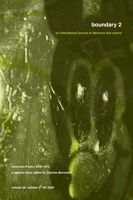 American Poetry after 1975
Duke University Press
a special issue of boundary 2
(Volume 36, Number 3, Fall 2009)
Paperback - $14.00
0-8223-6719-X
[ISBN13 978-0-8223-6719-2]
225 pages
It's entirely on-line via University of Pennsylvania library e-resources under "boundary 2 / Duke University Press Journals":
http://proxy.library.upenn.edu:3262/current.dtl
The Duke University Press page for the book: link.
Contents:
Charles Bernstein / American Poetry After 1975: Editor’s Note / 1
Jim Rosenberg / Bios / The Logosphere / The Finite-Made Evolver Space /3
Peter Gizzi / Eclogues / 9
Christian Bök / Two Dots Over a Vowel / 11
Lytle Shaw / Docents of Discourse: The Logic of Dispersed Sites / 25
Tracie Morris / Rakim’s Performativity / 49
Jennifer Scappettone / Versus Seamlessness: Architectonics of
Pseudocomplicity in
Tan Lin’s Ambient Poetics / 63
Craig Dworkin / Hypermnesia / 77
Jonathan Skinner / Poetry Animal / 97
Herman Rapaport / A Liquid Hand Blossoms / 105
Kenneth Goldsmith / In Barry Bonds I See the Future of Poetry / 121
Joyelle McSweeney / Disabled Texts and the Threat of Hannah Weiner / 123
Brian Reed / Grammar Trouble / 133
Juliana Spahr / The ’90s / 159
Al Filreis / The Stevens Wars / 183
Nada Gordon / Not Ideas about the Bling but the Bling Itself / 203
Marjorie Perloff / “The Rattle of Statistical Traffic”: Citation and
Found Text in Susan
Howe’s The Midnight / 205
Elizabeth Willis / Lyric Dissent / 229
Tan Lin / SOFT INDEX (OF repeating PLACES, PEOPLE, AND WORKS) / 235
Benjamin Friedlander / After Petrarch (In the Rigging) / 241
- - -
The abstract of my essay:
The Stevens Wars
Al Filreis
What reputation and influence has Wallace Stevens had in the years since 1975? The infamous Stevensean disaffection has tended to prohibit definitive legacy, and yet this, in the end, has been productive, forestalling closed arguments among poetics Lefts and Rights, keeping Stevens's work from theoretical alliances until past the point when such would fix its standing in contestations between, for example, theoretical as distinct from historical approaches. To the extent that Stevens can seem anything to anyone, the legacy is of little impact. The many imitations of Stevens's special rhetoric tend to riff on a single poem or idiomatic stance, quick-take attempts at posing in a particular ironic position, one abandoned as quickly as assumed. Among contemporary poets whose own writing contemplates Stevens's overall position, however, a larger pattern does emerge—two Stevenses. First, a meditative Stevens: unagonistic, verbally ruminative, romantic (but called "postromantic"), a repository of human responses, post-Christian yet lyric—a poet whose verse does not make truculent, discordant claims but rather "eke[s] out the mind," forming "the particulars of sounds." Secondly, a languaged Stevens: theoretical, serial, and nonnarrative, metapoetically radical, sometimes satirical (and antinarrative), always obsessive about the state of poetics and insisting on consciousness of the compositional mode as itself a pressure inducing the poem to be composed—a poet whose middle and late seriatic styles befit rather than reject the cyclonic modernist historical modes adopted early and briefly by Eliot, grandly and insistently by Pound, and later by Williams.
Friday, November 13, 2009
benefit

Charles Bernstein, presenting at a Writers House event at Meisel Gallery in SoHo last week.
Photo credit: Arielle Brousse
Sunday, October 11, 2009
distance learning
 At Paul Baker's Wordsalad today:
I have not attended the u. of pennsylvania and have not enjoyed the privilege of attending classes with charles bernstein. but you know what? Bernstein has been one of my most valuable and appreciated teachers over the past 5 years or so. How? because of his poetry, his radio programs, his books of essays and criticism, his conference appearances, his blog (which, yes, promotes his own work, but to a much larger degree promotes the work of others), and because of his work with Al Filreis, producing the audio content on Pennsound. I met Charles at a conference last year sponsored by the Academy of American Poets in NY a year ago. The guy’s passion and counter-establishment perspective will always be attractive to me.
Monday, August 24, 2009
restlessness in 25 minutes
 See the PoemTalk blog for a description of and link to the newly released 21st episode of the PoemTalk podcast series - this one a discussion of a poem by Charles Bernstein. Above, from left to right: Marcella Durand, Hank Lazer, Eli Goldblatt, and myself, in my office at the Writers House which doubles as a recording studio.
“Restlessness is discontent and discontent is the first necessity of progress. Show me a thoroughly satisfied man and I will show you a failure.” Thomas Edison said that.
Subscribe to:
Comments (Atom)


 "I teach horizontally, meaning that while I might begin with a fixed idea of what I'm going to teach that day, I let it drift rhizomatically way off topic, often pulling it back when it gets too far. I rely on non-fixed materials to teach this way; the whole world is at my fingertips. Should I go off on a tangent about John and Rauschenberg and their love relationship as expressed in Rauschenberg's bed, an image of that bed is always a click away. From there, we can head anywhere into the non-fixed universe, be it film, text or sound. And of course, that always takes us elsewhere. As Cage says, 'We are getting nowhere fast.'"

 that anyone has yet got the imaginative measure of that terrifying day six years ago. Certainly our Tolstoy has not crawled out of the rubble. The closest we have, Don DeLillo, succeeded as an essayist-journalist ("In the Ruins of the Future: Reflections on Terror and Loss in the Shadow of September,” Harper’s, December 2001) but, to my mind, failed as a novelist ("Falling Man"). One reason, perhaps, is that the remembered emotion was instantly buried under a pile of cultural junk.' - Tod Gitlin in his review of Susan Faludi's The Terror Dream (written for