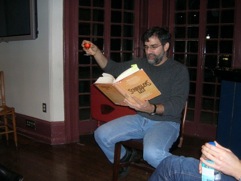
“[John] Tranter broke new ground in terms of serious criticism of poetry being spread all over the world,” [new editor Mike] Hennessey said.
Media Editor Steve McLauglin, a 2008 [Univ. of Pennsylvania] alumnus, is going on a two month bus trip this summer with his audio recorder to record poetry readings from all across the United States to use as podcasts for Jacket2.
“This project is an example of the kind of thing that doesn’t happen very often. Off-the-wall stuff happens at the Writers House,” McLaughlin said.
According to Charles Bernstein, American poet and Penn English professor, “the Web is the quickest and economically most efficient way to get poetry out there.”
“Jacket is one of the most appealing and best edited of literary magazines that exists,” Bernstein said.
[more]


 "I teach horizontally, meaning that while I might begin with a fixed idea of what I'm going to teach that day, I let it drift rhizomatically way off topic, often pulling it back when it gets too far. I rely on non-fixed materials to teach this way; the whole world is at my fingertips. Should I go off on a tangent about John and Rauschenberg and their love relationship as expressed in Rauschenberg's bed, an image of that bed is always a click away. From there, we can head anywhere into the non-fixed universe, be it film, text or sound. And of course, that always takes us elsewhere. As Cage says, 'We are getting nowhere fast.'"

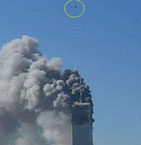 that anyone has yet got the imaginative measure of that terrifying day six years ago. Certainly our Tolstoy has not crawled out of the rubble. The closest we have, Don DeLillo, succeeded as an essayist-journalist ("In the Ruins of the Future: Reflections on Terror and Loss in the Shadow of September,” Harper’s, December 2001) but, to my mind, failed as a novelist ("Falling Man"). One reason, perhaps, is that the remembered emotion was instantly buried under a pile of cultural junk.' - Tod Gitlin in his review of Susan Faludi's The Terror Dream (written for