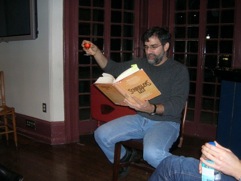
Had the pleasure of hanging out with Rufus Wainwright yesterday afternoon and evening at the Writers House. Anthony DeCurtis, above left, conducted a beautiful interview/conversation with him for an hour in front of a small audience of 50.
Showing posts with label Anthony DeCurtis. Show all posts
Showing posts with label Anthony DeCurtis. Show all posts
Friday, March 18, 2011
Rufus Wainwright at the Writers House
Had the pleasure of hanging out with Rufus Wainwright yesterday afternoon and evening at the Writers House. Anthony DeCurtis, above left, conducted a beautiful interview/conversation with him for an hour in front of a small audience of 50.


Sunday, October 31, 2010
Anthony DeCurtis interviews Keith Richards
 Our own Anthony DeCurtis recently interviewed Keith Richards at the New York Public Library. Here is one of the two courses Anthony will be teaching at CPCW/Writers House in the spring semester.
Thursday, August 05, 2010
Times music critic
 Nate Chinen, now a music critic for the New York Times, was a Writers House regular as a student and for the year or two afterward. Nate visited us again this past spring and here's a video of Anthony DeCurtis introducing him.
Sunday, May 16, 2010
Anthony, Nate, Greg
 From left to right: Anthony DeCurtis, Nate Chinen, and Greg Djanikian. Nate, my (and Greg's) former student and later a Kelly Writers House staffer, is now a regular music critic for the New York Times. See his NYT pieces.
Thursday, January 28, 2010
Anthony DeCurtis
 Listen to Anthony DeCurtis read from his writing. He teaches three courses each year through the Center for Programs in Contemporary Writing (CPCW) and the Kelly Writers House at Penn. He's a contributing editor at Rolling Stone, where he has written for nearly thirty years, and his work has also appeared in The New York Times and many other publications. He is the author of In Other Words: Artists Talk About Life and Work (Hal Leonard, 2005) and Rocking My Life Away: Writing About Music and Other Matters (Duke University Press, 1998). In addition, he coedited the third editions of The Rolling Stone Illustrated History of Rock & Roll and The Rolling Stone Album Guide (both published by Random House, 1992), and edited Present Tense: Rock & Roll and Culture (Duke, 1992). Most recently he edited Blues & Chaos: The Music Writing of Robert Palmer (Scribner, 2009). His awards include a 1988 Grammy Award in the "Best Album Notes" category for his essay accompanying the Eric Clapton box set "Crossroads," and three ASCAP Deems Taylor Awards for excellence in writing about music. Anthony holds a Ph.D. in American literature from Indiana University and lives in New York City.
At the Kelly Writers House Anthony has hosted our annual Blutt Singer-songwriter Symposium: Roseanne Cash, Suzanne Vega, Steve Earle - and next, Rufus Wainwright. And he is co-director of the RealArts@PENN project. His course the "The Arts and Popular Culture" has become a must-take seminar for young Penn writers interested in criticism, reviews, profiles, interviews and other forms of cultural journalism.
Sunday, August 02, 2009
read the words
 Anthony DeCurtis had a piece in the New York Times yesterday, called "Peace, Love and Charlie Manson"--Anthony's contemplation of 1969, partly written in response to Arlo Guthrie's recent assertion that other than Woodstock there wasn't really anything else to remember from that year. Because I've been on the road a lot, and knew I wouldn't be able to take time to read the piece on paper or on screen, I decided to use Read the Words to make a quick audio version of it - read by a one of the Read the Words avatars, "Tom." Tom misses his share of pronunciation but I'm at least going to hear the piece twice tomorrow when I'm on the road again. You can hear Tom read Anthony's piece here.
Subscribe to:
Posts (Atom)


 "I teach horizontally, meaning that while I might begin with a fixed idea of what I'm going to teach that day, I let it drift rhizomatically way off topic, often pulling it back when it gets too far. I rely on non-fixed materials to teach this way; the whole world is at my fingertips. Should I go off on a tangent about John and Rauschenberg and their love relationship as expressed in Rauschenberg's bed, an image of that bed is always a click away. From there, we can head anywhere into the non-fixed universe, be it film, text or sound. And of course, that always takes us elsewhere. As Cage says, 'We are getting nowhere fast.'"

 that anyone has yet got the imaginative measure of that terrifying day six years ago. Certainly our Tolstoy has not crawled out of the rubble. The closest we have, Don DeLillo, succeeded as an essayist-journalist ("In the Ruins of the Future: Reflections on Terror and Loss in the Shadow of September,” Harper’s, December 2001) but, to my mind, failed as a novelist ("Falling Man"). One reason, perhaps, is that the remembered emotion was instantly buried under a pile of cultural junk.' - Tod Gitlin in his review of Susan Faludi's The Terror Dream (written for