Showing posts with label interview. Show all posts

Wednesday, January 26, 2011

duet of Cheevers


Here is a link to the March 14, 1977 Newsweek interview of John Cheever conducted by his daughter Susan.

Sunday, October 31, 2010

Anthony DeCurtis interviews Keith Richards

Our own Anthony DeCurtis recently interviewed Keith Richards at the New York Public Library. Here is one of the two courses Anthony will be teaching at CPCW/Writers House in the spring semester.

Wednesday, June 16, 2010

more Christian Bök

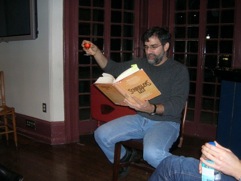
Over at her excellent blog Lemon Hound, Sina Queyras is hosting our talented transcriber of PennSound interviews, Michael Nardone. Michael has selected some excerpts from Christian Bok's discussion with Charles Bernstein's students at Penn a few years back. "Greetings from Blachford Lake," Michael begins, "up near the east arm of Great Slave Lake in the Northwest Territories. Via the satellites, I've been working under the direction of Al Filreis at the Kelly Writers House at the University of Pennsylvania, transcribing some recent and classic dialogues on poetry and poetics that will eventually be published in Jacket magazine once the journal takes up its new residence in Philadelphia. Occasionally, I hope to post on Lemon Hound a few excerpts from discussions I'm working on, and wanted to start with these selections from a conversation with Christian Bök featuring Charles Bernstein and students from the University of Pennsylvania." Here is your link to the blog entry. Above: Michael at left, Sina at right.

Friday, June 11, 2010

post-isolationist New Zealander

Below is a small transcribed piece of a "Close Listening" conversation with Wystan Curnow, conducted by Charles Bernstein. The full recording is of course available on PennSound. The full transcript will eventually be published in Jacket2; it has been prepared by the remarkable Michael Nardone.

- -

BERNSTEIN:
Now you have been interested in network connections trans-national or global, to some degree that was so commonplace as a way of understanding the visual arts. So, going back to my original question of location, thinking of New Zealand as one point in this global set of crossing points and so on, where do you locate your self on the globe in that respect? What are some of the currents, visual and verbal, that go through you, where you are?

CURNOW:
Well, first of all, I mean, let’s go back one step, and I sense that, I think that one reaction to going back to England or attachment to home was the idea of establishing something unique and of a particular place. So there was a type of isolationist, or a discovery of a New Zealand identity, a New Zealand literature.

BERNSTEIN:
Which would also be marked by features of the place itself.

CURNOW:
That’s right.

BERNSTEIN:
The boundedness by water, the particular fauna and flora.

CURNOW:
And the way in which as society developed, it grew out of those things in particular, rather than things that were elsewhere. That’s in some way a resistance to the global, a resistance to networks. Essentially, I’m of a generation that is more impressed with the limitations and the delusions of such a strategy, and wishes to expand the networks and make more of them. I think as you yourself indicated that somewhere in the 1970s, a considerable change occurred in terms of the influence particularly of American culture in New Zealand, but just at the popular culture level, but in the arts and in poetry.

But one of the things I wanted to say about the network thing is that whatever other sources you are talking about, one looks at sources in a different way than has occurred in the past. It’s a matter of relationships, and the negotiation of spaces between rather than a here and a there.

So networkers, in my view, understood that way.

BERNSTEIN:
I’m of course thinking of the particular show that you did of maps and the kind of global networking show. I wanted to ask you that question as you know, but—

CURNOW:
I mean for me, the border network began with the States. Then it’s extended to Europe, I would say, in the 1980s. Europe was a discovery for me. I’d never been there before.

Tuesday, June 01, 2010

retelling the Iliad with the letter 'e'

In 2005, a seminar of Penn students and Charles Bernstein spoke with Christian Bok, making a recording that is now part of the "Close Listening" series hosted by Bernstein. Here is the recording and here is more information about the session. Now Michael Nardone has transcribed the interview for later publication in Jacket2 but we cannot resist offering a brief excerpt here:

- -

PENN STUDENT:
So, while we are talking about Eunoia, can we look forward to a consonant sequel?

BÖK:
A consonant sequel? No, I’ve promised myself that I won’t ever write another constraint-based book again. The blood-pact I have with my peer group is that every book we write will be radically different from its predecessor, that the entire oeuvre should be completely heteroclite. So, the next project requires learning a whole new skill-set and re-training my brain, in effect, to learn something else. I probably would not have the endurance now or perseverance required to actually finish a constraint-based book.

PENN STUDENT:
So, clearly, this is very constraint-based, and from what you’re saying, you’re probably going to set yourself a new set of rules every time you write something new. So, are you arguing for something, for going back to sort of the poetic formality that has existed forever, against the tide of free verse, or stream-of-consciousness?

BÖK:
Well, actually, I have no problem with those poetic forms. I think my only complaint about those poetic forms you’ve cited is that they are not feeling much incentive to innovate and produce something new and reinvent themselves in a manner which is exciting and stimulating. And to me, it’s not so important that the work actually demonstrate some sort of formalistic character, so long as it has some kind of innovative rationale for its practice. So, I’m not making a case, I think, for a return to rigorous and strict formality. You know, I’m not that fascistic or school-marmish, I think, in my sensibilities. But I did this project thinking that it was a kind of experimental work. I didn’t know if it could be done, and I merely conducted the experiment to see what would happen. And to me, that’s really what writing poetry is about, it’s a kind of heuristic activity where you indulge in a completely exploratory adventure through language itself.

PENN STUDENT:
Well, speaking of innovative rationale, where did your constraints, your content constraints about, you know, the nautical voyage and so forth, come from?

BÖK:
Okay, in the book, the five chapters have a thematic thread, which runs throughout the entire book. Every chapter has to allude to the art of writing. All the chapters have to describe a culinary banquet, a prurient debauch, pastoral tableaux, and a nautical voyage. These four scenarios are indicative of a vocabulary that’s common to all five vowels. It’s possible to say something erotic or culinary in theme in all the vowels cause they actually have that vocabulary common to all of them. So, I wanted there to be sort of thematic consistency across the entire book. I didn’t want it to be just five separate, individual stories that had no correlations with each other. I wanted there to be some sort of thematic parallelism, and it just so happened that these were the lexicons that were common to the five vowels. So, included them in the story.

Now, coincidentally, those four scenarios are, in fact, the kinds of scenarios you typically see in Greek epic poetry. And, for me, the word eunoia, which is originally from Greek, means quite literally “good-will”—it was a term coined by Aristotle to describe the frame of mind that you have to be in in order to make a friend—it seems to me it reflects a kind of neo-classical set of values about beautiful thinking. And certainly, there is a kind of classical story in there. The re-telling of the Iliad in chapter E, I think, alludes, in fact, to these kinds of four scenarios, which are common to a classical form of story telling. You would find these scenes in that.

PENN STUDENT:
So, did the classical idea come first, because when I read the nautical voyage, it reminded me of, sort of, epic, the epic tradition? So, did the research for what was common come first, or sort of a homage to the classical traditions?

BÖK:
It’s all a side effect of the actual vocabulary itself. It wasn’t as though I planned to write about these four scenarios. The vocabulary determined, in effect, what it was possible for me to say, and I simply said it. It just so happens that, I think, coincidentally, they are easily integrated into this rationale, this explanation, you know, that it has something to do with, I think, a kind of neo-classical, kind of Apollonian rigor or, you know, aesthetic value that I think the Greeks exemplify.

PENN STUDENT:
Okay, my final question: have you ever thought of joining an acapella group?

BÖK:
No, I don’t think so. I don’t think I would join an acapella group. I’m too much of an auteur.

I have no vocal training. I’m not a musician.

BERNSTEIN:
You know, I always thought Eunoia was what people said about poetry like ours: You annoy-a me.

BÖK:
That’s right, that’s right. That was the standard joke my friends when the book was out wearing its welcome, people would describe it as Annoy-you, or, better yet, Ennui.

Saturday, May 08, 2010

the ghostly presence of New England in Robert Grenier

Back in mid-March, I traveled to Manhattan and met Charles Bernstein and Robert Grenier at the East Side apartment of Michael Waltuch, Grenier's old friend and collaborator. We recorded part 2 of what is now a long 2-part interview with Grenier about his early years. Part 1 focused on 1959-64, with a bit of a look back to Grenier's high-school years just before that period. Part 2 goes back a bit into the early 60s but then moves forward, covering 1965 to the early and mid 1970s. If last time the central topic was Harvard, this time the central topic, as it emerged, was New England: New England in the specific biographical sense (Bob G.'s wanderings there, especially on trips shooting outward from Harvard) but also in the meta-geographical sense--New England as a haunt, a crucial (it would seem now, in Grenier's way of thinking) ghostly presence in his thinking and in his writerly development.

We are pleased to release this second interview through PennSound - available, along with part 1 and many other Grenier recordings, on PennSound's Robert Grenier author page. It's a long recording (2 hours and 11 minutes) but I hope you'll find listening to it rewarding.

Wednesday, April 07, 2010

Rothenberg non-Adorno: writing after Auschwitz

Here is a short excerpt from a longer interview with Jerome Rothenberg. It has been transcribed by the wonderful Michael Nardone. The transcription is good but it's still a work in progress, and we hope to release this and other interview transcriptions through Jacket2 in the coming months. Meantime, here I am talking with Jerry about writing about the Holocaust.

FILREIS:
I guess the first question I have is about your uncle. You’ve said in a poem and in a preface, and also in conversation that the only story that has come directly to you, or indirectly maybe, about the Holocaust and your family is the uncle who was lost who found about his family killed, I think at Treblinka, and drank a bunch of vodka and blew his brains out. There were obviously others who were lost. When you got back, when you got to Treblinka, it wasn’t a roots visit, it was something that happened along the way because you were already in Germany. You decided to make the trip and you went to Treblinka but there you said that the poems you heard at Treblinka were the clearest message you’ve ever gotten about why you write poetry. Can you explain that a little more, and specifically what do you mean you heard the poems at Treblinka?

ROTHENBERG:
It wasn’t as if a voice was speaking to me. [Laughter]

FILREIS:
Glad we cleared that up. Jerry—

ROTHENBERG:
But it was if that experience plus more. I don’t if I began to write those poems following the Treblinka visit, which was early in the trip. Later, having passed some time in Krakow, in Silesia, we then travelled to Auschwitz. But the whole thing, from the moment that I set foot into Poland, I had a great sense of upset, you know, it triggered something. I think quite understandably.

FILREIS:
But the clearest message you’ve ever gotten about why you write poetry?

ROTHENBERG:
The clearest message, yeah, in the sense that I think for many of us, maybe most of us, who became poets and who had lived either directly or vicariously through the experience of the Second World War, the Holocaust, the great, very intense, brief period of destruction, you know, a few years. I’ve always tried to get an accurate account of how many people were killed during that time from 1939 to 1945. An extraordinary numbers of deaths, of burnings, of maimings.

I think I began to write poetry under the impact of that. I was still living under the, as were others of my generation. I don’t think I can define very clearly what I mean. I understood then, for the first time I was willing to say that something of what had happened there was what brought me into poetry in the first place.

I had been meditating to, or thinking about the statement of Adorno, attributed and sometimes mistranslated from Adorno about not writing poetry after Auschwitz. But that’s wrong, because really what drove me into poetry, or what I feel retrospectively drove me into poetry was the experience of Holocaust. And not just what happened in the death camps, although that was an extremity, but you know, the other, particularly once we got away from the war itself. And what happened at Hiroshima began to sink in first, I was a kid when we got news about that. I don’t think it was for me, at the age of 14, a sense of the horror of Hiroshima, but it didn’t take long before one realized what we had done there. And then, of course, things like Dresden only came to light for us much later.

FILREIS:
And you don’t really disagree with what we imagine to be the impetus behind Adorno’s statement, which is that poetry after Auschwitz would be barbaric.

ROTHENBERG:
O no.

FILREIS:
That is to say you believe that the enormity of that situation robbed language of its capacity to express appropriately what had happened. The disagreement is what happens afterwards, because you believe strongly, and you’ve said this in Khurbn, you’ve said it at the end of The Burning Babe, I believe, and you’ve certainly said it in various statements that poetry is all we have left.

ROTHENBERG:
Well, I think that the transformations that poetry makes possible were to me a more meaningful response than silence. Although silence can be very powerful, but who will know about it?

FILREIS:
Well there are some artists who would argue differently about silence.

ROTHENBERG:
Yes, but somebody has to get the word out.

Anyway, silence was not an option.

FILREIS:
Silence was not an option for you.

ROTHENBERG:
Silence means withdrawing from the world.

FILREIS:
In the Elie Wiesel sense, if you’re silent, you’re helping the bad guys. Don’t be silent. In that sense.

ROTHENBERG:
Yes, it’s not just the Elie Wiesel sense.

FILREIS:
I know that, I threw that in there to get a rise out of you.

ROTHENBERG:
You generally assume that if you’re not part of the solution, you’re part of the problem. This is stated in many different ways. As a poet, I began more and more to talk about the response to that mid-century Holocaust, holocausts, and so much that followed, the response being through the transformed language of poetry, and of course other responses also.