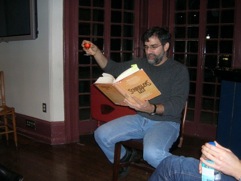
"No, he's not writing a book. He's holding up his end of a literary feud that began in 1903." (
Saturday Review of Literature, August 14, 1943, p. 13. Reprinted in 1949 during the Ezra Pound/Bollingen Prize controversy.)
The choice of year seems intended to suggest both that the "feud" has something to do with the first shocks of the modern era - incited among critics by, for instance, Kandinsky's first exhibitions - and that the message seems in part to be,
c'est la guerre. The scene at first seems settled, well-off, bourgeois and perhaps suburban, the home of the culturally mature. But the writer's wife hints at the domestic dystopia of nonlyricism. The poet-figure has become the critic-figure, the letter-to-editor writer, entrenched in back-'n-forth prose. Conservatives such as Peter Viereck were at the time explicit in associating prose with liberalism, poetry with conservatism, and hardly anything could irk an antimodernist more than the brazen way in which the communist poet ignored the distinction between the proper stations and functions of prose and poetry. Eve Merriam for instance in a poem called "Said Prose to Verse":
Listen, my insinuating poem,
stop poking your grinning face into every anywhere.
I have trouble enough keeping my house in order
without a free-loading moon-swigging boarder around
making like of solid ground.
For Viereck, conservatism "embodies" rather than "argues," and whereas poetry in the 1930s argued exactly as if it were prose, conservatism could claim a closer connection to poetry than did the liberal left. The liberals of Viereck's time could have prose; poetry--real poetry that did not poke its face into every empirical anywhere--would best be realized by conservatives. Following Yeats' distinction between embodying truth and knowing it, Viereck wrote, "Poetry tends to embody truth, prose to know it. Conservatism tends to embody truth, liberalism to know it."
 The "Is Party Line, Comrade!" series was selected for republication in the Conservative Book Club's Omnibus, volume 6 which included Elizabeth Bentley's Out of Bondage, Richard Weaver's Visions of Order, and Ludwig von Mises's The Anti-Capitalistic Mentality.


 "I teach horizontally, meaning that while I might begin with a fixed idea of what I'm going to teach that day, I let it drift rhizomatically way off topic, often pulling it back when it gets too far. I rely on non-fixed materials to teach this way; the whole world is at my fingertips. Should I go off on a tangent about John and Rauschenberg and their love relationship as expressed in Rauschenberg's bed, an image of that bed is always a click away. From there, we can head anywhere into the non-fixed universe, be it film, text or sound. And of course, that always takes us elsewhere. As Cage says, 'We are getting nowhere fast.'"

 that anyone has yet got the imaginative measure of that terrifying day six years ago. Certainly our Tolstoy has not crawled out of the rubble. The closest we have, Don DeLillo, succeeded as an essayist-journalist ("In the Ruins of the Future: Reflections on Terror and Loss in the Shadow of September,” Harper’s, December 2001) but, to my mind, failed as a novelist ("Falling Man"). One reason, perhaps, is that the remembered emotion was instantly buried under a pile of cultural junk.' - Tod Gitlin in his review of Susan Faludi's The Terror Dream (written for