Sunday, August 31, 2008

can the poem be tested any further?

Ceptuetics Radio is hosted by Kareem Estefan: avant-garde poetry readings and interviews airing Wednesday nights from 7:30-8:00 on WNYU 89.1FM in the NYC tri-state area and also through www.wnyu.org, or through iTunes. PennSound features 25 of these shows here.

I think my favorite of these episodes is number 5, recorded in December '07, in which Rodrigo Toscano shares technical, social, and theoretical aspects of his Collapsible Poetics Theater (CPT), generally discusses performance in poetry, and performs a radio work called "Eco-Strato-Static." Be sure to check out the Ceptuetics blog.

More on Toscano's project: The Collapsible Poetics Theater is an all volunteer effort, one that assembles itself within a given 48-72 hour period of each performance. Each locale (with its resident poets, experienced actors, experienced non-actors) brings an entirely new set of possibilities. It is reminiscent of Commedia Dell'Arte in its traveling, portable, rapid-set up qualities. To be sure, Poetics Theater fits into the poetry scene as a baby does in itchy burlap; it fits into the drama scene as does a little crown, little scepter, little gown, all neatly stored in a metal suitcase (quite literally!). The dings are just dings. The persistent question is: can the poem be tested any further?

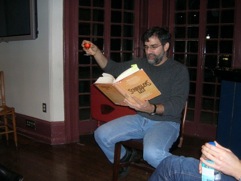
The full text of "Eco-Strato-Static" can be found on Toscano's Electronic Poetry Center site. At the bottom of this entry see a photo of the performance. That's Rodrigo on the right.

Here is September's Ceptuetics line-up: Sep 10 Tan Lin, Sep 17 Tracie Morris, Sep 24 Juliana Spahr.

Saturday, August 30, 2008

apotheosis in several senses

There's constantly something new at Ubu. I watch for it pretty much daily. Now it's the 1970 Yoko Ono experimental film short, Apotheosis, completely mesmerizing. Up we go in a hot-air balloon, wintertime, and a single continuous shot (with sound) gets the scene. (Actually, Kenny Goldsmith's notes indicate that somewhere in there Yoko spliced in some images from a second camera she had with her.)

I like intuiting and knowing of the thrill behind the scenes: John and Yoko going up, up, up in '70. They--or at least John--are apotheosized in our watching this film now. The slow rising up, along with the ambient sounds capturing the extraordinarily silence of leaving terra firma: that's a heavenly gesture too. This thing is really intentioned.

Friday, August 29, 2008

the Williams who torques sentences

The William Carlos Williams that motivated a young Robert Creeley was The Wedge of 1944. For Ron Silliman and--he suspects--others among those who "became known as Language Poet[s]"--the key Williams was to be found in Spring & All (1923). They found it in the 1970 Frontier Press edition.

Silliman believes that one of the important distinctions between the Language Poets and earlier avant-garde generations was their "different reading" of Williams - their Spring & All-centered reading of him.

As Ron prepared to participate in a 1999 symposium I hosted at the Writers House on contemporary poetry, I asked him about his WCW, and this is how he responded:

[S]omething Robert Creeley said at his reading in Camden recently [November 1999] made me conscious once again of how radically different the different generations will read certain poets. For Creeley, the important Williams was his 1944 book, The Wedge, and what mattered to Creeley was seeing how much the work was driven by (his word) "anger."

Now Williams had a huge impact on me -- it was discovering The Desert Music when I was 16 that made me realize that poetry was the form/genre/tradition that would allow me to do what I wanted to as a writer. But it was Spring & All that would be for me (and I suspect for many others of "my" generation) become the defining WCW text, coming as it did into print for us only with the 1970 Frontier Press edition. Similarly, I have always been struck by how there seems to be one Louis Zukofsky who exists for poets only a few years my senior (John Taggart or the late Ronald Johnson, say) and another for "my generation." One of the real distinctions of what became known as Language Poetry would be this different reading of these two writers.


In George Hartley's book about the development of the so-called language poetry, he has a chapter on modernist influences. "Williams writes words and sentences that continually drift between materiality and transparency," notes Hartley. In WCW Hartley finds "the 'torquing' of sentences that Silliman values," and he quotes from that early Williams:

Will you bring her here? Perhaps---and when we meet on the stair, shall we speak, say it is some acquaintance---or pass silent? Well, a jest's a jest but how poor this tea is. Think of a life in this place, here in these hills by these truck farms. Whose life? Why there, back of you. if a woman laughs a little loudly one always thinks that way of her. But how she bedizens the country-side. Quite an old world glamour. if it were not for-but one cannot have everything. What poor tea it was. How cold it's grown.

Sunday, August 24, 2008

Al's Kindle

I'm trying out the Kindle. So far I love it. It's true that the sort of books I read are generally not available in Kindle's format (sold only through Amazon), but a few are: e.g. Joan Didion's Political Fictions, including the fabulous essay "Clinton Agonistes." So I'm reading Didion on this little beautifully designed device. It feels very much like a paperback (it's intentionally the same size as most paperbacks). I like the way I navigate it. I've also subscribed to two newspapers (the Times and the Philadelphia Inquirer) and three Kindle-versioned blogs (Huffington Post, Daily Kos, and Slate's blog). The newspapers are downloaded automatically to the Kindle early in the morning; the blogs are updated almost hourly. The thing uses the cellular network and so can download books or update blogs anywhere where one is in the range of cell service.

I do intend to use all the above, but my main notion is to read chapters, books, articles etc. of the sort that are sent to me as email attachments. I have found that I was only reading some of these, even if the Word doc sent to me was important or timely. I've downloaded such things - let's say the draft of an essay a friend is writing, or a dissertation chapter - but have felt it wasteful to print them out; yet if I didn't print them yet swore I'd read on the desktop's screen or even on my laptop, I never quite got to it. I still like to read while supine - and, in any case, somewhere away from my desk.

The Kindle is set up to enable one to email oneself (to an @kindle.com address that is automatically created at the time of purchase) any document. It arrives on the Kindle quickly and appears like any other book or article. Below you see Rachel Blau DuPlessis's new short essay on re-reading George Oppen. Below that you can see the Kindle it its black leather case - looking rather, again, like a paperback or small notebook. The thing travels well.


Wednesday, August 20, 2008

alphabetic constraint

Pasternak

Piano, piano, piano,
A decrescendo.
Such desires as he knew.
Transparency of the house.
Error made him lose another
chapter.
Right that he should leave
the enjoyment.
Now the name of an enormous variety
of satisfactions.
And he started forward, fell, arose
fell again, walked.
Kursk station on a hot summer
morning in the year 1900.

- - -

Tom Devaney is working on a new series of alphabetic acrostics. Above is one of them. He's (often, not always) end-stopping the penultimate line, so that the final line can be a fragment in the imagist mode (with the "objective" descriptor of the haiku operating somewhere back there in the logical-rhetorical lineage).

I believe that the sheer pressure of the constraint has Tom thinking, at the end, that he needs a denotative fragment. In this case somewhat simply, it makes one think of the poem's title in case the connection had been implicit up to that point.

Here's another, working somewhat in the same way.

- - -

Manichaean

My ideas of the prize.
A ship taken by force.
Nautical waves, nautical waves of light.
In a privateer The Manichaean.
Chilling night, steam-engine afternoons.
Here I am without you.
At moments all can spring from all.
Evil is a catch-all crime pitched
to its own composite ends.
Again away from you by the river dock.
NIKE the Greek goddess of victory in billboard bold.

Monday, August 18, 2008

Kafka = Kold Kash

Kafka's friend, the brilliant editor/critic Max Brod, saved his strange pal's papers despite his pleas that they be destroyed. Brod's lover-secretary got them after his death and now her daughter has them somewhere in or near Tel Aviv. Finally, because the daughter needs some cash, it seems that these papers will be made available, once some archive buys them (for many millions). This is all a big deal, although the Times, in covering the story this morning, hasn't much to go on: their writer in Tel Aviv quotes various Kafka scholars relevantly and irrelevantly. Is the question of Kafka's possible interest in the Hebrew language, in his Jewish identity, in Zionism, relevant to the news of the extant papers? Not necessarily. And via the headline we learn that the pressure of the daughter of the former lover-secretary to release the papers is "Kafkaesque." It doesn't seem Kafkaesque to me at all - in fact, the opposite. The motive (originating in her, not put on her) is purely to turn the writer's extraodinarily uncommercial writing into lots of cash. Such straightforward normative valuation seems unlike anything I've ever read in Kafka. Here is your link the Times article.

Sunday, August 17, 2008

the territorio libre of baseball

I'm not a huge fan of Lawrence Felinghetti's poems but I've always admired and enjoyed the early figure he cut. The poetry, especially later, is schticky. Well, if you're going to do irreverent liberationist schtick, why not turn the glance at baseball and modernism at once.

In "Baseball Canto" Ferlinghetti runs through a crude analogy between the racial and class undersides of baseball and the kind of poetry and poetics that might stand against the exclusivist epic-oriented modernism inherited from Ezra Pound. The analogy only works in a superficial political sense: Tito Fuentes and Willie Mays, beloved by the grungy populace in San Francisco's bleachers, surely hate usury. Poundian modernism becomes an imperialism. It's fast and, as I say, very rough. But funny and fun.

I've made a RealAudio recording of Ferlinghetti reading this poem. If you don't have a RealPlayer on your computer, I apologize. (You can donwload one from Real.com.)

Click here to listen. And here's the poem's text:

Watching baseball, sitting in the sun, eating popcorn,
reading Ezra Pound,
and wishing that Juan Marichal would hit a hole right through the
Anglo-Saxon tradition in the first Canto
and demolish the barbarian invaders.
When the San Francisco Giants take the field
and everybody stands up for the National Anthem,
with some Irish tenor's voice piped over the loudspeakers,
with all the players struck dead in their places
and the white umpires like Irish cops in their black suits and little
black caps pressed over their hearts,
Standing straight and still like at some funeral of a blarney bartender,
and all facing east,
as if expecting some Great White Hope or the Founding Fathers to
appear on the horizon like 1066 or 1776.

But Willie Mays appears instead,
in the bottom of the first,
and a roar goes up as he clouts the first one into the sun and takes
off, like a footrunner from Thebes.
The ball is lost in the sun and maidens wail after him
as he keeps running through the Anglo-Saxon epic.
And Tito Fuentes comes up looking like a bullfighter
in his tight pants and small pointy shoes.
And the right field bleechers go mad with Chicanos and blacks
and Brooklyn beer-drinkers,
"Tito! Sock it to him, sweet Tito!"
And sweet Tito puts his foot in the bucket
and smacks one that don't come back at all,
and flees around the bases
like he's escaping from the United Fruit Company.
As the gringo dollar beats out the pound.
And sweet Tito beats it out like he's beating out usury,
not to mention fascism and anti-semitism.
And Juan Marichal comes up,
and the Chicano bleechers go loco again,
as Juan belts the first ball out of sight,
and rounds first and keeps going
and rounds second and rounds third,
and keeps going and hits paydirt
to the roars of the grungy populace.
As some nut presses the backstage panic button
for the tape-recorded National Anthem again,
to save the situation.

But it don't stop nobody this time,
in their revolution round the loaded white bases,
in this last of the great Anglo-Saxon epics,
in the territorio libre of Baseball.

Friday, August 15, 2008

iconoclasm and its discontents

Here is the first paragraph of Bob Perelman's old article "Building a More Powerful Vocabulary: Bruce Andrews and the World (Trade Center)":

Not many days after the 1993 bombing of the World Trade Center, the New York Times ran an article discussing the structure of the building and the possibilities of its being brought down by a larger and more thoughtfully placed explosion. It turns out not to be easy: apparently, each tower is built to withstand the impact of a fully loaded jet liner taking off. In addition to the strength of the structure, attackers would have to confront its complexity: there are twenty-one load- bearing pillars and they could not be reached simultaneously by the force of an explosion. In being destroyed, a particular section would in fact shield other areas by absorbing the impact. The timing and placement of the article is interesting in itself: it was a rapid-response anodyne to the spiral of geopolitical urban trauma while at the same time, under the cover of a discussion of engineering, it invited its readers to participate in transgressive calculations of how the Trade Center towers might actually be brought down.

Just a bit more of this article can be read here. The link to Bob Perelman's own home page seems to have broken in the years since I first excerpted the article for my students. Not sure why. I'll ask Bob.

Wednesday, August 13, 2008

remember the day we met?

It seems unlikely that a John Ashbery poem would pose this sentimental question. Well....

The newest PoemTalk show is officially out now: a 25-minute discussion of John Ashbery's late poem "Crossroads in the Past" published in Your Name Here (2000). Above you see the PoemTalkers who joined me for this 9th episode: Jessica Lowenthal, Greg Djanikian and Tom Devaney.

Sunday, July 27, 2008

academic blacklisting

Academic blacklisting, a creature of the McCarthy heyday, was still affecting some of the accused in 1960. That was the case with Chandler ("Chan") Davis, once on the University of Michigan faculty. Look on my 1960 blog for more.

Thursday, July 24, 2008

Creeley tattoo

On this arm: the first stanza of Robert Creeley's "The Warning":

The Warning

For love – I would
split open your head and put
a candle in
behind the eyes.

Love is dead in us
if we forget
the virtues of an amulet
and quick surprise.


Click on the image for a larger view.

Thanks to Mike Van Helder.

Wednesday, July 23, 2008

visiting WCW


Kaegan Sparks was passing by Paterson NJ on her way to Beacon NY, the latter a trendier destination, to be sure. But she saw the sign for Williams's beloved city and turned off the highway, found Passaic Falls (star of the epic poem of American place, Paterson) and snapped these shots.

Monday, July 21, 2008

per Göransson

Johannes Göransson's blog features a response to Charles Bernstein's review of my new book. He writes:

"...an important point here is that the historical avant-garde - dada, Surrealism etc - was deeply political and their reception was mostly seen in political terms. This is even true in my favorite area of study, the Finland Swedish Modernists, who were accused of being foreign/German instigators and Bolsheviks (even though Björling fought on the side of the anti-communist Whites during the Finnish Civil War)."

how truly "neat" could it be?

For the blockbuster special Esquire issue on the 1950s (June 1983), Frank Conroy contributed a piece called "America in a Trance." Here is a passage:

The Beats were just beginning, Kerouac, et al., and we greeted them with a certain amount of suspicion, convinced that art was not that easy. Our standards were rather high, I think. The New Critics had filled us with an almost religious awe of language. We read Leavis, Edmund Wilson, and Eliot as well, taking it all very seriously, worrying over every little point as if Truth and Beauty hung in the balance. The conservatism that colored so much of our experience did not evaporate when we dealt with literature. We defended literary art as if it were a castle under siege, in imminent danger of being destroyed by the vulgarians. In every college or university I knew anything about the most hated course was Social Science, as much a result of the incredibly rotten prose of the text as it was of our disinterest in things social.... We were neat, very neat, and sloppiness of any kind irritated us.

Most of this will strike readers of this blog as unremarkable since so many chroniclers of and generalizers about "the fifties" set alleged Beat easiness against the rigors demanded by New Criticism. And the New Critics' hatred of Social Science seems to have persuaded aspiring young literati to join the crusade against sociological (and social-psychological) interpretation. And yet, when one steps even further back, one sees that the most influential social science - epitomized by Daniel Bell's End of Ideology - formed a great political alliance with New Critical formalism. In the former case, we're talking about conservatives (of Ransom's and Tate's and Donald Davidson's stripe) coming on as centrists; in the latter case - that of sociologists like Bell (shown at right) - we're talking about left-liberals moving rightward to the post-ideological center. In that context (and perhaps only that context) Conroy's recollection of being pro-New Criticism and anti-Social Science seems odd, and only points up the passion (I would say it comes from an exhaustion with political interpretation) with which the young generationally-unselfconscious writers of that day embraced aesthetics. But--again--this embrace was a function of an urge to gain distance from the merge of aesthetics and politics that had gotten so many in an earlier self-conscious generation into trouble.

The result is the advocacy of "neat" and a distrust of "sloppy." Yet "neat" derived from victory after a very sloppy battle defending the castle against vulgarians. Think about how truly neat that could be.

Thursday, July 17, 2008

Paterson on the road

For a while I've been reading the blog New Jersey as an Impossible Object written by Joe Milutis. William Carlos Williams' beloved Paterson becomes the basis for all kinds of interesting projects and thought. That very idea is enough to interest me, but there's always more of interest too. Joe's been on the road the past few months and he's been stopping at various places to speak with people about Paterson. He visited the Kelly Writers House a few weeks back where, in my third-floor office, Joe and Randall Couch and Jessica Lowenthal and I chatted about Paterson from every which way.

Now Joe has made a blog entry of this visit, and has organized sound recordings of parts of the conversation. Please go here and have a listen.

cold-war politics of poetic form

Charles Bernstein's review of my new book appears in the current issue of The Boston Review. Here's a link. And here's a paragraph from the middle of the essay:

One thing the anticommunist antimodernists had right was that the poetic form of radical modernism was political; Filreis calls this the “cold war politics of poetic form.” A 1953 article by Donald Davidson targets parataxis in poetry—the juxtaposition of two images or units of sense that lack any immediately apparent connection—for its “treacherous political irresponsibility in the act of eschewing relations of cause and effect while the related elements [are] left to stand in unordered, unsubordinated lists.” Just a few years earlier, Robert Hillyer, in the widely circulated Saturday Review of Literature, assailed modernism in poetry as an “illusion of independent thought” and a “propaganda” machine of “the powers of darkness.” Writing in the Bulletin of the Poetry Society of America, Hillyer accused modernists of “a cold conformity of intellectualism” that eliminated “diversity” and insisted on “a critical censorship, in its effects like that of the Kremlin.”

this is the end

Who is it that put Arthur Rimbaud and Jim Morrison together in a book? It will probably surprise you to know that its author took his academic degrees in the early 1930s. He was Wallace Fowlie, a serious popularizer of surrealism. For much more about Fowlie, take a look at my 1960 blog.

By the way, as many people know, The Doors took their name from an Aldous Huxley book called The Doors of Perception and that Huxley had taken his title from a line in William Blake's "The Marriage of Heaven and Hell": "If the doors of perception were cleansed, every thing would appear to man as it is: infinite."

Wednesday, July 16, 2008

songbag

LINK

Tuesday, July 15, 2008

G-men lit crits

Over at the Poetry Foundation's "Harriet" blog, there have been several postings made by Mark Nowak about recent scholarship on Claudia Jones, a writer-activist who was hounded as a subversive by the FBI. To get a sense of these blog posts and of the many comments made about them, start here and look for links to the comments.

As I prepared to write a book on the anticommunist attack on modernism, I accumulated (slowly--very slowly--over time) FBI files on a number of writers, especially poets, and read others' that had already been released through the Freedom of Information Act (FOIA). I had already written about communists' interactions with modernists in the 1930s and was generally well versed in the impact of the CPUSA and most generally of communist culture (some would say "culture" in scare quotes) on American poetry and poetics. Perhaps foolishly (insofar as use of my time goes) I read thousands of pages of materials compiled during the Smith Act prosecutions of communist leaders (especially the so-called "Foley Square trials" that began in 1949.

I wrote a review-essay on a book about the Smith Act prosecutions and in the course of writing that review realized the crucial role that language and literary interpretation played in the strategy to which the Justice Department resorted in order to prove that communists "meant" something that was (under the Smith Act) illegal and thus could cause judge and/or jury to send these people to jail for acts they did not "yet" commit but which they "meant" when they wrote what they wrote.

Here is a portion of that essay:

...the distance between the subversive language of the depleted postwar [post-WWI] CPUSA and a future violent toppling of the American government was so great, the sign pointing so indirectly toward the signified, as to make the danger extremely unclear, indeed, largely absent. Lacking the external evidence that seemed required by the Schenck interpretation [a World War I-era radical speech case--the famous "fire in a theatre" case], the prosecutors, aides in the executive branch (guided by Truman and his attorney general), the FBI, the lower court, and eventually the high court succeeded in shifting the test from the relation between language and the world to the intention of the language itself--that is, from external evidence of a powerful state imminently endangered by subversive language to internal evidence offered in a text which "meant" future illegal action. The government was ready to devalue clear and present danger in order to place great emphasis on the most impressionistic aspect of Holmes's 1919 writing: the First Amendment, Holmes had written, "does not even protect a man from injunction against uttering words that may have all the effects of force." One easily perceives instability in the relation of utterances to effects of force, let alone the susceptibility of the idea of intentionality to abuse. When Harold Medina instructed the jury that "words may be the instruments by which crimes are committed" as Steinberg quotes him (Steinberg has performed the heroic task of reading the entire million-plus-word transcript of the trial), the judge was making sure the jury understood that it was their duty to interpret intention. He was "instructing" them to read the texts of subversion thus: punishable advocacy was that which would incite illegal action "by language reasonably and ordinarily calculated to do so."

Thursday, July 10, 2008

fun with Nazis

Before Hogan's Heroes started up its run of several years airing weekly on a TV network, a pre-debut radio ad for the show was heard widely - and quoted in Newsweek:

Question: "What are some of the amusing ingredients?" Answer: "German police dogs, machine guns, the Gestapo… shall we say, ‘If you liked World War II, you’ll love Hogan’s Heroes’"

The second voice was that of Bob Crane, the actor who played Hogan.

(The Newsweek piece was called "Fun with the Nazis.")

See more.

carefully written legislation

Below is an excerpt from the texts of the Communist Control Act of 1954. Note that membership in the Communist party could be discerned from the accused person's having knowledge of the purpose of the evil organization. Juries were instructed by this act (it established guidelines as to what was criminal behavior) not to limit themselves to evidence such as a current membership card. Here we go:

"In determining membership or participation in the Communist party of in any other organization defined in this act, or knowledge of the purpose or objective of such party or organization, the jury, under instructions from the court, shall consider evidence, if presented, as to whether the accused person...

... 8. Has written, spoken, or in any other way communicated by signal, semaphore, sign, or in any other form of communication, orders, directives, or plans of the organization...

12. Has indicated by word, action, conduct, writing, or in any other way a willingness to carry out in any manner and to any degree the plans, designs, objectives, or purposes of the organization;

13. Has in any other way participated in the activities, planning, actions, objectives, or purposes of the organization."

Tuesday, July 08, 2008

no ideas but in bling

Nada Gordon joined a conversation some of us were having yesterday in New York about the spare late poem of Wallace Stevens, "Not Ideas about the Thing But the Thing Itself." Nada, a proud flarfist, feels that poetry should include (rather than exclude) and would seem to love the fecund, richly imaginative Stevens of poems like the florid, overwritten "Comedian as the Letter C." But "Not Ideas" is sparse, thin, scrawny, barely there. In it, nonetheless, Nada finds here a beckoning to the (faded, past, almost gone) richness of the imagination. The poem's call for thing-only objectivity is not (at it were) real. Nada has written about all this on her blog today. She has also rewritten the poem and that seems to express perfectly well her overall response to it:

Not Ideas About the Bling But the Bling Itself

At the earliest antinomian disaster,
On Mars, a prawn-y guy from outside
Seemed like he had blown his mind.

He knew that he blown it,
A dry curd, under a fluorescent light,
In the early harsh of mellow.

The sun wore purple underwear,
No longer a buttered ganache above dandruff...
It would have been outside.

It was not from the vast vacuum cleaner
Of creepy jaded poetics conferences...
The sun was wearing purple underwear inside out.

That brawny gay--It was
A chorine whose c preceded the bleach.
It was part of the giant lox,

Surrounded by its collar rings,
Still barbarous. It was like
A new knowledge of reality shows.

Monday, July 07, 2008

lost in the woods of pages

I love this old photograph of Rae Armantrout. Presumably she is reading her own poems from a temporarily bound typescript. To me she seems lost in the pages.

She recalls being read to her mother as a child, and in a poem called "The Way" brilliant reproduces the effect of that special kind of abandonment: the child, sent into story, follows Gretel-like into the pages' wood (Ron Silliman believes the mention of "paper" in "The Way" is a forest made of pages), gets horrifyingly lost, only to come into a clearing once again.

The 8th episode of PoemTalk is being released today. I gathered the abovementioned Ron Silliamn and also Charles Bernstein and Rachel Blau DuPlessis to talk with me about "The Way" for about 25 minutes. Here is your link; have a look and listen and please let me know (afilreis [at] gmail [dot] com) what you think.

Sunday, July 06, 2008

kinetic? not on your life


How does a poet in 1960 turn this momentous modernist gesture of 1912 into an opportunity for standing below the staircase to peekaboo upward? Click here to find out.

Saturday, July 05, 2008

"Are we stupider?" is a stupid question

There's been much talk about Nicholas Carr's Atlantic essay bemoaning the demise, in the internet age, of deep reading (“Is Google Making Us Stupid?,” Atlantic, July/August 2008, pp. 56-63). Carr's answer is that Google is indeed making us stupid and, to be perfectly frank, I think the question is itself rather stupid. First off, "us"? Second: "stupid"? Reading habits are changing, just as they always have been changing; it's just that they are changing more rapidly than usual. I'd guess that the emergent ubiquity of the daily newspaper in the 18th century probably changed urbanite reading habits as quickly as they've changed in the 1996-2008 period in which the web has become a major source of words to be read. And I'm not sure anyone will ever be able to speak very specifically about wide reading as distinct from deep reading as a positive or negative value. The traditional notion is that deep reading is of greater value than wide. But I've never felt that way. Moreover, when we're moving fast we are wide readers pretending (e.g. in class, at cocktail parties, at the office on a Monday morning) to be deep readers.

One sane response to Carr is at the blog called PolEconAnalysis: here. Disclosure: I found this because GoogleAlerts signalled to me that this blog response mentions me.

Responding to the above, Murat Nemet-Nejat wrote: In my view, the real value of reading occurs in re-reading. The speed at which things occur in the web, the intense flow of time constructs in the web represent -for instance, the way entries of "yesterday" gain a secondary place in a blog, replaced by the entry of "today"- make re-reading very difficult. When Thoreau says that one does not have to travel the world, that examining one's own place is the greatest of travels, he is also referring to the experience of re-reading, the loss of which can be nothing but a melancholy experience.

To which I casually wrote: You're certainly right about re-reading. I think re-reading prose in particular has gone or is going out the window. Fortunately certain forms have the experience of re-reading inhering in them (or seemingly) - poetry being one. I might be unusual in that I do in fact re-read a lot of things that fly past me digitally. I save them, put them somewhere (bookmark, saving-as, etc.) where I can find them again. I take advantage of the new portability. But again I take your point. I like your second point even better - yesterday's blog entry becomes secondary. But but but...web searches produce old blog entries and bypass that hiearchizing within any one blog. Make sense?

Then Murat again: Particularly in its manifestation in blogs, but even more generally, in its incredible ability to produce, to replicate, the internet makes the passage of time very concrete. By definition, reading/re-reading is a meditative activity, involving a slowing of the time process, in Spicer's terms, going against its grain. Here is the dilemma, for me, in the contradictory nature of the internet, both its intense allure, its power, and the peril involved in this fatal seduction. I do not mean by this that one can or one should wish to undo this historical change, as if not more profound than the industrial revolution; only that one must -particularly us as poets- develop a more complex relationship to it.

Tuesday, July 01, 2008

Cuban gays and Wallace

Eric Keenaghan published a very good essay on the Cuban “Origenes” group whose leading figure was Jose Lezama Lima. It’s called “Wallace Stevens’ influence on the construction of gay masculinity by the Cuban Origenese group” (published in the Wallace Stevens Journal a few years back).

Stevens befriended (by mail) the Cuban poet-editor Jose Rodriguez Feo, and they exchanged affection – at certain points one would almost say loving – letters for many years starting in 1944. When Beverly Coyle and I set about to edit the entire correspondence (both sides, not just Stevens’s letters) we decided – back in those Reagan-era cold war days – to meet Rodriguez Feo if we could. The State Department would not approve visas for a visit to Cuba. I had located Jose (“Pepe,” he wanted us to call him) in Havana and we exchanged letters for several years; finally, somewhat suddenly, Pepe got approval to travel to New York, where he spent about 5 days visiting old friends, going openly to gay bars in the Village. The latter especially was a huge treat for him, since he had not been to New York since (I think) 1949. We met with him in a borrowed downtown apartment for two or three long sessions of interviews and talks. We hit it off. He gave me a copy of a book by Stevens that the poet had inscribed for his Cuban friend, Transport to Summer. And one evening we all went to a bar on Christopher Street.

What emerged from our meetings with Pepe and our work on the letters was published in ’86 by Duke University Press, Secretaries of the Moon.

I’m pleased that Eric Keenaghan begins his essay with this sentence: “Publication of Alan Filreis and Beverly Coyle’s Secretaries of the Moon, the collected correspondence of Wallace Stevens and Cuban translator and editor Jose Rodriguez Feo, opened new possibilities for the study of North-South relations in modernism.” Three other studies made use of the letters in Secretaries: chapter 5 of my own book, Stevens and the Actual World; an essay by Roberto Ignacio Diaz; an essay on the queer dynamics of the letters by David Jarraway. I in my book and Ignacio Diaz in his essay focus on Stevens’s encouragement of the Cuban’s primitivism as an imperialistic gesture.

For Jarraway, by the way, the letters are a way of understanding why Mark Doty thinks Stevens’s writing is a model for what Keenaghan calls “a contemporary poetics of queer androgeny.” That’s not as much a stretch as it would seem.

Above: Jose Lezama Lima

Monday, June 30, 2008

American Century intellect

There’s much one can say about the iconoclastic philosopher Mortimer Adler - the complex, driven brilliant co-creator of Great Books and of the all-knowledge totalizing ultra-simplifying encyclopedia (The Synopticon) that was a child or grandchild of Great Books that Adler edited with the support of the president of the University of Chicago, Robert Maynard Hutchins. I won’t say even a fraction of what I could about Adler, who has long fascinated me.

For now I will just repeat the wonderful (and mean-spirited but perhaps accurate) phrase James T. Farrell once used to describe Adler: “a provincial Torquemada.”

quoted by Leo Gurko in “The Angry Decade,” p. 127.

new New comes after New quieted

Robert Creeley wrote the preface to Paul Blackburn’s Against the Silences. Creeley there counted Blackburn as among those who starting in the late 1940s had hopes for poetry and felt “the same anger at what we considered its slack misuses.” Thus Creeley implicitly interprets Blackburn’s title phrase: this is a new poetry written against the quietude (to use that apt Sillimanian phrase) that Creeley and Blackburn, among others, associated with poetics that we can now describe as between modernism and postmodernism. I especially like the dating of Creeley’s realization: the late 1940s. In the view of some, that would be a bit early. After all, the anthology that certified that there was a new American poetry to supercede the old-New was published in 1960.

In an email here is what Creeley once wrote me when I asked him about the scene in the late 40s and early 50s: “Everyone of my authenticity or political definition was laying low.” The use of “authenticity” here C. did not mean as boast; he meant those who shared his version of authenticity – which is to say, not the then-usual sincere.

abstract art = socialst realism

Henry Kissinger in the early 1950s edited a magazine out of Harvard called Confluence, and (presumably with help from some friends in the humanities) he published there a number of influential center-Right literary intellectuals, and a few in the category once known as "anticommunist liberals." In the latter camp was Richard Rovere; some say Daniel Bell too. Alberto Moravia’s “Communism and Art,” a series of anitcommunist aphorisms, is fascinating.

“A painter like Titian would see abstract art and Socialist Reaism as one. To the former he would say: 'Paint me a hand that is a hand,' to the latter: 'Endow your portraits of generals and politicians with a sense of power, of greatness, of poetry, as I did mine.'”

Another problem of the day was that communist poets know “instead of poetry only artifice.” And “instead of spontaneous creativity only the will to produce.” And this: “Art is memory, propaganda is prophecy.”

So: abstract art and constraint-driven poetry and poems that eschew personal remembrance are worse than bad; they’re subversive.

Okay, so at least we know where Moravia stands. But wait, how will we apply his standards against poetry that has these awful qualities? This is a problem, for, according also to Moravia, “The first requirement of party art should be that it not look like party art.” Ah, so the art that has been described as bad will not seem to have such qualities, which means it might indeed not at all have such qualities, since it might well have been disguised as creative, unabstract, highly personal writing.

Confluence vol 2, no. 2, June 1953.

Friday, June 27, 2008

abecedarianism as body memory

The other day several of us were remembering high-school typing classes. Sit at old desk. Clang away at old worn manual typewriter. Type lines your teacher tells you will enhance your fingers' sense of the full range of QWERTY. Such as "Now is the time for all good men to come to the aid of the party."

I never knew what party this was, but the article "the" made me suspect that it was the G.O.P., a hunch seemingly confirmed by a glance up at my extremely prim typing teacher. Once in a while, in a resistant mood, I would type this: "Now is the time for all good men to come to." "Mr. Filreis," Miss Prim would say, "please complete the assignment." "I didn't have time to finish" was my retort, whereupon I swung my bookbag over my shoulder, and was off, down the hall among the party-minded teenagers who wandered there during class.

To type this entry, which I did with great efficiency as always, I had once again to poke the letters forming that expression of classic American get-alongism. And I could strongly feel the body-memory, an adolescent sensory shadow.

a Zelig of modern poetry

Very soon we at PennSound will be announcing a new page of recordings: those of the poet Walter Lowenfels. We've been working with WL's daughter Judy to preserve readings and interviews that have been stored on reel-to-reel and cassette tapes. First they were digitized and put onto CDs. Then we've been selecting batches to upload, tag, name and organize on the new Lowenfels author page: here. We'll be adding more soon, but check it out now. Rare stuff there.

Lowenfels is, in a way, the Zelig of modern American poetry--part of nearly every aesthetic and political movement of his time. In the 20s he was an expatriate avant-gardist living, writing, experimenting, publishing, frolicking in Paris; toward and in the 1930s he became a political activist, and a member of the Communist Party; in the 1950s he actually went to jail after having been convicted under the anticommunist Smith Act, and wrote sonnets to love and liberty while in jail; re-emerging in the early and mid-1960s, he was taken up avidly by a new generation of readers and became a leader among the poet-activists who opposed the war in Vietnam.

For my book on the poetry of the 1950s and the way it responded to modernism in the 1930s, I spend a good deal of time tracking down Lowenfels' publications and reading among his unpublished letters and other archival materials. So this new Lowenfels PennSound gives me special pleasure.

Armand Schwerner: "Way before the sixties, Walter Lowenfels perceived the lopsided canon of our poetry; he did a great deal to change the climate, in which, as he writes, the country needed to include 'the vast emotional resources and insights that Indian, Black and Chicano people express in their poetry."

Thursday, June 26, 2008

owning the epoch


From Robert Stone’s June 2004 remembrance of Ken Kesey:

“More than the inhabitants of any other decade before us, we believed ourselves in a time of our own making.”

And: “I knew that the future lay before us and I was certain that we owned it.”

From “The Prince of Possibility,” June 14/21, 2004, p. 71.

Thursday, June 19, 2008

as if it needed to be invented

Misha Defonseca's best-selling Holocaust memoir, a tale of a petite Jewish lass wandering around Europe and cohabitating with wolves, turns out to have been a hoax. Her confession came just yesterday. The online Boston Globe has the story.

I have mixed feelings. Oh, let me say my disgust is unambiguous. My indecision is this: do I care much about it (just another fake of our time) or do I work hard at the problem, countering such things, teaching verity as the only alternative, etc.? The latter impulse is to counter the way in which this sort of thing seems to give credence to "Holocaust revisionists" (deniers), the fabricators about an alleged fabrication who use "history" to (a) doubt the efficacy of fictive forms of representation of the genocide, and to (b) cast doubt on survivor testimony generally.

Thanks to Leslie Onkenhout, once a student in my Holocaust course, for pointing out the Globe story.

more on paradise

At right, El Paso-based poet Bobby Byrd, co-editor of Puro Border: Dispatches, Snapshots & Graffiti from the US/Mexico Border.

Byrd's blog is subtitled "It’s a good time to be a poet, I think, although the pay is shitty," and recently paid tribute to Keith Wilson (in poor health, at 80) and invited us to come to Placitas, New Mexico, for a tribute reading. "Welcome,"Byrd said in his talk this past Sunday, "as Jerome Rothenberg would say, to the Paradise of Poets. Welcome, as Gertrude Stein might say, to the continuous now of poetry. We are here today to honor poet Keith Wilson, and by our presence, the radiant beast of poetry survives."

Pondering further in his blog on the phrase he used from Rothenberg, "paradise of poets," Byrd writes about his connection to that generous poet about whom I've also written here a few times in recent months. Along the way, Byrd kindly mentions our recent PoemTalk show about the poem from which the generative phrase is taken.

'70s in Orono

Quaint downtown Orono, without the snow. I've eaten several times at this restaurant. Once the confab, which went on happily for hours, was highlighted by a delightful conversation with Harvey Shapiro. Harvey's company was ten times finer than the food.

The National Poetry Foundation - its home has been Orono for many years - hosts a series of conferences on poetic decades. I've attended several of these, mostly notably the gatherings on the 1930s and 1940s. Alan Wald and I drove up (what a long drive!) from New Haven to Orono for the '30s conference. A highlight there was a talk by M. L. ("Mac") Rosenthal reflecting (for the first time in public, so far as I know) on his late-'40s NYU dissertation on '30s poets Rukeyser, Fearing and Horace Gregory.

That MLR had been somewhat ashamed of his choice of topic was obvious even at that late date (it was 1994 or so--which would be 2 years before Mac died); to choose 3 communist-affiliated "social" poets for a dissertation topic--not to mention such contemporary writers--at the beginning of the cold war did not seem to augur well at the time for Mac's career. And indeed he never published the dissertation as a book. (I own a clumsily bound copy printed from microfilm by that dissertation service in Ann Arbor.) He went on just fine at NYU, editing anthologies, publishing his own poems, teaching some of the great younger poets (Paul Blackburn was his student), becoming poetry editor of The Nation in the late 50s.

Now the tribe is back at Orono again (not I this time, though) to talk about the 70s. I'm somewhat following the proceedings because "LJS," the Britain-born NYC-based student of Anglo-Saxon and poetics who authors the blog called "The All-Purpose Magical Text," is and will be blogging summaries of readings and talks.

An Orono alphabet: here.

Some photos and a few videos: here

And from the blog called "glamor levels hi," this here entry that enchants me with its surprising phrases: "I imagine a world in which all objects retain the the political essence of previous use: I am me because my second-hand anarchist scarf knows me." "[A]nd when will the 70s end? and haven’t we quite eerily at this conference recreated social conditions?" "Everybody has to eat breakfast and then drive an hour to a museum to hear Bernadette Mayer and Clark Coolidge. This is why I am in Orono at all."

Here's the conference schedule.

Wednesday, June 18, 2008

podcast of vibe guy

Rock journalist Alan Light visited the Writers House in September 2007 and gave a talk about his book The Skills to Pay the Bills, The Story of the Beastie Boys. Light is former editor in chief of Vibe, Spin, and Tracks magazines, and a former senior writer for Rolling Stone. He is also the editor of Tupac Shakur and The Vibe History of Hip Hop.

I just completed a Kelly Writers House podcast which features a 20-minute excerpt from Light's talk. Here's a link to the podcast mp3. And here's a summary of the event, and other links, from the Writers House web calendar.

Tuesday, June 17, 2008

walking around New York in a red aura

Pepi Ginsberg, the 24-year-old Brooklyn (via Philadelphia) singer-songwriter, has a new video out - a song, "On the Waterline," that's on her new album, Red. Albert Birney directed the video and it's a fine one: Pepi's evocative warbly voice, ruminative and Dylanesque through phrasal repetitions, is matched by what the Stereogum note-writer calls the "vintage, analog-drenched feel" of the video. Her lyrics are poems for sure. Bias disclosure: Pepi (aka Jessy) was a student of mine many times over, and a close affiliate of the Writers House, and one of my favorite people in the world.

Monday, June 16, 2008

cover without a record

A new publication, Cover without a Record, was created by students and faculty who were part of a second-time experimental seminar co-sponsored by the Center for Programs in Contemporary Writing (CPCW) and the Institute of Contemporary Art (ICA) here at Penn.

Cover without a Record works with--plays off, as it were--the fall 2006 Christian Marclay exhibit at the ICA. In Marclay's work, the artworks are based on the idea of and artifacts of sound, LPs, album covers, the shape of records, the material of cassette tape, etc. The students, many of them writers, and their teacher, our pal Kenny Goldsmith, created a catalogue-length response in this publication that transfers or extracts sound and/or sound-based art into language of some kind.

So in Cover without a Record, whose cover is white yet somewhat faintly embossed with concentric ridges in the shape and size of a 45 rpm single, includes the following, among others:

[] a piece of writing that consists of descriptions of sounds in twenty-seven books extracted from their sources;

[] sounds from various books extracted from their sources and rendered into concentric circles of text, mimicking a 45 rpm record -- thus a series of concrete poems;

[] the titles of every track from The White Album removed from their corresponding song lyrics;

[] a piece called Mobius Thunderclaps which is described by its creator, Steve McLaughlin, as follows: "When cut out, twisted, and joined at the ends, the shapes on the following pages form small Mobius strips. Each bears a looped version of one of James Joyce's thunderclaps: ten 100-letter words scattered through the novel Finnegan's Wake."

[] sound effects extracted from a series of comic books, placed on top of musical staves;

[] gunshot scenes from various films, transcribed and collaged into a unified screenplay;

and more.

The whole work can be found at writing.upenn.edu/ica/2008/.

Here is certainly the place (one of several) to thank the dean of the School of Arts & Sciences, Rebecca Bushnell, and Penn's provost, Ron Daniels, for providing grants to enable this innovative year-long seminar to happen.

Sunday, June 15, 2008

oh, so you're that kind

At a party last night, Upper West Side-y gathering. Great fun, nice people, lots of interesting folks to talk to. But one of those scenes where once you find out what someone does you can't help but think that you know a good deal about who he or she is. The architect who really turned out to be very much the kind of person who is an architect. A photographer with, in other ways too, a very good eye. A guy who, when he gives you his email address, you realize has his own domain name ([his-last-name].org) who turns out of course to be a technology entrepreneur. And I the Ivy League professor? The others, this morning upon arising, if they think of me at all, will think, That guy surely was the Ivy League professor he told us he was.

In part this is obvious, this is tautology. A photographer is, after all, a photographer. And is likely to seem so generally.

No sooner do I decide that there is nothing profound about any of this, I happen to re-read Lydia Davis's fabulous prose-poem or short-short short story titled "A Position at the University." It was published in a book of such pieces, called Almost No Memory in 1997. The text is below, and the recording of Davis herself reading the piece is in PennSound.

Saturday, June 14, 2008

audio Stevens

When Don Share was an archivist at Harvard, he worked with audio recordings that were and are in the collection of the Woodberry Poetry Room, and (getting grants and whatnot) started to put together "The Poet's Voice" - subtitled "a digital poetry collection." Harvard has a recording of the 1952 poetry reading Stevens gave there, introduced by Richard Wilbur. And also the more well known 1954 reading which became the basis of a cassette Stevens distributed by Random House Audio. Click here to see the Poet's Voice entry for these two recordings. Here is a perhaps more helpful listing of all the poems Stevens read aloud - with links to RealAudio streaming (not downloadable) digital recordings of some of them.

With thanks to Ben Wiebracht who helped me conduct this search, here is a list of other recordings of Wallace Stevens poems:

(1) A poetry blog where someone who calls himself "Hoon" quotes, comments on and reads aloud some poems by Stevens:

*http://audiopoetry.wordpress.com/category/poet/wallace-stevens/

(2) Early poems read aloud by Alan Davis Drake. Many of these readings were made for LibriVox.org and Cloud Mountain Studios.

*http://drakesdoor.org/podcasts/ws/wallacestevens.xml
*http://drakesdoor.org/podcasts/ws/stevens_public_domain.html

(3) "Peter Quince at the Clavier" read by Walter Rufus Eagles.

*http://www.eaglesweb.com/Sub_Pages/stevens_wallace_poems.htm

(4) An old, not-maintained HarperAudio site that includes old-format digital audio files in three formats of Stevens himself reading "The Idea of Order at Key West," "The Poem that Took the Place of a Mountain," and "Vacancy in the Park," and "To An Old Philosopher in Rome."

*http://town.hall.org/radio/HarperAudio/021594_harp_ITH.html

(5) Wesleyan University hosts the site of the Hartford Friends and Enemies of Wallace Stevens. Here there is a link to a single poem read by Stevens from the recording made at Harvard in 1954, "Not Ideas about the Thing but the Thing Itself." The audio file is stored on a Wesleyan media server, but did not work the last time I attempted it.

*http://www.wesleyan.edu/wstevens/stevens.html

(6) Salon.com hosts recordings of Stevens reading "To the One of Fictive Music" and "Not Ideas About the Thing but the Thing Itself."

*http://poetsonline.blogspot.com/2007/04/wallace-stevens-audio-downloads.html