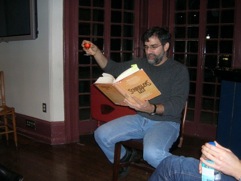
Recently my students and I finished up a "chapter" of English 88 on the New York School. The final class in this part of the course was devoted to some collaborative close readings of several poems by John Ashbery: "The Grapevine", "What Is Poetry", and "Hard Times". (Well, the discussion of "Hard Times," due to lack of time at that point, is really just me reading the poem and making a few comments.) A number of people watched the video live on their computers at home and work, and several of them telephoned in to ask questions or make comments. Here's your link to the video recording of the class.
Thursday, November 20, 2008
teaching Ashbery (video)
Recently my students and I finished up a "chapter" of English 88 on the New York School. The final class in this part of the course was devoted to some collaborative close readings of several poems by John Ashbery: "The Grapevine", "What Is Poetry", and "Hard Times". (Well, the discussion of "Hard Times," due to lack of time at that point, is really just me reading the poem and making a few comments.) A number of people watched the video live on their computers at home and work, and several of them telephoned in to ask questions or make comments. Here's your link to the video recording of the class.


man pays utility bill with spider drawing
 A man named David Thorne attempts to be his overdue utility bill with his drawing of a spider, which he values at a dollar figure exactly equal to the money he owes. Jane Gilles of the utility company engages him in an email dialogue about this. Read the entire exchange.
 “The means to gain happiness," wrote Tolstoy, "is to throw out from oneself like a spider in all directions an adhesive web of love, and to catch in it all that comes." As you get about halfway through the dialogue, you realize that the delinquent bill-payer is half-hoping this will work, but just half. He does seem somewhat to believe that he is throwing his spider in all directions, hoping that it--his modest little art--lands safely somewhere. (Maybe I'm a sap, but I think he wants her to like it.)
Thanks to Malka Fleischman for pointing this out.
your daily Al for today
 1) Get your daily Al.
2) Check out the new Zukofsky page on PennSound.
3) Listen to the Creeley-Zukofsky conversation.
Wednesday, November 19, 2008
blockbuster Zukofsky
 Today PennSound proudly unveils the new Louis Zukofsky page, edited by Danny Snelson and done with the permission of Paul Zukofsky. Amazing. Simply amazing. Go there and download some favorites to your iPod. Do it now! Holy cow.
Kenyata listening to Mozart
Here's a poem a particularly admire: from the early 1960s by LeRoi Jones (later Amiri Baraka), "Kenyata Listening to Mozart." And here's a link to a better view of the text. And here's a link to a recording of Jones reading the poem in California in December 1964.


Tuesday, November 18, 2008
believing in the world because it is impossible
 My short piece on George Oppen's poem "Myth of the Blaze" is currently appearing in Jacket 36: here. Thanks to Tom Devaney and John Tranter.
 The short essay was written to be read aloud/performed at this occasion.
Sunday, November 16, 2008
your PennSound daily
 Mike Hennessey, PennSound's Managing Editor, daily composes your PennSound daily. That's Mike, looking at us on the right. Just go to the main PennSound page and you'll read Mike's thoughts on selected new recordings. You can subscribe using your favorite RSS reader.
 In the latest daily, Mike turned his attention to the new episode of PoemTalk - the one on Pound's early poem, "Cantico del Sole." Here's what he says:
Listeners eagerly awaiting the latest installment of the PoemTalk podcast series need wait no longer — host Al Filreis is back with a new episode, the twelfth in the series. Joining Filreis this time, for a discussion of Ezra Pound's "Cantico del Sole," are his PennSound co-director, Charles Bernstein, Rachel Levitsky (this year's CPCW Fellow in Poetics and Poetic Practice) and Joshua Schuster (a longtime member of the UPenn community and an architect of the Kelly Writers House).
Bernstein begins by citing the differences in tone between the two recordings presented in the program — while the 1939 version is introspective, the 1958 rendition plays up the poem's satirical edge — a distinction Levitsky elides to depict the speaker's ambivalence. Filreis recalls that Pound studied the classics at UPenn, and that the poet translated Francis of Assisi's "Hymn of the Sun," which gives Pound's poem its name, as part of his masters thesis. This fact, taken together with a contemporary legal decision that the classics should be exempted from obscenity laws, since (as Pound reprints in the essay originally accompanying the poem) they "usually appeal to a comparatively limited number of readers," forms the context for the poem as both a lament for America's disinterest in classical (or any serious) literature, and also a glimpse towards a society in which the opposite were true.
Schuster is quick to point out that it's not a staid pedagogy rooted solely in the past that Pound is aiming for, but rather the "24-hour experimental poet world that the classics kinda suggest were in existence back then." Indeed, a society as receptive to the classics would be equally receptive to the contemporary avant-garde, and Schuster notes that, in Pound's time, certain notions of the avant-garde were precisely tied to revisiting the classics (H.D., for example).
Bernstein makes another connection, to the Canticle of Simeon (a devout Jew who was promised he'd live to see the coming savior), which raises the issue of the poem's sacrilegious tone as well as Pound's later anti-Semitism, and how one navigates that facet of his history in light of his work overall. He also points out how incompletely the allusions to both Assisi and Simeon are integrated within the multi-vocal palimpsest, which adds to both the poem's tensions — including the contradictions between its anti-Phillistine and elitist voices.
Filreis brings the conversation to a close by introducing the writings of Peter Wilson, who discusses the differences between the avant-garde's relation to mainstream society in the contemporary era (in which poets can more easily find an audience) versus Pound's time (where the Modernist ideal trended towards isolation and exclusivity). Schuster expands this notion to consider implications of medium and availability, suggesting that in the present, the avant-garde is not rereading the classics, but rather fully embracing and exploiting technological means to develop and share new ideas, a rubric into which sites such as this one neatly fit (and be sure to listen through to the end, where Bernstein parodies Pound's parody, by sharing how "the thought of what America would be like if PennSound had a wide circulation" troubles his sleep).
PoemTalk's next episode will see the show go on the road, to New York City, where Filreis, along with Bernstein, Nada Gordon and Lawrence Joseph will discuss a late poem by Wallace Stevens. In the meantime, be sure to visit PoemTalk's homepage, where you can download the first dozen episodes and find more information about the poems and panelists, along with listener comments.
Friday, November 14, 2008
on the so craze
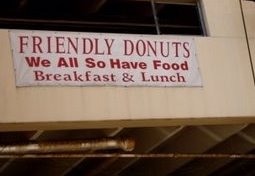
 For a time, about two years ago, I so thought that my students were mainly the ones putting so somewhat randomly in front of verbs - between subject and verb - but now as an addicted listener to news and culture podcasts I realize that everyone is so doing it. It's an intensifer for the most part. Inserting "very much" in the same spot would have done it 50-75 years ago. I very much want you to come visit me. And sometimes "so very much." So I'm not against so, since it's succinct and even dramatic. The stronger the verb the better the effect. Weak verbs, and to-be verbs make me less a fan. I am so against that. And negatives, in the same grammar: I am so not with you on that point. Now find a two-word subject pronoun ("We all," which is a rarely used first-person plural form of "you all") and stick "so" between them and one of those weak verbs ("have") and you've got a sign Linh Dinh saw recently and snapped for his blog. All I can say is, they'd so better be friendly.
Jack on Long Island
 Last year, the folks at poetryvlog.com went out to Northport, Long Island, where Jack Kerouac lived from 1958 through 1964. In a 5-minute video, one of the two poetryvlog producers, George Harris, takes us on a tour of the town, which was in the midst of a community celebration at the time. A general holiday it was, into which honor due Jack fits as a small part in the municipal unconscious. (Ah, Long Island.) Here's your link to the the video and here's the link to the blog entry.
tapeworm foundry on KWH-TV

an opening for TAPEWORM
a collaborative exhibition based on Darren Wershler-Henry's
The Tapeworm Foundry (and/or the dangerous prevalence of imagination)
Thursday, 11/20 at 7PM
Kelly Writers House | 3805 Locust Walk
Philadelphia, PA 19104
This event will be webcast live: find out more by clicking here.
Tapeworm is a collaboration of art projects radiating from a writing piece by Canadian artist Darren Wershler-Henry, The Tapeworm Foundry (andor the dangerous prevalence of imagination). The text is available on UbuWeb. The Tapeworm Foundry is an intriguing instance of conceptual writing, faithfully formulaic but also unusually compelling in its fruition: a single rambling, unpunctuated sequence of possible projects, ranging from quirky to absurd to highly ambiguous and all largely allusive of the twentieth century avant-garde. The potential 'instructions' that comprise Tapeworm, linked by the pulsating conjunction 'andor', are themselves mini-premises for a thousand other projects, making the 50-page list the ultimate conceptual catalyst.
This exhibition challenges a group of young contemporary artists and writers at Penn to realize some of Wershler-Henry's hypothetical instructions. The Penn students and graduates participating in the exhibition include: Grace Ambrose, Joyce Lee, Ned Eisenberg, Vladimir Zykov, Kimberly Eisler, Artie Vierkant, John Carroll, Jamie-Lee Josselyn, Arielle Brousse, Manya Scheps, Brooke Palmieri, Nick Salvatore, Robin McDowell, Sofie Hodara, Cecilia Corrigan, and Thomson Guster, with assistance from James La Marre and Trisha Low. Curated by Kaegan Sparks. There will be a limited quantity of complimentary exhibition catalogues available at the opening. Please email kwhart@writing.upenn.edu for more information.
on your holiday list
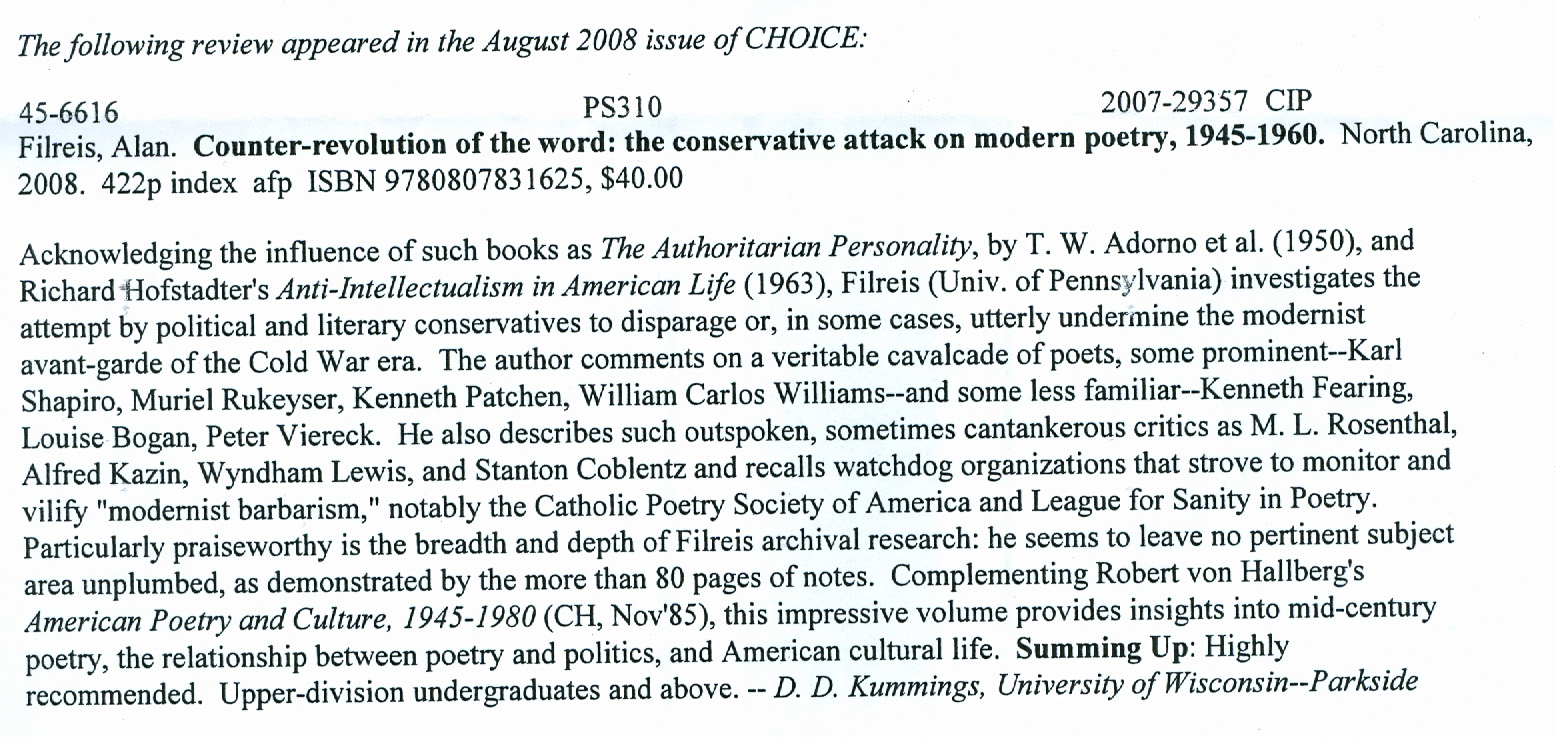
A short but sweet review of my recent book appeared yesterday on Tom Devaney's blog, here. Upon which one reader commented: "On my holiday list!" (Yes, go ahead, shop this depressed season!)
At the North Carolina Press site you can buy your copy easily.

At the North Carolina Press site you can buy your copy easily.

Thursday, November 13, 2008
wide circulation
 Our 12th PoemTalk show is being released this week. Here it is. You've not heard PoemTalk yet? Well, it's 25 minutes of talk about a single poem. Tightly focused talk at moments, but mostly rather loose. Which is why I say "a close, but not too close, reading of a poem." Some poems are left largely unsaid by us by the end, but for some few poems we're really able, it seems, to cover the ground. I think we cover most of the ground this time, talking about Ezra Pound's broadly satiric - and wonderfully performative - early poem, "Cantico del Sole." Give a listen and let me know (afilreis [at] writing [dot] upenn [dot] edu) what you think. The thought of what America would be like if PoemTalk had a wide circulation. (I don't flatter myself.)
Wednesday, November 12, 2008
webinar
 Two nights ago Jessica Lowenthal and I taught a Dickinson "webinar." With 50 people watching and participating from near- and far-flung locations, we discussed two poems, #556 ("The Brain, within its Groove") and #1129 ("Tell all the Truth but tell it slant"). Some participants phoned us and made comments and asked questions that way. We had two phones working so there was some byplay and fun confusion. We also took comments and questions by email.
 Of course we made a recording of the once-live video and here is your link to it. (You need QuickTime Video on your computer to play this recording.)
The Brain, within its Groove
Runs evenly--and true--
But let a Splinter swerve--
'Twere easier for You--
To put a Current back--
When Floods have slit the Hills--
And scooped a Turnpike for Themselves--
And trodden out the Mills--
This, we decided, was the true end of industrialism-era assumptions about the imagination.
Tuesday, November 11, 2008
in search of endangered languages
 Bob Holman, about as passionate about poetic orality as anyone, is visiting Senegal, Gambia, and Mali for the next seven weeks filming endangered languages and presumably, too, doing a series of wildly entertaining performances. He's set up a blog for the trip, the Griot Trail.
For some good recordings of Holman doing his thing, check out his PennSound author page.
Monday, November 10, 2008
permitting contradictions
 In the summer of '99 a group of us gathered to talk at great length about a single poem by William Carlos Williams - "To Elsie" ("The pure products of America / go crazy"). At one point Bob Perelman, one of the participants, said something about the way the poem leaves elements open and contradictory, and then implied (and then at one moment said outright) that this became and still is a key idea operating in contemporary avant-garde poetics. I think Bob frames the point very nicely here, so have a listen to this very brief excerpt from the longer discussion of the poem.
Lebanese novelist here
 Writers without Borders presents Lebanese novelist Hanan al-Shaykh on November 18 at the Writers House. The program is co-sponsored by the Middle East Center and Al-Bustan Seeds of Culture.
 Hanan al-Shaykh was born in Lebanon and grew up in Beirut. Her most recent novel, Only in London, was shortlisted for the Independent Foreign Fiction Prize. She was educated in Cairo and wrote her first novel there when she was nineteen before returning to Beirut to work as a journalist for Al-Nahar newspaper Al Hasna magazine. In 1975 she left Beirut because of the civil war and moved to the Arabian Gulf, dividing her time between London and the Gulf States for the next nine years. Since 1984 she has lived in London with her family.
Friday, November 07, 2008
when computing was news
 A few of us created the project (one of the first of its kind in the U.S.) through which undergraduates received "front-line" computing support in their residences. House calls, as it were. It was, at the time, a revolutionary approach: after all, think, circa 1994-96, of how "computing support" was conceived. You have a problem with your computer, you pick up and carry it to a centrally located "Help Desk." But by '95 and '96 the first issues were those of connectivity - not something well done away from the connection! And then of course, after a while, students need less strictly technical help - and more in the way of guidance about using software, connecting with academic materials on this newish thing called the web, and playing, sandbox-like, with the new tools. We needed people who wouldn't mind getting sand on their hands and knees. Thus: the ITA, Information Technology Advisor. At some point KYW Radio (all news all the time) got wind of this and did a super-quickie little radio story about it. Very slight and barely broke the surface. I recently found the cassette they sent me after airing the story and now have converted it digitally, so here it is.
create community post-MFA
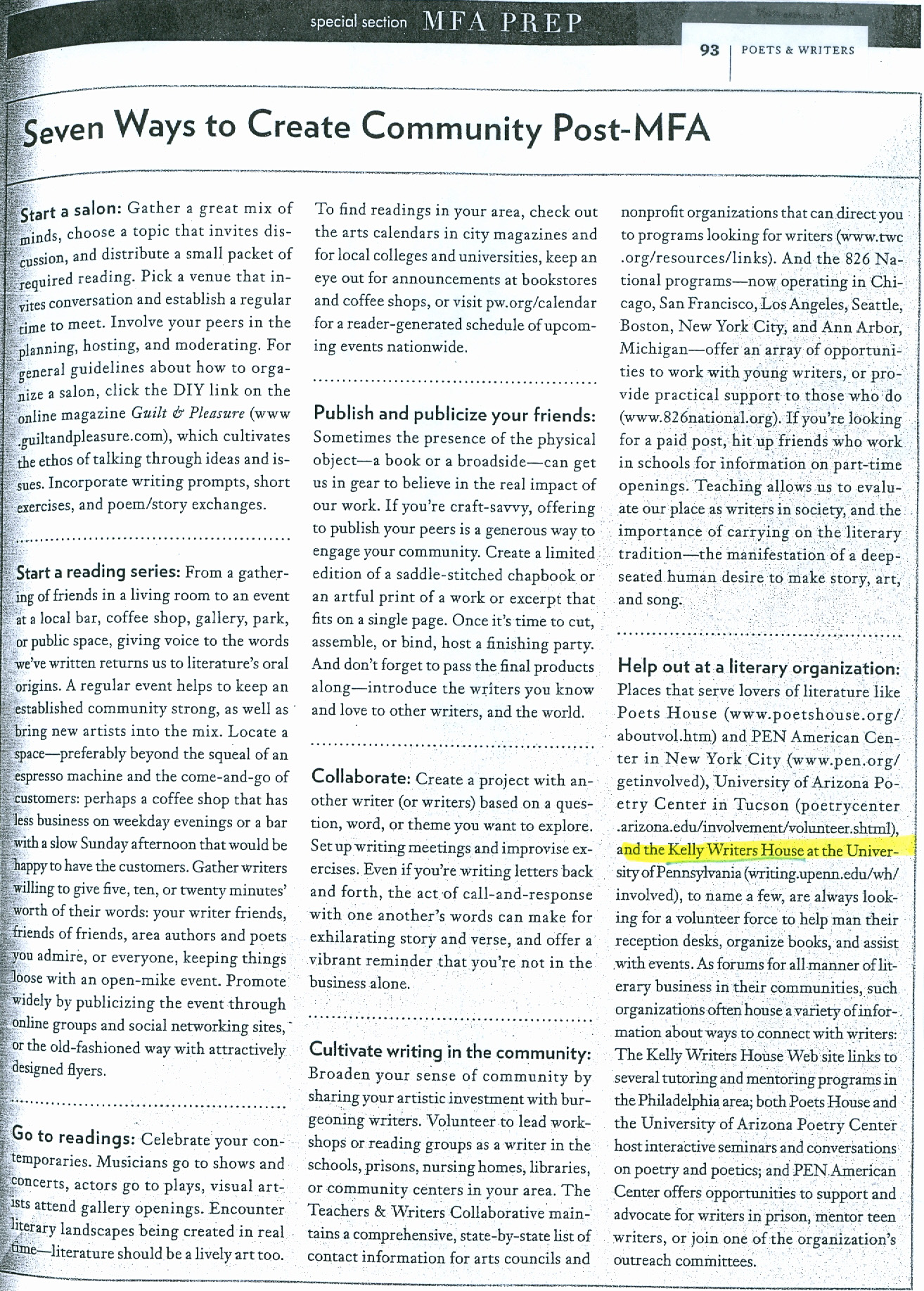
 Poets & Writers, quite pre-professional, nonetheless fairly often admits or implies that young writers who get MFAs might want or need to do things other than join the academy, where "Creative Writing" programs as such are often if not mostly deemed fringe zones of mere practice. Anyway, I was pleased to see that the magazine's latest stab at alternative options includes advice for young writers to "Help out a literary organization," and mentions the Kelly Writers House as one such site. Below is the relevant passage (click on the image for a larger view). And click here for the whole article.
poems for new prez
 Partly because I create and produce a regular podcast series in collaboration with the Poetry Foundation of Chicago (PoemTalk), partly because I've become about as electorally wonky as anyone in the past year or so, and partly because I subscribe to about two dozen ongoing podcasts....there was no way I'd miss the new "Poetry Off the Shelf" episode, which (surprise!) features poems for and about Obama. Here's your link to the Poetry Foundation site's link to the audio. You can also get it (and subscribe to the series) in your ITunes music store. Just search for "Poetry Foundation Shelf".

incident
 Shout out to... the 40 or so schoolchildren on the public school bus that drove by our polling place on Tuesday.
West Philly, 47th and Pine. About 150 of us were standing there, the line going nowhere: all three voting machines were "broken." How could this be? Geez, don't these people at least check the night before to make sure the machines are working? This is an important election. Pennsylvania is a swing state. C'mon! I, deeming myself ever ready for such crises, dial The Committe of 70, the Election Commission, WNYC/NPR which is sending out reporters to all problem spots. We're monotonally told: "The voting-machine repairman has been called and is apparently on his way." The Obama volunteers got us coffee and donuts but a few impatient people began peeling away, needing to get to work, feed families breakfast, get little ones off to school. A few tempers flared. Then the bus. As it neared, we realized there was something a little different. The kids had seen us, had run to the windows on the sidewalk side, were reaching out ecstatically with arms and heads and were chanting loudly and in unison: O-BAM-A! O-BAM-A! Cheering on the adults, whose spirits had so easily flagged. Vote for us! Do it for us! And the bus, which had paused at the stop sign, soon rumbled onward. We smiled huge smiles at each other, shook our heads at the Meaning of the day, munched our donuts, and readied ourselves for the long wait for the repairman.
Thursday, November 06, 2008
poems in your phone
 I've downloaded a few useful apps to my new iPhone. One is an RSS Reader that allows me to pick up top news and magazine items, features under various topics, as well as links to new web stuff in fields of my interest, without the strain/time of having to download these items. The thing gives a quickly loaded look at stories and links of the moment, and then I can go follow up by reading full web versions if I want. Not that the iPhone is slow to browse the web, but it's slower than this RSS feed gives me a top look.
My newest app is called "Files lite," a free program that acts as a documents folder. Yes, I can put documents (in Word, in PDF, in Excel, in HTML [e.g. saved web pages]) onto my phone! I'm working on an essay so I've put the latest draft there, which means (am I being obsessive about my time? maybe) I can re-read and ponder changes wherever I find myself stalled, waiting in line, stuck between meetings. I've also put there the text of a few poems I want to read often and really come to know. The photo here is a standard screen shot of this app in action; it's not my phone. I snapped a shot of my phone but find it's hard to take a good picture of the glassy surface of this otherwise utterly and fabulously accommodating device, the iPhone G3.
A happy shout-out to Mark Lindsay who urged me in this direction and made it all work.
Wednesday, November 05, 2008
whence the snark?
 One of my students today observed that she has felt, already, a lessening of the snarky tone she's heard and read all around her pretty much all her conscious life. I think she believes that tone will be at an end, that sincerity, rhetorical calm, un-irony will wash over the language. My guess - still plenty of the snark in me, I suppose - is that it will last a few months. Snark is here to stay.
I want to ponder this. Eight years of an awful presidency has generated the super-skepticism - the hypersatirical state of public political (and to some significant extent cultural) commentary - and that, in the most general way, makes sense. Harding and Coolidge certainly created, or at least contributed to, Roaring Twenties ironic hilarity, flapperistic farce.
But this era of snark happened to coincide with the emergence of the web, the proliferation of voices, the radical democratization of the commentariat, 1000 blogs blooming, social networking in which your "Friends" are your ready audience for daily expressions of your "status," podcasts made in the breakfast room recorded on a Radio Shack microphone plugged into a $600 computer. Bush + web 2.0 = snark.
Obama in part succeeded because of this interactive social revolution, and his movement would by no means want to put it all back in the bottle. But can the tone change? Can sincerity coexist with the ubiquity of these voices?
Saturday, November 01, 2008
mongo media links
 Every recording - in whatever medium - that we've made in a dozen plus years since the founding of the Writers House has been indexed on a page we clumsily call "medialinks". This is kitchen-sink web databasing but we love it.
Wednesday, October 29, 2008
beat girl migrates to Venice
 Howard K. Smith did a news report on "the Beat revolution" in 1960. Smith intended to be even-handed, although today his commentary and questions (in interviews) will strike us as amazingly condescending. These poor deluded children. Charming, but oh how misguided. My favorite moment in the report is a 56-second segment from what must have been a longer, perhaps much longer discussion with a teenaged girl - who had fled her square suburban parents and had migrated to Venice, CA. Listen to her. I'm entranced by her utterly sincere critique of American conformity, in the high sweet tone that anticipates the classic flower child of seven or eight years later.
Tuesday, October 28, 2008
And then the Windows failed
 Yes, speaking of Dickinson... The sculptor, maker of media art and film (and who specializes in public art) Lynn Tomlinson created a series of very short 35 mm films. One of these is an animation of the Dickinson poem, "I heard a Fly buzz – when I died –". Go here and click on the third-from-left little thumbnail below the main screen.
Monday, October 27, 2008
pixelate in possibililty
EMILY DICKINSON WEBINAR
live video feed on KWH-TV
November 10, 7 PM
hosted by Al Filreis & Jessica Lowenthal
at the Kelly Writers House
 Join us for a live interactive online discussion of the poetry of Emily Dickinson. The discussion will be led by Al Filreis and Jessica Lowenthal on Monday, November 10, at 7 PM (eastern time). The session will last about an hour; we will discuss several poems in detail; participants will be able to pose questions and responses by email and phone.
To participate in this session, you'll connect to our KWH-TV live video feed:
writing.upenn.edu/wh/multimedia/tv/
No need to read or prepare in advance of the session. We will guide you through the poems during the program.
RSVP to wh@writing.upenn.edu. Those who register will receive further instructions and guidelines before the event.
live video feed on KWH-TV
November 10, 7 PM
hosted by Al Filreis & Jessica Lowenthal
at the Kelly Writers House
 Join us for a live interactive online discussion of the poetry of Emily Dickinson. The discussion will be led by Al Filreis and Jessica Lowenthal on Monday, November 10, at 7 PM (eastern time). The session will last about an hour; we will discuss several poems in detail; participants will be able to pose questions and responses by email and phone.
To participate in this session, you'll connect to our KWH-TV live video feed:
writing.upenn.edu/wh/multimedia/tv/
No need to read or prepare in advance of the session. We will guide you through the poems during the program.
RSVP to wh@writing.upenn.edu. Those who register will receive further instructions and guidelines before the event.
surely some revenue stamp is at hand
 When she was at Brown University, poet Lee Ann Brown assigned her students to write according to a rule or constraint they chose from among a list of possible writing experiments she provided. She has learned the technique from Bernadette Mayer (who has always kept lists of such experiments). Lee Ann called this "Multiplicity Sisters" and I once excerpted a few of these for my own poetry class. My students took this up with interest, wanting to see if paradoxically constraint would free them from the typically trite things they were writing.
 They found Mayer's lists (e.g. this one). "Write what cannot be written; for example, compose an index." "Write a work gazing into a mirror without using the pronoun I." "Attempt to speak for a day only in questions; write only in questions."
They especially liked the N+7 routine ("N + 7: Look up every noun in the piece and replace it with the 7th Noun down in the dictionary"). One of them rewrote Yeats' "The Second Coming" following the N+7 procedure and came up with this:
"The Second Comma Bacillus"
Turning and turning in the widening gyropilot,
The faldstool cannot hear the Falkirk.
The think pieces fall apart; the centerpiece cannot hold;
Mere anastomosis is loosed upon the World Series,
The blood-dimmed tiding is loosed, and everywhere
The cerite of innovation is drowned;
The bestiaries lack all convolution, while the worthless
Are full of passionate interactants.
Surely some revenue stamp is at hand;
Surely the Second Guess is at hand;
The Second Guess! Hardly are those wordings out
When a vast imaginariness out of *Spirit of Ammonia*
Troubles my sight-reading: somewhere in sandbars of the desexualization
A shard with lion bodyguard and the head doctor of a managed currency
A gazpacho blank and pitiless as the sun bonnet,
Is moving its slow thimblerig, while all about it
Reel Shadrachs of the indignant desert birdhouses.
The dark horse drops again, but now I know
That twenty cephalic indeces of stony sleeping sickness
Were vexed to nightshirt by a rocking crag,
And what rough beater, its house come round at last,
Slouches toward Betjeman to be born?
Saturday, October 25, 2008
southern peas in pod
 Allen Tate called John Crowe Ransom "modern without knowing it." For more, click here.
execs deal with upside-down urinal
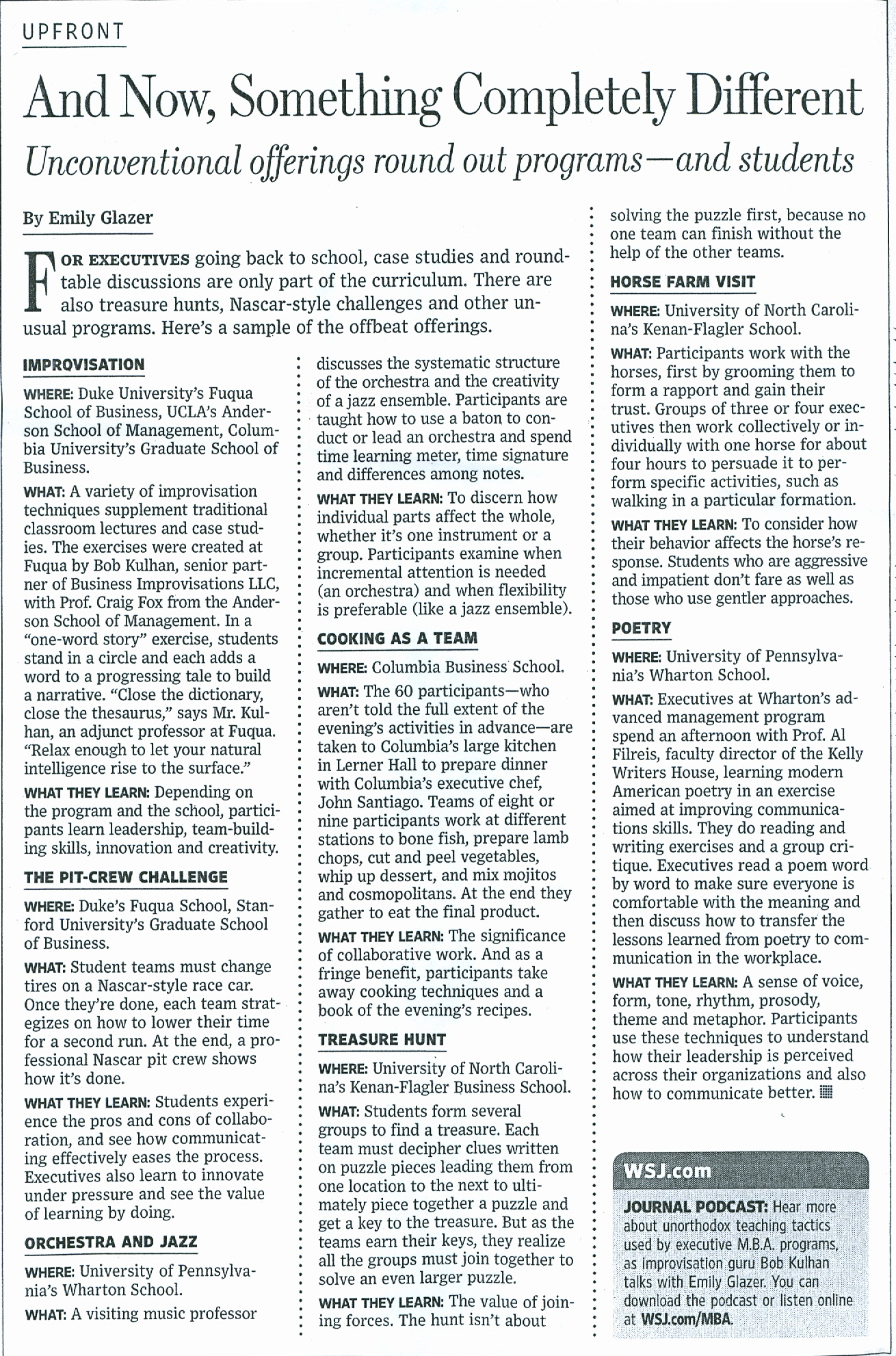
 For about a decade I've been teaching in the executive education program of the Wharton School here. For three hours the execs--here for five weeks of intensive courses--and I talk about modern poetry. We do some Dickinson, some Williams, occasionally a little imagist Pound, often some McKay and Cullen, and Wallace Stevens' "Gray Room" (a poem about desire unperceived by the diffident poet-speaker). We also discuss Duchamp's "Fountain" (the readymade that is an turned-upside-down urinal). That's hilarious and, I think, edifying. Perhaps someday I'll write at length about my experience with these businesspeople, but for now I only want to point out that when the Wall Street Journal ran a round-up on unusual Executive Education Program pedagogy, I made the story. Quite astonishing, really. Here's a link to the article. (WSJ 9/30/08, p. R2.)
know what is happening in your heart
Here's a poem by Robert Penn Warren called "Tell Me a Story":
Long ago, in Kentucky, I, a boy, stood
By a dirt road, in first dark, and heard
The great geese hoot northward.
I could not see them, there being no moon
And the stars sparse.I heard them.
I did not know what was happening in my heart.
It was the season before the elderberry blooms,
Therefore they were going north.
The sound was passing northward.
This poem, which was required reading somewhere along the line, always irked me and I never bothered to think about why. (By the way, I saw and heard Warren read in person in maybe 1979 or 1980, at the University of Virginia, although I don't think he read the irksome poem. He did read "Bearded Oaks" as an encore and received a prolonged standing ovation.)
 Why am I irked? Maybe it's the absolute way in which northward movement is naturalized. It happens, the young southerner doesn't see it, can't see it, won't see it, and the logic (it's a certain season and "therefore" they go north) is fixed. Sure, in the poem he's a young boy and so "I do not know what was happening in my heart" we ascribe to innocence and inexperience. And yet this is not the kind of northern migration that one will ever actually come to know by experience; it's a priori true. There's a dishonesty here in the slight implication that later one will know what is in one's heart.
Later Robert Penn Warren, who had been a racist, thought of himself as a reformed racist.
Starting in 1964, Warren conducted a series of taped interviews with major civil rights leaders and literary figures of the time, including Martin Luther King, Malcolm X, Medgar and Charles Evers, Ralph Bunche, James Baldwin, Ralph Ellison, Richard Wright, and others. Think about it: Robert Penn Warren and Malcolm X.
 These interviews formed the basis of Warren's 1965 book, Who Speaks for the Negro?, an exploration of the Civil Rights movement from the point of view of a "reformed racist." After four years of negotiation with Yale's Beinecke Library, conducted mostly by Dan Traister and Ancil George and instigated by the research of Kristina Baumli, Penn's Van Pelt library acquired copies of these tapes which, so far as the Yale people knew, had not been heard by anyone. In April 2005 Kristina organized with the Writers House a panel discussion about these recordings, co-sponsored by CPCW and the library.
Here is the audio recording of the panel, which includes some excerpts from the old tapes themselves. Participants are Ancil George, Paul Hendrickson Kristina Baumli and Anthony Sczcesiul of U-Mass-Lowell.
I take poems seriously and about this one I feel a terrible implication. Why did I not bother to figure out why the little poem about the southern boy sensing northward migration disturbed me? I did not know, the boy in the poem did not know, and I did not bother even to know why I did not know. The poem is finally about reproducing ignorance, which is defined here as inexorable reason for not seeing major change occurring around you. First dark, last dark.
- - - -
Rachel Blau DuPlessis, a regular reader of this blog, wrote an edifying response to the above and here (with her kind permission) is what she wrote:
Al to Rachel: I'm really really happy for and edified by your thoughts on that Warren poem. What you say about the title is really important (and only clinches my sense of its oddness/mystery). The northern migration the story tells of is not vague as a natural fact; what's vague is how he feels about it and thus I keep thinking it' s not "just" the geese.
Rachel:
Now Kristina Baumli (who has read as much Warren as anyone) adds:
Long ago, in Kentucky, I, a boy, stood
By a dirt road, in first dark, and heard
The great geese hoot northward.
I could not see them, there being no moon
And the stars sparse.I heard them.
I did not know what was happening in my heart.
It was the season before the elderberry blooms,
Therefore they were going north.
The sound was passing northward.
This poem, which was required reading somewhere along the line, always irked me and I never bothered to think about why. (By the way, I saw and heard Warren read in person in maybe 1979 or 1980, at the University of Virginia, although I don't think he read the irksome poem. He did read "Bearded Oaks" as an encore and received a prolonged standing ovation.)
 Why am I irked? Maybe it's the absolute way in which northward movement is naturalized. It happens, the young southerner doesn't see it, can't see it, won't see it, and the logic (it's a certain season and "therefore" they go north) is fixed. Sure, in the poem he's a young boy and so "I do not know what was happening in my heart" we ascribe to innocence and inexperience. And yet this is not the kind of northern migration that one will ever actually come to know by experience; it's a priori true. There's a dishonesty here in the slight implication that later one will know what is in one's heart.
Later Robert Penn Warren, who had been a racist, thought of himself as a reformed racist.
Starting in 1964, Warren conducted a series of taped interviews with major civil rights leaders and literary figures of the time, including Martin Luther King, Malcolm X, Medgar and Charles Evers, Ralph Bunche, James Baldwin, Ralph Ellison, Richard Wright, and others. Think about it: Robert Penn Warren and Malcolm X.
 These interviews formed the basis of Warren's 1965 book, Who Speaks for the Negro?, an exploration of the Civil Rights movement from the point of view of a "reformed racist." After four years of negotiation with Yale's Beinecke Library, conducted mostly by Dan Traister and Ancil George and instigated by the research of Kristina Baumli, Penn's Van Pelt library acquired copies of these tapes which, so far as the Yale people knew, had not been heard by anyone. In April 2005 Kristina organized with the Writers House a panel discussion about these recordings, co-sponsored by CPCW and the library.
Here is the audio recording of the panel, which includes some excerpts from the old tapes themselves. Participants are Ancil George, Paul Hendrickson Kristina Baumli and Anthony Sczcesiul of U-Mass-Lowell.
I take poems seriously and about this one I feel a terrible implication. Why did I not bother to figure out why the little poem about the southern boy sensing northward migration disturbed me? I did not know, the boy in the poem did not know, and I did not bother even to know why I did not know. The poem is finally about reproducing ignorance, which is defined here as inexorable reason for not seeing major change occurring around you. First dark, last dark.
- - - -
Rachel Blau DuPlessis, a regular reader of this blog, wrote an edifying response to the above and here (with her kind permission) is what she wrote:
Dear Al—since I wasn’t irked but fascinated, I thought I’d write about Warren (whom I hardly have ever thought of...). Writing admiringly to you as usual. Chalk this one up to “not being able to participate in PoemTalk and missing it.” First, the division into stanzas mirrors an attenuation and sense of loss. 3 lines together, then 2 + 1 (twice). The one liners sort of match emotionally. Second, and I need to say: I liked this poem, innocently. I liked the off-rhymes of stanza 1. I liked the alliteration of great/geese and stars/sparse [that one fabulous] and even dirt/dark and the vowel assonance between dirt/heard (tho my accent might be different from his) as well as hoot/moon/blooms. It is a remarkable skilled poem - also the way the syntax moves from short phrases separated by commas whenever he talks about “I” (that is, in the first 5 lines of the 9 line poem) UNTIL the key line “I did not know what was happening in my heart.” At that line, the “I” is syntactically, not to say lyrically! integrated in a great sweeping, global line. From that point on “they” are the agent, and also “it.” “Logically” the poem reads: SINCE he does not know what is happening in his heart, THEREFORE they are escaping and going away. That is “if” he had known, then they would have stayed?? No—they are “geese” and not beholden to him. So the illogic of this mixed up sense of agency is part of the strangeness of the poem. Geese always fly north in the spring. His agency has nothing to do with it. Their migration is completely about nature. By the way—since “migration” is then one of the secret words, do we know whether when RPW wrote this poem (and when was that), the northward movement was called The Great Migration? A historical question. Anyway, in the Great Migration, and here you are dead on, Blacks were leaving (and were very beset AS they left as well as before, of course—cf. Jacob Lawrence’s series). The speaker’s agency in a very indirect way is responsible, but he is just a “boy.” If this is autobiographical, we can say RPW has no direct agency for (his and others’) racism and social/economic cruelty at that moment. Responsibility is already always “ELSEWHERE.” A space off the map of this poem “matches” the space off the map of this poem where the geese are going. "Kentucky" may be precise as a locale, but it is hardly up to matching those two other mysterious "elsewhere's." This is a poem about the loss of agency, a tremendously pained and nostalgic poem. It also somewhat confesses ….something. Something about desire, yearning—goodness only knows — certainly a desire for whatever is passing out of his life. Could he have been in love, connected to, cathected to someone who was leaving, and he remembers being troubled and aroused and upset by the loss, feelings which he had to suppress??? Since the birds will return, and one could have talked about that cycle of nature in the poem, part of the coiled contradiction in the poem is that he is mapping a human loss upon a natural cycle, claiming the loss to him of self-knowledge is just “natural.” So “what is happening in my heart” (and his inability to know what WAS happening) appears permanent (“the sound was passing northward” not “the geese were passing northward [and next winter would return]”). WHAT IS UNSPOKEN in this poem gives it its evocative quality. And this is doubly distanced by that bizarre title. After talking about ‘sound,” the title shifts to “story” as the naming of something. Story is solid; sound is more like Nate Mackey argues-—an emotional pipeline to a sense of orphic orphanhood. The title makes me ask: What story? Is he framing the poem as a “story”—just another tale? The title seems to contain and dry out the exposed yearning of the poem. Who is speaking this title? to whom? The title sounds like a child asking for a story from an adult. What child? What adult? THUS the detail word of condensation: “elderberry”—which is broken into components “older person / small fruit” is striking to me. I can’t go further with that, but it is acutely visible. The poem is a poem of mixed-up agency and mixed-up desire, and these two very buried things are mixed up with each other. How we are not certain...
Al to Rachel: I'm really really happy for and edified by your thoughts on that Warren poem. What you say about the title is really important (and only clinches my sense of its oddness/mystery). The northern migration the story tells of is not vague as a natural fact; what's vague is how he feels about it and thus I keep thinking it' s not "just" the geese.
Rachel:
You are so right that it's not "just" the geese. And therefore I really wonder about the date of the poem and how it does encode the Great Migration. I think yours is a wonderful "contrapuntal" reading in Said's sense--that which is off the map of the text is central to the text. Said says this about slavery and fortunes made with it in relation to an Austen novel--I think it's Persuasion. I liked your
reading a lot; I just also like the poem, too.
Now Kristina Baumli (who has read as much Warren as anyone) adds:
The poem "Tell me a story" is a section of a larger piece: "Audubon," which is an eight-poem cycle -- so it is out of context with the other poems in its group.
Warren is fascinated by birds, but in his ornithology (he has a poem that makes that taxonomy clear) geese are not an admirable species--with connotations of silliness, etc. And these are unseen geese-- mythic geese--heard but not seen. I think that it is making an ironic commentary on the values of the times--southern ideas are being replaced by northern ideas--or that's what people say, but they don't really do anything about it. The title undercuts the rest of the poem--Tell Me a Story--puts this shift in values as a fable, fiction, not fact..
In Who Speaks? Warren doesn't "know what is happening in his heart" when confronted with a lynching and he didn't know what was going on with his aesthetic when he "retracts" "The Briar Patch" on aesthetic not political grounds. And he never retracts the insane racism of "Pondy Woods." ("In fact, while writing it[The Briar Patch], I had experienced some vague discomfort." [WSFTN?, p. 11])
Warren hides behind ambivalence, irony, and damn fine poetry.
Friday, October 24, 2008
man in black on man in black
 I've been keeping up with news of Steve Earle and lately, on Earle's main site, learned that the newest bio-documentary on Johnny Cash includes an interview with Earle about Cash. I'm DVR'ing the bio on Biography (cable) and will catch Earle talking influences--Earle who has been far more overtly political than Johnny C ever was but otherwise derives a great deal from this gone elder.
I also recommend this YouTube video clip - a contemporary montage of Cash's dark view.
Wednesday, October 22, 2008
explanations offered to the exposition
 Okay, quick. Take this SAT question. Answer. If you selected D, you were right and should consider re-taking the test after all these years. Do you even remember the damned things? I remember the pencil. It hurt to hold it so tightly for so long. I remember having a mantra that I would repeat to myself so that I would concentrate and do well. I remember having the mantra but I forget the mantra. (The thing about mantras.)
Yes, D is correct. I bring this to you from an email I receive every morning at 6 AM. Think about being greeting by such a thing in your inbox upon awaking. It's for my son who is in the SAT season and this is the extent of his prep: I print out "Your SAT question of the day" for him, along with the answer, and he does them at breakfast. Like a vitamin, one a day. Or an innoculation against incorrectness.
D is correct, they SAT folks tell you, because the words filling the blanks are supposed to be opposites. If explanations are one thing, it is unfair to treat them as the opposite. They are incidental and cannot be treated as the opposite of incidental, namely essential. Got it?
By the time I myself "took" the question, 4,459 others had tried their hand at answering. That's a lot for this early in the morning. I'm printing it out for my son and in order to get to the answer page, which I also print for him, I have to click on an answer (usually I choose randomly, just to get to the answer page and unconcerned about getting the right answer for myself!). On the answer page they show you a pie chart of the correct and incorrect answers so far. A whopping 56% got this one wrong.
I would opt for F if I had the opportunity. Leave the adjectives out. Here's the result:
Since the explanations offered are to the exposition, it would be unfair to treat them as parts of the studies under consideration.
Who needs this kind of lame opposition anyway? Frankly, I think the "correct" answer seems intended to make lawyers out of all our children. I'm being entirely serious. I'm putting my incorrect parental shoulder to the wheel!
Tuesday, October 21, 2008
elegy for a city
 Recently we took the recording of my February 14, 2006 interview with novelist Richard Ford and segmented it into short recordings on various topics, taking one question and response at a time, one topic at a time. Here's your link to the Ford page, where you can stream or download all this audio.
A few days after Katrina first hit New Orleans, Ford - who has lived in and around N.O. on and off for many years and in recent years, with his wife Kristina (a city planner), has owned a house there - wrote an op-ed piece for the New York Times: an elegy for a city. When he visited us in February, a few months later, I asked him to read a passage from that piece, and he and we were surprised and moved by how difficult he found it. Click here to listen to that.
Sunday, October 19, 2008
the corporate veil
 Recently I interviewed Gerald Stern, who wrote a book about the 1972 Buffalo Creek (West Virginia) mining disaster that has become assigned reading in many if not most law schools. The book has made several major contributions to the prosecution of larger owning entities, chief among them the principle and tactic of piercing the corporate veil. Jerry as an attorney was always a storyteller, and so writing a book seemed a natural follow-up to a case such as Buffalo Creek, where he prosecuted on behalf of hundreds of miners. His new book is Scotia Widows, about another mining case.
 The interview and discussion were webcast live on KWH-TV and are now available as a video recording. Go here to view the recording, and here for more about Stern and the program at the Writers House.
writers, not possessive
 Thanks to the hard and brilliant work of Mark Lindsay, Jessica Lowenthal, and Bill Sulit (and others), the Kelly Writers House has a newly designed and re-organized web site.
 Back in the fall of '95 the founding gang (the "hub" they were and still are called) designed the original web site as in itself a planning mode. Really. It was surely the first of its kind at Penn. We created the idea of the Writers House through the collaborative making and non-hierarchical but categorical linking of web pages, which were merely instantly published documents that might otherwise have remained private, internal, committee-like, read by just a few instead of available to anyone. Down with private, internal, committee-like behind-scenes pondering! Up with accessible collaboration! We wrote the first manifesto-like constitution (mission statement) for the Writers House (non-possessive "Writers"--lots of discussion about that), and many other documents and concepts (including designs for rooms of the House, plans for writers' series, ideas for a fresh approach to a young writer's apprenticeship) collectively through a 100-message-per-day listserv, with text going rapidly from the layered/group-revised emails into the shared unix files in html format that would then quickly become part of the growing web page. Today no one would build a web site in such a crazily democratic manner. And having done it the way we did, I am sure we made the re-design of the site these past few months nearly impossible, painful. (In such cases, web re-designers are tempted to scrap the whole thing and start over. Because of our mission and our peculiar pedagogical origins, that was not an option.) Mark and Jessica had quite a job before them: save the old pages, figure out a natural array of buckets to put them in and yet retain a sense of the original feel of the site: deep, complex, almost insanely devoted to archiving the process by which diverse people did and do things at 3805 Locust.
To say again a main point here in a somewhat tech-wonky way: because the Writers House was created just at the moment (1994-95) when the world wide web's capacity for collaborative thinking-through-writing could be realized through linked visual realizations of stages (versions) of planning, our site took on and still discloses a communalist dynamism that is (to me at any rate) the key feature of a learning community, where how is as important as what and where the form of what is done is the only compelling reason for doing it.
Jessica and Mark and Bill are among my heroes of today. Some shout-outs too to those who taught me and us about the process-oriented power of the web as a planning device back in the mid-90s: Jack Lynch, Sam Choi, Carolyn Jacobson (Carolyn was a Writers House original too), Ira Winston (enabler of all such things), the late Jack Abercrombie, Dave Deifer, Jim O'Donnell (the first person I ever saw, in '92, have a face-to-face meeting with me while at the keyboard emailing with others), Mike Eleey, Meng Weng Wong, Jay Treat, Michael Nenashev, and Alex Edelstein (who was a student then and seemed to get his entire education while working with Deifer on our original web site - and who then went to Seattle to do web stuff for this young small venture that had ideas of selling books online). Here's to web 1.0!
Saturday, October 18, 2008
Obama on the good sentence
 "A good compromise, a good piece of legislation, is like a good sentence."
 Barack Obama actually said that. Here's my not well-documented source, with no date/place attribution. It really does sound like him. At first the idea exhilarates me, but then I begin to wonder about this moderate man's conception of legislation, especially if it's the case that he will be working with a significant congressional majority in both houses. Then again, that we might be electing a person who thinks about the way the world works in connection with the "good sentence" is heartening.
more primitive fantasies
 Amazon has now made available almost the full text of Secretaries of the Moon: The Letters of Wallace Stevens and Jose Rodriguez Feo, which I edited in the mid-80s with Beverly Coyle at Duke University Press. Prior to Secretaries about 80% of the letters Stevens wrote to the Cuban poet-editor -- member of the literary movement called "Origenes" - had already been published in Holly Stevens's Letters (1966). But a number of Stevens's letters, including several of the more idiosyncratic he ever wrote, had not been published, and none of Rodriguez Feo's. Stevens's letters without the Cuban's, it turns out, are only readable in an abstract lit-crit sort of way -- in a way that left the question in one's mind: what the hell was this young Cuban saying to the great poet, after all?
So here is your link to Amazon's digital Secretaries of the Moon.
I've written here before about the gay Cuban literary culture Stevens was somewhat wittingly walking into when he struck up such an intense correspondence with Rodriguez Feo.
I have also written here, months back, about the primitive fantasies the letters with the young Cuban enabled.
Finally, there's this page I put up about the book some years ago.
Friday, October 10, 2008
Al out
 Tomorrow morning early I leave for a week's true vacation. Unlikely to blog from the paradise we've chosen. Tennis, hiking, seafood, reading unassigned books more likely. Seeking such pleasure? Get in line. (Look again to this space on October 19 or 20.)
Thursday, October 09, 2008
Yom Kippur 1945
 What did it mean for survivors of the concentration camps to fast during the first Yom Kippur after the war - September '45? Some reporter for the Jerusalem Post in 2006 went around to survivors to interview them about that first post-genocide fast. "Edith Cohen recalls her hunger pangs in a sealed cattle car on the way to Auschwitz from her home in Hungary. When her food ran out she chewed on one piece of chicken skin for four days just to keep something in her mouth." So fasting a few months after liberation was easy. The article that resulted from this investigation is no great shakes (and indeed full of stupid puns - one survivor faster found fasting "easy as pie") but I find it fascinating nonetheless. If going without food was still the norm, what did fasting seem to mean to them? Did they momentarily thrive on the company of sufferers? Otherwise--as nearly every account and testimony suggests--these people felt extraordinarily alone.
Subscribe to:
Posts (Atom)


 "I teach horizontally, meaning that while I might begin with a fixed idea of what I'm going to teach that day, I let it drift rhizomatically way off topic, often pulling it back when it gets too far. I rely on non-fixed materials to teach this way; the whole world is at my fingertips. Should I go off on a tangent about John and Rauschenberg and their love relationship as expressed in Rauschenberg's bed, an image of that bed is always a click away. From there, we can head anywhere into the non-fixed universe, be it film, text or sound. And of course, that always takes us elsewhere. As Cage says, 'We are getting nowhere fast.'"

 that anyone has yet got the imaginative measure of that terrifying day six years ago. Certainly our Tolstoy has not crawled out of the rubble. The closest we have, Don DeLillo, succeeded as an essayist-journalist ("In the Ruins of the Future: Reflections on Terror and Loss in the Shadow of September,” Harper’s, December 2001) but, to my mind, failed as a novelist ("Falling Man"). One reason, perhaps, is that the remembered emotion was instantly buried under a pile of cultural junk.' - Tod Gitlin in his review of Susan Faludi's The Terror Dream (written for