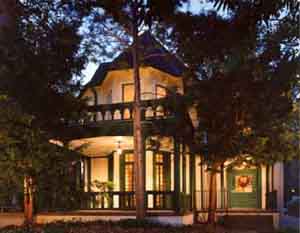
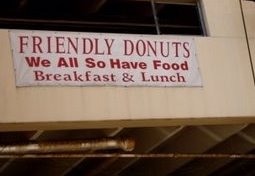
Quaint downtown Orono, without the snow. I've eaten several times at this restaurant. Once the confab, which went on happily for hours, was highlighted by a delightful conversation with Harvey Shapiro. Harvey's company was ten times finer than the food.
The National Poetry Foundation - its home has been Orono for many years - hosts a series of conferences on poetic decades. I've attended several of these, mostly notably the gatherings on the 1930s and 1940s. Alan Wald and I drove up (what a long drive!) from New Haven to Orono for the '30s conference. A highlight there was a talk by M. L. ("Mac") Rosenthal reflecting (for the first time in public, so far as I know) on his late-'40s NYU dissertation on '30s poets Rukeyser, Fearing and Horace Gregory.
That MLR had been somewhat ashamed of his choice of topic was obvious even at that late date (it was 1994 or so--which would be 2 years before Mac died); to choose 3 communist-affiliated "social" poets for a dissertation topic--not to mention such contemporary writers--at the beginning of the cold war did not seem to augur well at the time for Mac's career. And indeed he never published the dissertation as a book. (I own a clumsily bound copy printed from microfilm by that dissertation service in Ann Arbor.) He went on just fine at NYU, editing anthologies, publishing his own poems, teaching some of the great younger poets (Paul Blackburn was his student), becoming poetry editor of The Nation in the late 50s.
Now the tribe is back at Orono again (not I this time, though) to talk about the 70s. I'm somewhat following the proceedings because "LJS," the Britain-born NYC-based student of Anglo-Saxon and poetics who authors the blog called "The All-Purpose Magical Text," is and will be blogging summaries of readings and talks.
An Orono alphabet: here.
Some photos and a few videos: here
And from the blog called "glamor levels hi," this here entry that enchants me with its surprising phrases: "I imagine a world in which all objects retain the the political essence of previous use: I am me because my second-hand anarchist scarf knows me." "[A]nd when will the 70s end? and haven’t we quite eerily at this conference recreated social conditions?" "Everybody has to eat breakfast and then drive an hour to a museum to hear Bernadette Mayer and Clark Coolidge. This is why I am in Orono at all."
Here's the conference schedule.


 "I teach horizontally, meaning that while I might begin with a fixed idea of what I'm going to teach that day, I let it drift rhizomatically way off topic, often pulling it back when it gets too far. I rely on non-fixed materials to teach this way; the whole world is at my fingertips. Should I go off on a tangent about John and Rauschenberg and their love relationship as expressed in Rauschenberg's bed, an image of that bed is always a click away. From there, we can head anywhere into the non-fixed universe, be it film, text or sound. And of course, that always takes us elsewhere. As Cage says, 'We are getting nowhere fast.'"

 that anyone has yet got the imaginative measure of that terrifying day six years ago. Certainly our Tolstoy has not crawled out of the rubble. The closest we have, Don DeLillo, succeeded as an essayist-journalist ("In the Ruins of the Future: Reflections on Terror and Loss in the Shadow of September,” Harper’s, December 2001) but, to my mind, failed as a novelist ("Falling Man"). One reason, perhaps, is that the remembered emotion was instantly buried under a pile of cultural junk.' - Tod Gitlin in his review of Susan Faludi's The Terror Dream (written for