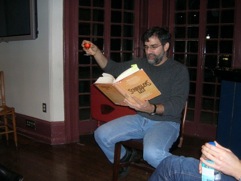
In Praises & Dispraises--a book about political poetry finished not long before his awful and untimely death--Terrence Des Pres began with a remarkable chapter on Antigone. I think I'm going to teach this chapter/essay in my course on the holocaust when I teach it next year. Here is a link to a PDF copy. I've written about Des Pres (my former teacher) here before; click also on the tag below for more.
Wednesday, September 22, 2010
as a way of getting to political poetics
In Praises & Dispraises--a book about political poetry finished not long before his awful and untimely death--Terrence Des Pres began with a remarkable chapter on Antigone. I think I'm going to teach this chapter/essay in my course on the holocaust when I teach it next year. Here is a link to a PDF copy. I've written about Des Pres (my former teacher) here before; click also on the tag below for more.


Tuesday, September 21, 2010
Toronto poet, hand-delivered to KWH
 Victor Coleman, born 1944 in Toronto, worked for the Toronto Star, Oxford University Press and then did a stint as the linotype operator for Coach House Press. Then for ten years he was the editor in chief at Coach House. And he's done a thousand other things. The other day who should step into the Writers House here in Philly but Andrew Whiteman, the Canadian songwriter and musician, longtime Toronto guy (and now in Montreal). Most people know Andrew from his band, Broken Social Scene. Anyway, Andrew is a fan of PoemTalk, he says, and spends a good deal of time listening to PennSound and Ubuweb recordings. He had with him some recordings of Victor Coleman, whom he thinks should be better known in the U.S. and generally. Well, thanks Andrew, and now we indeed have a new PennSound author page for Victor Coleman. So far we have segmented recordings of three readings, two from 1980 and one from this year.
Monday, September 20, 2010
Joyce reads
Joyce Carol Oates reads at the Writers House last year. She was the first of three 2010 Writers House Fellows. For more about the Fellows program, click here. Note: This recording runs for about an hour.
Leonard Schwartz here this week
 Poet and host of the great radio program, "Cross Cultural Poetics," Leonard Schwartz will be visiting the Writers House this Thursday. He will give a reading at the Writers House at 7 PM. For more details, click here.
Sunday, September 19, 2010

sincere vs. disoriented: which side are you on?
I listened to the current Poetry Magazine podcast - a monthly show hosted by Don Share and Christian Wiman, editors of Poetry. They feature readings from and discussions of poems, reviews and essays appearing in that month's issue. Tony Hoagland talks with them by phone about his essay ("Recognition, Vertigo, and Passionate Worldliness") dividing contemporary poetry into two tribes or camps, one (in short) sincere and the other (in short) disoriented. The very terms I find misleading and troubling. Have a listen to the podcast (you can also find it on iTunes). And see, below, my exchange with Don Share on Facebook.

The web site for the magazine offers this "discussion guide" on the Hoagland piece:
If you want me to post a response, please email me at afilreis[at]gmail[dot]com.

The web site for the magazine offers this "discussion guide" on the Hoagland piece:
The September issue of Poetry includes an essay on poetics by Tony Hoagland, who considers two kinds of poetic meaning. Hoagland, a poet and professor at the University of Houston, distinguishes between poems that familiarize and those that confuse, “the gong of recognition versus the bong of disorientation.” His piece focuses on the latter sort, the “poetry of derangement.” Hoagland suggests that vertigo (which he defines as “a sensation of whirling and loss of balance, associated with looking down from a great height . . . dizziness”) “is the preeminent topic of contemporary poetry” and “may be the dominant stylistic inclination as well.”
Hoagland points to various techniques of imitating and inducing vertigo: non sequitur, fragmentation, disassociation, truncation. (For further reading on this general topic, see his 2006 Poetry essay “Fear of Narrative and the Skittery Poem of Our Moment” and Stephen Burt’s 1998 Boston Review exposition on Elliptical poetry.) Do you agree with him that vertigo helps define contemporary poetry? If so, does it play other roles than the ones Hoagland discusses? Further, why would a poet employ such a tactic in the first place?
If you want me to post a response, please email me at afilreis[at]gmail[dot]com.
Anne Frank's fetching tartan plaid fashion cover
The Westport CT Country Playhouse is putting on a production of The Diary of Anne Frank along with a series of events intended to remind theater-goers and neighbors of the details of that genocide. One of the events features Lawrence Langer, whom I admire very much. Here's a blurb from an emailed newsletter:
 Concurrent with the production of The Diary of Anne Frank, Westport Country Playhouse presents an unprecedented series of lectures, film-screenings, talkbacks, art exhibits and panel discussions designed to provide a wider context in which to access the life of Anne Frank, the Holocaust, genocide and issues of social justice. Join an important conversation with influential scholars, artists, advocates for human rights, educators, documentarians and eyewitnesses as they shed light on a broad spectrum of fascinating subjects. These programs, the fruit of partnerships with sixteen community organizations, offer something for every interest, and will enhance your understanding and appreciation of one of the most urgent stories of the twentieth century.
But then there's this among the associated events:
Making Diaries: A Family Workshop Based on The Diary of Anne Frank
Friday, October 8
Westport Arts Center
Join Molly Ephraim, the actress who plays Anne Frank, as she recites Anne's powerful words, and then create your own story in a mixed-media diary using a range of innovative art materials.
 I'm sure I deserve some flack for being impatient with this, but...come on. Maybe it's the pink tartan snap-closed diary that's setting me off. But really. If there are ways to engage children aged 6 through 12 on the topic of the Holocaust (and I have my doubts, as I've said here in this blog in various ways), making your own "mixed-media diary using a range of innovative materials" is certainly not it. I rather think it's appropriate even for a family-oriented theatrical center to say: In this one instance, we suggest that you leave the children at home. A friend, in pointing out this session, acidly observed: "They get points for trying to shake up the Westport cocktail ice cubes with some Holocaust Awareness this Fall, but check out session with the Anne actress who will help you do your own diary--presumably with the fetching pink tartan plaid fashion cover! Had Anne just had a nice diary cover like this no doubt it would have eased her suffering."
 Concurrent with the production of The Diary of Anne Frank, Westport Country Playhouse presents an unprecedented series of lectures, film-screenings, talkbacks, art exhibits and panel discussions designed to provide a wider context in which to access the life of Anne Frank, the Holocaust, genocide and issues of social justice. Join an important conversation with influential scholars, artists, advocates for human rights, educators, documentarians and eyewitnesses as they shed light on a broad spectrum of fascinating subjects. These programs, the fruit of partnerships with sixteen community organizations, offer something for every interest, and will enhance your understanding and appreciation of one of the most urgent stories of the twentieth century.
But then there's this among the associated events:
Making Diaries: A Family Workshop Based on The Diary of Anne Frank
Friday, October 8
Westport Arts Center
Join Molly Ephraim, the actress who plays Anne Frank, as she recites Anne's powerful words, and then create your own story in a mixed-media diary using a range of innovative art materials.
 I'm sure I deserve some flack for being impatient with this, but...come on. Maybe it's the pink tartan snap-closed diary that's setting me off. But really. If there are ways to engage children aged 6 through 12 on the topic of the Holocaust (and I have my doubts, as I've said here in this blog in various ways), making your own "mixed-media diary using a range of innovative materials" is certainly not it. I rather think it's appropriate even for a family-oriented theatrical center to say: In this one instance, we suggest that you leave the children at home. A friend, in pointing out this session, acidly observed: "They get points for trying to shake up the Westport cocktail ice cubes with some Holocaust Awareness this Fall, but check out session with the Anne actress who will help you do your own diary--presumably with the fetching pink tartan plaid fashion cover! Had Anne just had a nice diary cover like this no doubt it would have eased her suffering."
Saturday, September 18, 2010
the whole island
 Mark Weiss has edited Six Decades of Cuban Poetry, an anthology given the title The Whole Island. published recently by UC Press. We're bringing Mark to the Writers House for an event on September 30. Here's an audio announcement about it. The anthology includes several poems by Jose Lezama Lima and a few others from the so-called "Origenes" group.
open access in action
 As a strong proponent of open access, I'm an avid user of both Selected Works and Scholarly Commons. My Selected Works site is http://works.bepress.com/afilreis/. I've just begun to add old articles and book chapters to the site, but I can say that it's not at all hard: find the offprint or make a photocopy, scan, upload, add the bibliographic information with an easy interface, click. Now anyone can read these heretofore hard-to-find essays, reviews, etc. As I do this work I ponder whether anyone will care, but then I receive monthly stats on how many people have downloaded each article. I'm amazed and gratified by how many. I suspect many if not most are outside the academy, far-flung geographically, or are high-school students without access to a good library.
top 20 PoemTalks in the last month
The most-often listened-to PoemTalk episodes in the last month: 1) Bruce Andrews, 2) Robert Creeley, 3) William Carlos Williams, 4) Wallace Stevens, 6) Charles Olson, 7) Robert Grenier's Williams, 8) Susan Howe's Emily Dickinson, 9) Adrienne Rich, 10) Ezra Pound, 11) Ginsberg sings Blake, 12) Barbara Guest, 13) Sharon Mesmer, 14) Ted Berrigan, 15) Gertrude Stein, 16) Lydia Davis, 17) Cid Corman, 18) Kit Robinson, 19) Rae Armantrout, 20) John Ashbery.
at the ball game
 The Poetry Society of America's web site is featuring short pieces on favorite poems. Spring and All is perhaps my favorite poetic sequence, for what it's worth, so when asked by PSA to write about a short poem, I chose the "At the ball game" section of the sequence. I was at the time writing an essay for the Cambridge University Press companion to baseball (my first time ever publishing something in print on the beloved game) so WCW's take on the crowd struck me particularly. (My essay for the Cambridge book is on "the baseball fan," a topic I'd written about several times in this blog.) Here is your link to the little essay on the PSA site.
on Williams's Paterson
 Joe Milutis at New Jersey as an Impossible Object has in my opinion mastered the form of the blog as an ongoing investigation or project. I've written about it here before. A few years ago Joe came to Philly wanting to talk about William Carlos Williams and he recorded a conversation with me, Randall Couch and Jessica Lowenthal. He edited it and made it available in segments as mp3 audio files. You can find links to the audio and Joe's nice entry on his visit here but I'm happy to reproduce the links below:
1. on teaching Paterson
2. Paterson, keep your pecker up
3. Ginsberg and Nardi
4. Sam Patch and general privation
5. the discovery of the triadic line
6. approaches to the knowledge
7. Paterson and the world
Friday, September 17, 2010
on the seminar
 As it appears in Selected Essays about a Bibliography: Seven Controlled Vocabularies and Obituary 2004. The Joy of Cooking, my short essay "Seminar": [PDF]
Ted Berrigan: it's too hot
 Ted Berrigan on the radio: "In the American Tree: New Writing by Poets," originally broadcast on Berkeley’s KPFA-FM and hosted by Lyn Hejinian and Kit Robinson, August 11, 1978. In this excerpt of a transcription made recently by Michael Nardone for Jacket2, we join the three about 10 minutes into the show:
BERRIGAN:
You just mentioned the secret actually of all my entire poetry, which is that it has to do with planes of reality, of perception. Not of reality, because that sounds theoretical, but with planes of being coming not in a theoretical sense but in a sense of trying to get accurate.
I am talking to you but he is thinking about it while I am talking.
ROBINSON:
And they, they said something about this, too. And other peoples’ voices come into your work.
BERRIGAN:
They are over there, though, and I is here. And he is a little bit over there but is near.
ROBINSON:
So there’s an incredible sense of location.
BERRIGAN:
Yeah.
ROBINSON:
Like when you say three hundred and sixty degrees, you get a center.
BERRIGAN:
Right.
ROBINSON:
And you get a circumference, and a point of the center.
BERRIGAN:
There’s something feminine if you can actually get three hundred and sixty degrees, which I didn’t realize, I suppose, until a few months ago that you could have planes and still have a circle, which is a really nice idea.
HEJINIAN:
Right.
BERRIGAN:
All that sounds so abstract, and it’s not abstract when I’m doing it. It’s simply trying to have something exist without describing it. To name its parts rather than describe it. Description is slow. I can’t keep up to the pace of my metabolism when I am using description usually. But I can do it while simply naming things. You know I don’t use images much but I will name an image. I mean I will say a tree. I don’t try to make a picture of a tree for you. I assume—
HEJINIAN:
What about in your novel, in Clear the Range?
BERRIGAN:
What about it? I mean, that’s another story entirely. I mean that’s a poet’s novel. I wrote it as this poem, was writing it. It’s a genre work, a genre which I was thoroughly familiar with, the Western novel. And I used the genre then to make everything be very slow and to make this setting in which there was a hero and a villain. Almost like Commedia del Arte. Then there was a girl. And then there were various other characters, including a horse and a mule. But, I mean, the main thing that was going on was that the villain and the hero were constantly having these Western confrontations, in which they didn’t finally pull out their guns and shoot each other. And they were very similar sort of, except that the villain was obviously villainous, and the hero was obviously the hero.
Anytime one of them did anything like go into a restaurant or a bar, then the other one was a waiter or the bartender, and they had these confrontations every minute. I think I thought I was making something similar to Camus’ book The Stranger, in which the guy, Meursault, the hero, walks around and becomes totally bemused by the sun smashing on his brain every minute and he ends up, it seems, that he killed somebody. He doesn’t quite remember, or he does remember but he doesn’t know why he did it or any thing in particular, but he did it for a very good reason: it’s too hot.
- - -
Here is the recording of the original show, how housed at PennSound.
Thursday, September 16, 2010
are you writing poems?
During a LINEbreak show, hosted by Charles Bernstein in New York in 1995, Bruce Andrews was asked: "Do you think of yourself as writing poems?" Here was his answer:
Here is an audio recording of the LINEbreak show featuring Bruce Andrews.
That's an interesting question. I do now. I guess when I started, I started writing in the 1969-1970 period, I thought of it as a kind of literary writing or experimental work in writing, more than I thought of it as poetry. Poetry I think of now as an institutional designation, so as soon as I began publishing and getting in touch with other writers, it was clear that any future for anything I did or anything they were doing was going to be under the category of poetry as defined by other people. So, over the years I've just accepted that.
I remember, for instance, when the term 'language poetry' started getting thrown around, and my original nervousness about the term stemmed mostly from the P word rather than from the L word. You know, that I thought of it as language writing, a term that I wasn't all that displeased with, because it suggested almost a new genre or a new sub-genre possibility that hadn't yet been defined, so that it would be a type of writing that had the certain way of foregrounding the way meaning was produced and operated on in a social world, rather than language poetry, which then implies that language is the adjective referring to a sub-category of what we already think of as poetry.
Here is an audio recording of the LINEbreak show featuring Bruce Andrews.
Monday, September 13, 2010
Carl Rakosi on writing political poetry
 Speaking of the 1930s: Carl Rakosi was a member of the communist party and, when he was merely 99 years old, several of us at the Writers House asked him to talk about the problems and possibilities of writing a politically radical poetry. He gave a halting but very thoughtful response. Keep in mind that he was speaking in 2002 about the period 1938-41. It's hard to see clearly through the fog of warring politico-poesis. Many thanks to Henry Steinberg for editing this segment. The questioner is Tom Devaney. The whole interview with the 99-year-old Rakosi can be found here.
from the 'twenties to the 'thirties
 About a decade ago I recorded a mini-lecture about the transition from the American poetry of the 1920s to that of the 1930s. It gives some obvious dramatic examples of big changes, e.g. Isidor Schneider's move from latter-day imagist in the mid-1920s to communist poet of the 1930s. I left out any nuance here, but then the nuance became the subject of my most recent book, which in a sense refutes the standard description of the big change ("from modernism to radicalism"). However, I do stand by this little audio mini-lecture as a first foray into the topic for my students. And naturally, in the course, we read lots of examples.
natural abstraction
 My former student Ed Fuhr is a photographer. The shot above is one of his natural abstractions (a garden hose in a swimming pool, I believe). I taught Ed at Virginia in the--when was it, Ed? late 1970s or 1980--and we've been in touch, on and off, in recent years. So here's a shout-out to Ed!
Sunday, September 12, 2010
magazine troubles, yes, but where's the story?
 Yesterday's Times ran a story on the Arts page - something of a lead story - that struck me as oddly reported and unfinished, and it bothered me quite a bit that they'd even run it. Where was the story? At the University of Virginia, the venerable and, until recently, rather sleepy old quarterly, Virginia Quarterly Review, is having some problems. Its editor, whom almost everyone praises for having revived the journal, seems to be a bad manager and supervisor. There have been complaints to the university from the staff. The editor was turned town for a faculty appointment in the English department. The managing editor, who had suffered from depression, recently committed suicide. The article implies a cause-and-effect connection between and among these factors but--unless we're not being told some crucial fact--it just doesn't add up. Bad relations between a university-affiliated journal and the English department? No news there. A talented editor is bad at running his office? University staff complain about poor management? No news there either. A person suffering from depression takes his own life? Sadly, no news there. So where's the story? I missed any sort of narrative smoking gun here. Presented with this story, as written, the Times editors should have killed the article or asked that the evidence of something newsworthy be made clear. Otherwise, it's commonplace innuendo. As an attentive reader I kept thinking this: Is there something else I need to know to understand this? Is the Times being tasteful in leaving out something salacious? At its worst, the story vaguely implies that the editor drove his managing editor to suicide. But no one quoted in the article comes even close to saying that, so running a fairly major article implying it is, I think, reprehensible as journalism.
(Full disclosure: I got my PhD from UVa; I slightly knew VQR's old longtime editor, Staige Blackford, and wrote perhaps one short review for the journal 25 years ago.)
Saturday, September 11, 2010
on memory and writing
Several times recently I've mentioned Susan Schultz' Dementia Blog here, so I won't repeat the basic information about the project; rather I'll direct you back here. Michael Nardone recent completed transcribing the conversation between Leonard Schwartz and Susan recorded for one of Leonard's "Cross Cultural Poetics" shows. We hope to publish it some day in Jacket2 but meantime here's a preview - an unedited transcription of one portion of the interview.
- - -
SCHWARTZ:
So, it's a really rich and complicated weave of things, and so beautifully juxtaposed. You know, you have that section: my empathy is memory, is a container into which your experience sometimes fits, shallow grave or swimming pool, death by water. The mind is a memory of overpasses, not to pass over but under by way of air. The air is human. I am the limbless woman.
Can you say a little bit—-I know this is a, you know, vast and grave question—-but a little bit about your take on memory having moved through this experience with dementia, and on the personal level, your mother's dementia, and the political level, with the Bush administration now reaching its end?
SCHULTZ:
Could you ask me a bigger question, Leonard?
SCHWARTZ:
Were one to ask Proust the question about memory, I know what we would get. It would take several volumes. It's a big question. He's got quite a few books that are devoted to that, but what would be the thumbnail sketch of Susan Schultz's vision of memory?
SCHULTZ:
Well, I've always been quite obsessed with memory, and I think most of my work comes out of the way in which my memory—which I think in many ways is simply an echo chamber of the larger cultural and social memory—works, if that's the right word. So, I think memory is not just a solitary activity, it's very much a communal activity. It's what joins us to other people once we take our memories and offer them to others. So, perhaps one of the most striking effects of memory-loss is that return to a kind of profound solitude that I certainly saw in my mother for a long time. Now that she's in a better place—she's in an Alzheimer's home and she is very well taken care of—there is a sense that she's back in community. But she doesn't speak of her memories. I'm not sure she has them anymore, and so, in that sense, I think there's a kind of profound solitude that has to do with living exclusively in the present.
There's also a strong ethical sense to memory. There's a wonderful book about the ethics of memory by an Israeli philosopher whose name, of course, I can't call to mind at the moment, but the sense in which if you have a memory and you use it correctly, it's an ethical act. If you fail to remember certain important things, that's an unethical act. And yet, if you lose your memory to illness, it's something else again. So the difference between that loss of memory to illness and the loss of memory that the Bush administration tried to create for all of us, I think, is very telling that there are different uses of the erasure of memory, and in my book I was trying to negotiate a place from which I was encountering both at the same time. So, I don't know if that answers your question—
SCHWARTZ:
It's a wonderful response to the question. I'm so glad I insisted even though you tried to laugh the question off at first, because it's a great—and there's so much to think about in what you just said, the way in which, in fact, memory is communal, we think of memory at some level as a deep form of introspection, and it is, but at the same time certain kinds of memory, certain forms of memory would not be possible without a conversation, or without the wider conversation that is sometimes called community. So, that complexity, that complicated tissue of discourse and language that makes memory possible, you speak to so tellingly in what you just said, and in the book itself, Dementia Blog, which is really quite extraordinary.
- - -
SCHWARTZ:
So, it's a really rich and complicated weave of things, and so beautifully juxtaposed. You know, you have that section: my empathy is memory, is a container into which your experience sometimes fits, shallow grave or swimming pool, death by water. The mind is a memory of overpasses, not to pass over but under by way of air. The air is human. I am the limbless woman.
Can you say a little bit—-I know this is a, you know, vast and grave question—-but a little bit about your take on memory having moved through this experience with dementia, and on the personal level, your mother's dementia, and the political level, with the Bush administration now reaching its end?
SCHULTZ:
Could you ask me a bigger question, Leonard?
SCHWARTZ:
Were one to ask Proust the question about memory, I know what we would get. It would take several volumes. It's a big question. He's got quite a few books that are devoted to that, but what would be the thumbnail sketch of Susan Schultz's vision of memory?
SCHULTZ:
Well, I've always been quite obsessed with memory, and I think most of my work comes out of the way in which my memory—which I think in many ways is simply an echo chamber of the larger cultural and social memory—works, if that's the right word. So, I think memory is not just a solitary activity, it's very much a communal activity. It's what joins us to other people once we take our memories and offer them to others. So, perhaps one of the most striking effects of memory-loss is that return to a kind of profound solitude that I certainly saw in my mother for a long time. Now that she's in a better place—she's in an Alzheimer's home and she is very well taken care of—there is a sense that she's back in community. But she doesn't speak of her memories. I'm not sure she has them anymore, and so, in that sense, I think there's a kind of profound solitude that has to do with living exclusively in the present.
There's also a strong ethical sense to memory. There's a wonderful book about the ethics of memory by an Israeli philosopher whose name, of course, I can't call to mind at the moment, but the sense in which if you have a memory and you use it correctly, it's an ethical act. If you fail to remember certain important things, that's an unethical act. And yet, if you lose your memory to illness, it's something else again. So the difference between that loss of memory to illness and the loss of memory that the Bush administration tried to create for all of us, I think, is very telling that there are different uses of the erasure of memory, and in my book I was trying to negotiate a place from which I was encountering both at the same time. So, I don't know if that answers your question—
SCHWARTZ:
It's a wonderful response to the question. I'm so glad I insisted even though you tried to laugh the question off at first, because it's a great—and there's so much to think about in what you just said, the way in which, in fact, memory is communal, we think of memory at some level as a deep form of introspection, and it is, but at the same time certain kinds of memory, certain forms of memory would not be possible without a conversation, or without the wider conversation that is sometimes called community. So, that complexity, that complicated tissue of discourse and language that makes memory possible, you speak to so tellingly in what you just said, and in the book itself, Dementia Blog, which is really quite extraordinary.
Kelly Writers House is 15 years old
KWH 15th Anniversary Celebration, a reading by former students of Al Filreis, 4 PM in Saturday, October 30, 2010, in the Arts Cafe of the Kelly Writers House at 3805 Locust Walk. RSVP to rsvp: whhomecoming@writing.upenn.edu or call (215) 746-POEM
Here are the four readers:
Suzanne Maynard Miller
Alicia Oltuski
Eric Umansky
Kerry Sherin Wright
 Suzanne Maynard Miller (C'89) is a playwright and teacher. Her plays include Young Love, Flirting With the Deep End (Dramatic Publishing, 2007); Beatrice; The Handwriting, the Soup, and the Hats; and Abigail's Atlas. Her work has been produced in Los Angeles, Seattle, Providence, New Haven and at the Edinburgh Fringe Festival. Maynard Miller has taught playwriting and expository writing at Brown University and at the Rhode Island School of Design. She has been an artist-in-residence at public schools in Seattle, Providence, Brooklyn, and the Bronx and a playwright-in-residence at Annex Theater in Seattle, where she was a company member from 1989-1996. Maynard Miller has also led playwriting workshops for incarcerated women and was a founding member of Kidswrite, a Seattle-based literacy program for fifth graders. Currently, she teaches in the English Department at the New York City College of Technology/CUNY. A graduate of Penn, Maynard Miller received her MFA in playwriting from Brown University in 1998. She lives in Brooklyn with her husband and two daughters.
 Alicia Oltuski (C'06, G'06) is a writer whose book about diamonds is forthcoming from Scribner. She concentrated in creative writing at Penn and spent many happy hours at the Kelly Writers House. After graduating, she completed an MFA at Columbia and taught at the University of the Arts. Her work has appeared in literary magazines, newspapers, and on the radio. She lives with her husband Uri Pasternak, a 2004 graduate of Penn Engineering.
Eric Umansky is a senior editor at the non-profit investigative newsroom, ProPublica. This year, ProPublica became for the first online-only news organization to win a Pulitzer Prize. Previously, Umansky was a columnist for Slate. He has also written for The New York Times Magazine, Washington Post, The New Republic, and elsewhere. Umansky is also the co-founder of DocumentCloud, a new non-profit that's building tools to improve how documents are shown and shared online. Earlier in his career, Umansky was editor of MotherJones.com.
 Kerry Sherin Wright is the founding Director of the Philadelphia Alumni Writers House at Franklin & Marshall College and Executive Director of Poetry Paths, a poetry and public art project in Lancaster, PA. She is also an adjunct assistant professor in the English department at Franklin & Marshall, where she teaches courses in creative writing, contemporary experimental fiction, and graphic literature. Before joining Franklin & Marshall in 2003, Wright served for six years as the first Director of the Kelly Writers House at the University of Pennsylvania. Wright was recognized upon her departure from the Kelly Writers House at Penn with the creation of The Kerry Sherin Wright Prize, an annual award that supports an event or project that "best captures" her spirit of "aesthetic capaciousness and literary communitarianism." She has a PhD in English literature from Temple University, and she received her Masters in creative writing from Hollins College and her Bachelors in religious studies from the University of Pennsylvania. Wright serves on the boards of the James Street Improvement District and the Pennsylvania College of Art and Design’s Public Art Advisory Committee. She is a writer of both scholarly and creative prose and is currently working on a novel. She lives in Lancaster with her husband Scott Wright and their son Skyler.
Here are the four readers:
Suzanne Maynard Miller
Alicia Oltuski
Eric Umansky
Kerry Sherin Wright
 Suzanne Maynard Miller (C'89) is a playwright and teacher. Her plays include Young Love, Flirting With the Deep End (Dramatic Publishing, 2007); Beatrice; The Handwriting, the Soup, and the Hats; and Abigail's Atlas. Her work has been produced in Los Angeles, Seattle, Providence, New Haven and at the Edinburgh Fringe Festival. Maynard Miller has taught playwriting and expository writing at Brown University and at the Rhode Island School of Design. She has been an artist-in-residence at public schools in Seattle, Providence, Brooklyn, and the Bronx and a playwright-in-residence at Annex Theater in Seattle, where she was a company member from 1989-1996. Maynard Miller has also led playwriting workshops for incarcerated women and was a founding member of Kidswrite, a Seattle-based literacy program for fifth graders. Currently, she teaches in the English Department at the New York City College of Technology/CUNY. A graduate of Penn, Maynard Miller received her MFA in playwriting from Brown University in 1998. She lives in Brooklyn with her husband and two daughters.
 Alicia Oltuski (C'06, G'06) is a writer whose book about diamonds is forthcoming from Scribner. She concentrated in creative writing at Penn and spent many happy hours at the Kelly Writers House. After graduating, she completed an MFA at Columbia and taught at the University of the Arts. Her work has appeared in literary magazines, newspapers, and on the radio. She lives with her husband Uri Pasternak, a 2004 graduate of Penn Engineering.
Eric Umansky is a senior editor at the non-profit investigative newsroom, ProPublica. This year, ProPublica became for the first online-only news organization to win a Pulitzer Prize. Previously, Umansky was a columnist for Slate. He has also written for The New York Times Magazine, Washington Post, The New Republic, and elsewhere. Umansky is also the co-founder of DocumentCloud, a new non-profit that's building tools to improve how documents are shown and shared online. Earlier in his career, Umansky was editor of MotherJones.com.
 Kerry Sherin Wright is the founding Director of the Philadelphia Alumni Writers House at Franklin & Marshall College and Executive Director of Poetry Paths, a poetry and public art project in Lancaster, PA. She is also an adjunct assistant professor in the English department at Franklin & Marshall, where she teaches courses in creative writing, contemporary experimental fiction, and graphic literature. Before joining Franklin & Marshall in 2003, Wright served for six years as the first Director of the Kelly Writers House at the University of Pennsylvania. Wright was recognized upon her departure from the Kelly Writers House at Penn with the creation of The Kerry Sherin Wright Prize, an annual award that supports an event or project that "best captures" her spirit of "aesthetic capaciousness and literary communitarianism." She has a PhD in English literature from Temple University, and she received her Masters in creative writing from Hollins College and her Bachelors in religious studies from the University of Pennsylvania. Wright serves on the boards of the James Street Improvement District and the Pennsylvania College of Art and Design’s Public Art Advisory Committee. She is a writer of both scholarly and creative prose and is currently working on a novel. She lives in Lancaster with her husband Scott Wright and their son Skyler.
howl festival

 The Howl! Festival 2010 kicked off in Tompkins Square Park yesterday evening (5-7 PM). Three days of events to follow. Meantime, our best and favorite photographer of poets, Lawrence Schwartzwald, was there and snapped some great shots, these two among them. From left to right: John Giorno, Anne Waldman and Bob Holman. Bob was MC. Take a look at the East Village Howler blog for various commentaries and Howl! Festival news.
Thursday, September 09, 2010
online book discussion groups

The Writers House today announced its new slate of online discussion groups for Penn alumni and parents of Penn students. Here's the new roster.
Waldman is in a rogue state of mind
 Anne Waldman gave a reading at Belladonna on April 26, 2002. She read five poems. Thanks for our friends at Belladonna, we at PennSound have the recording. Yesterday we segmented the recording into singles, which include the powerful anti-George Bush chant, "Rogue State" (PennSound now has several recordings of this), and Waldman's singing of William Blake's "The Garden of Love." The latter is an arrangement that Allen Ginsberg composed for his album of Blake songs. One of PennSound's most popular pages, in fact, is the Ginsberg/Blake page. Here is Ginsberg singing "The Garden of Love," and here is an episode of PoemTalk featuring a 25-minute discussion of it.
Tuesday, September 07, 2010

Friday, September 03, 2010
Cagean, plus or minus
 Here is the text* of Joan Retallack's poem "Not a Cage." And here is a recording of Joan reading the poem at Buffalo in 1993.
* from How To Do Things with Words, Sun & Moon, 1998.
poetry on rooftops
 Last night Dorothea Lasky, Matt Hart and Catie Rosemurgy presented "Poetry from the Rooftops" in association with the New York City Department of Parks & Recreation, sponsored by The Academy of American Poets atop The Arsenal Building in Central Park. Lawrence Schwartzwald, fabulous photographer of poets, was there and, among many good shots, took this photo of Matt Hart during his reading.
Wednesday, September 01, 2010
Sappho-Dickinson hybrid with a Beat sensibility
 Tony Trigilio has been working this past year on an edited collection of poems and fragments from Elise Cowen's only surviving notebook. This edition will reproduce the notebook poems themselves, as they were written in Cowen's hand. Cowen's surviving family generously granted the rights to Tony to edit the book. The project, which is still looking for a publisher, will include many never-before-seen Cowen poems and will correct those that had been mis-transcribed in the past. The book is taking shape as an intriguing Sappho-Dickinson hybrid with a Beat sensibility -- an odd mixture, perhaps, but an accurate description of Cowen's varied influences.
For years I've taught Elise Cowen in my modern/contemporary American poetry course (English 88) and once created a modest Cowen web page here. Here's more about Tony.
Cole Swensen on gardens
 Cole Swenson was a guest on Leonard Schwartz's radio program, "Cross-Cultural Poetics," back in January. Thanks to Henry Steinberg, now PennSound offers a segmented recording of the reading and discussion. Swensen offers a reading of "A Garden Is a Start" and then takes a few minutes to talk about the style of that poem. She reads "If a Garden of Numbers" but we are also treated to her discussion of the geometry of Le Notre gardens, of gardens taking dominion over nature, of fountains as a public commodity. (The readings were from her recent book, Ours.) It's all here--available as of just yesterday. By the way, I'm happy to say that Leonard Schwartz will be here at the Writers House this fall (9/23/10) - and also a guest on PoemTalk.
Edit Publications
 On July 29th, Edit Publications launched eleven books expanding Tan Lin's Seven Controlled Vocabularies and Obiturary 2004, The Joy of Cooking (Wesleyan Poetry Series, 2010). These printed editions derive from an event at the Kelly Writers House at the University of Pennsylvania on April 12th, 2010 titled "Handmade book, PDF, lulu, Appendix, Powerpoint, Kanban Board/Post-Its, Blurb, Dual Language (Chinese/ English) Edition, micro lecture, Selectric II interview, wine/cheese reception, Q&A (xerox), film."
Books published include: Purple/Pink Appendix by Tan Lin with an introduction by Danny Snelson, afterword by Charles Bernstein and indexes by Lawrence Giffin, Ashley Leavitt, John Paetsch, Danny Snelson, and Tan Lin. Blurb by Tan Lin. Event Inventory and Documentation (monochrome and polychrome editions) by Jeremy JF Thompson. Selected Essays About a Bibliography, with contributions by forty-eight authors. 7CV Chinese Edition (1-4) (七受控詞表和2004年訃告). 7CV Critical Reader, with full text downloads in PDF format. Printed on demand by lulu.com in a continual state of revision.
Event Editors and Authors include: Matthew Abess, Chris Alexander, Louis Asekoff, Stan Apps, Danielle Aubert, Charles Bernstein, Marie Buck, Lee Ann Brown, E. Shaskan Bumas, Ken Chen, Evelyn Chi'en, Clare Churchouse, Cecilia Corrigan, AMJ Crawford, Kieran Daly, Monica de la Torre, Thom Donovan, Patrick Durgin, Kareem Estefan, J. Gordon Faylor, Al Filreis, Thomas Fink, Mashinka Firunts, Robert Fitterman, Jonathan Flatley, Brad Flis, Peter W. Fong, Christopher Funkhouser, Kristen Gallagher, Sarah Gambito, Ellen Gruber Garvey, Kenneth Goldsmith, Cecilia Gronberg/Jonas (J) Magnusson, Heidi Brayman Hackel, Erin Gautche, Lawrence Giffin, Diana Hamilton, Eddie Hopely, Paolo Javier, Greem Jellyfish, Josef Kaplan, John Keene, Diana Kingsley, Matthew Landis, Ashley Leavitt, Tan Lin, Warren Liu, Jessica Lowenthal, Sueyeun Juliette Lee, Maya Lin, Warren Liu, Dana Teen Lomax, Patrick Lovelace, Dan Machlin, Rachel Malik, Josiah McElheny, Stephen McLaughlin, Joe Milutis, John Paetsch, Asher Penn, Ellen Quinn, Diana Ro, Raphael Rubenstein, Jay Sanders, Katherine Elaine Sanders, Karen L. Schiff, Jeremy Sigler, Danny Snelson, Carlos Soto, Kaegan Sparks, Chris Sylvester, Gordon Tapper, Michelle Taransky, Jeremy JF Thompson, Richard Turnbull, Dan Visel, Dorothy Wang, Andrew Weinstein, and Sara Wintz.
You can download everything at once, or you can purchase individual copies of the volumes - or download each separately.
Your friendly blogger here has an essay in the volume called "Selected Essays About a Bibliography." Click here and you should get to a page where you can buy a copy of that book.
Tuesday, August 31, 2010

Tuesday, August 24, 2010
Bruce Andrews

Episode 35 of PoemTalk is being released today: here. Tan Lin, Sarah Dowling and Chris Funkhouser discuss Bruce Andrews's poem from Moebius, "Center."
Sunday, August 22, 2010
Poetry mag "versus" beatniks
 There isn't any conflict of interest between the universities and POETRY. Quote, unquote.
Thursday, August 19, 2010
featured podcast
 Today the University of Pennsylvania's main news page features a program in the Kelly Writers House Podcast series. This is a conversation I hosted with Jessica Lowenthal and Jamie-Lee Josselyn about the book Jamie-Lee has been writing about her mother's death. The direct link to the podcast is here.
Tuesday, August 17, 2010
four new Creeley recordings
 Thanks to the work of Henry Steinberg, we've just added four new recordings of Robert Creeley reading his poems: "The Dishonest Mailman," "Please," "After Lorca," and "The Ballad of the Despairing Husband." We've also included links to four YouTube video clips of the same reading. Go to PennSound's Creeley page and scroll down to the bottom.
Monday, August 16, 2010
another Filreis survivor of the Holocaust
 Zalman was born in Warsaw in 1927 as the only child of Izaak and Haja Akerman. Before marrying Zalman's father, Haja's name as Haja Filreis. I believe that Haja was a sister of my father's father--my grandfather--Ben. That would make Zalman my father's first cousin. Ben and his brother left Warsaw to come to Brooklyn in the 1910s, so the family was permanently split up even before World War II.
He calls himself the only survivor of his family. But now, finally, he knows that other Filreises survived.
Zalman's father Izaak was a hat-maker who specialized mainly in leather hats. His mother Haja--formerly Haja Filreis--was a senior nurse in one of the hospitals of Warsaw. Zalman who was an only child studied at the Polish School on Ptasia Street.
As you will see, if you read on, Zalman is a survivor of the Holocaust. He was involved with the Warsaw Ghetto Uprising fairly far into that battle. The rest of his story is told through a web site called "Virtual Stetl," an attempt by some people in Israel to record the memories of Eastern European Jews who eventually found their way to the middle east.
"I had a happy childhood", says Zalman, yet he remembers very little from his childhood days and from his parents. "All what happened before the war was almost entirely erased, except for a few remembrances". For instance, Zalman remembers a colored painting of him when he was four, painted on canvas, which was hanging on the wall in their living room. From the house he remembers the opening sofa in the living room and the round table, which stood in the middle. The cooking stove in the kitchen, which was heated by fire-woods, and the portable stove from cast iron. One of the rooms served as a workshop for his father Izaak, including special models which Izaak sewed his hats on them.
His grandmother (on his mother's side) lived together with their small family and took care of the household and of Zalman, since his mother was working at the hospital.
"I don't remember the face of my mother clearly. What I picture in my mind is her image dressed in the white uniform of a nurse," Zalman sums up his vague memories of that period.
"My Holocaust started when I was 12", relates Zalman. "On September 1st, 1939, the Germans bombed Warsaw. A bomb fell on our house and miraculously we were saved. We were put in a ghetto. One day, during one of the actions, the Germans caught me and I found myself, together with several dozens of other Jews, marching towards the Umschlagplatz - the place from where the Warsaw Jews were sent to extermination camps. We waited for the train inside a large building. When the sign was given, we were ordered to march towards the train, escorted by armed Ukrainian soldiers.
Then one minute I ran away. I hid under a pile of feathers in a garage nearby. When the Germans entered the garage - I held my breath so that no feather would fly.
At night I left my hide-out and returned to the ghetto".
On April 1943, the Jews' uprising in ghetto Warsaw broke out. All the ghetto residents went down to the underground bunkers. Zalman and his mother stayed in one of the largest bunkers in the ghetto, on 22 Franciszkańska Street (his father Izaak was taken away and sent to extermination already in 1942).
On April 20th, the fighters were given an ultimatum to put down their weapons till 10.00 o'clock in the morning. The Waffen SS forces, which arrived at the place faced strong resistance. At that stage, the Germans began setting the ghetto houses on fire. When the fighters fled from the upper burning floors to the underground bunkers, the fire from above took all the supply of oxygen down below and turned the bunkers into suffocation traps. The Germans pumped poisonous gases into the sewage canals and the Jews who had to leave their hide-out were shot dead.
Zalman and his mother were caught and sent by train to one of the extermination camps. Zalman jumped off the train and ran away and since then he never saw his mother who continued her way by train till her bitter end.
Zalman wandered among the villages. He looked for partisans in order to join them and continue fighting the Germans, but he didn't find any and since he was afraid of being handed over to the Germans by the local peasants, he decided to return to Warsaw. He was captured again, and again found himself on a cargo train, this time on the way to Majdanek.
After several months in Majdanek, Zalman was sent to several concentration and forced labor camps. He prefers to avoid the details of those hard experiences he went through in that road of torment and he just sums them up in a few words: "It was very hard !!!"
Zalman was liberated by the American Army in Gedburg, Germany, wherein he arrived with the death march. After his liberation, when Zalman was eighteen he returned to Warsaw, but didn't find any family relative of his. He turned for help to the Jewish Committee in Warsaw, among whom the leaders of the ghetto Warsaw uprising, Izaak Zukerman and Cywia Lubetkin, were active. They sent him to the “Dror” Zionist youth movement. Zalman joined the Kibbutz of the movement (a group of youngsters who were preparing themselves for immigration to Israel and settling down there in a kibbutz). During their training, Zalman was sent to a seminar for youth instructors and for two years he was training children who were Holocaust survivors, most of them were orphans. "That work left in me a deep sense of responsibility towards the children and gave me great satisfaction. That period actually influenced my entire life", says Zalman. On April 1947, he sailed together with a group of 43 children, from Marseille, France to Israel (which was then still Palestine), on board the ship "Theodor Herzel". But when they reached the coasts of the country, the British Mandate authorities prevented their ship from anchoring in Haifa and they were driven away to Cyprus.
They were released at the end of 1947 and left Cyprus and arriving in the land of Israel. The children were sent to Kibbutz Beit Hashita while Zalman volunteered to the Palmach (the military force of the Hagana organization).
In the Independence War of Israel, Zalman enlisted to Battalion 6 of the Harel Brigade, where he served till the Palmach was dismantled and its fighters joined the Israeli Defense Forces.
"After the war ended and I was released from the army, I felt lonely and therefore the Kibbutz way of life seemed ideal for me", tells Zalman, "and choosing to join Kibbutz "Lohamei Hagethaot" seemed only natural. Many members of the "Dror" movement were there, and I knew some of them from the time I was activein the "Bricha" organization.
(The organization was established by the soldiers in the Jewish Brigade and the emissaries of "Aliya Beth" (Hebrew: the second immigration). The "Bricha" operated during '44-'49 to transfer Holocaust survivors from eastern Europe to western Europe and the coast, in order to bring them to Palestine. Survivors of youth movements, partisans and fighters from the ghettos also participated in the "Bricha" activities.)
Zalman continues: "Kibbutz" Lohamei Hagetaot" was founded in 1949, in the Western Galilee, by Holocaust survivors, partisans and fighters from different ghettoes. At the Kibbutz I was instructing immigrant youth".
There at the kibbutz he also met Sheila Feingold, a new immigrant from England. They married on May 3rd, 1953. Their first daughter, Amit, was born in 1956.
In 1959, Zalman and Sheila together with their daughter Amit moved to the youth village of Ben Shemen, where their second daughter Anat was born in 1962. In Ben Shemen he worked as a teacher in the Aliyat Hanoar immigrant youth movement. Sheila started working as an English teacher on Educational Television since it was founded in 1964, and continued working there for the next 32 years.
Zalman decided to complete his education, since he managed to study only six years before the war broke out. Although he was then already married and a father of two, he took his matriculation exams and along the years completed three university degrees in education. His doctorate work for his Ph.D Degree was about Janusz Korczakwho had interested him since he was a child. "Kortchak was my guide along my work in the educational field", he used to say. And so Zalman, who started as an unqualified teacher, ended his role in the educational system as a boarding schools’ inspector on behalf of the Ministry of Education.
Another passion of Zalman was theatre. Already in 1945, in Poland, he directed a theatre play about ghetto Warsaw, in front of an audience of Jewish survivors. In Israel, while he was a school director in the city of Ramle, he founded a puppet theatre. After his retirement Zalman founded a marionette theatre, "Bubonoa", which performed most successfully for six years all over the country and received the recognition of the Ministry of Education.
At the end of the 1990's, Zalman and Sheila moved to a Home for Retired people, called "Migdalei Hajam Hatichon" in Kefar Saba. Zalman received a studio from the house management, where he creates puppets from different materials (some of them are recycled) and also instructs a study group among the house members how to create marionettes. Each year the study group members present an exhibition of their own hand-made marionettes.
Yet Zalman declares, "The main thing in my life was and always remains my family". Indeed, as the only survivor of his family, all alone in the world, Zalman was fortunate to raise a wonderful family. Sheila and Zalman have seven grandchildren. Their eldest daughter Amit has four children: Yuval, Eyal, Razi and Dani. Their second born daughter Anat has three children: Guy, Omer and Ayelet.
Sunday, August 15, 2010
Amazon review of "Counter-revolution of the Word"
Counter-revolution of the Word explores in great depth the antimodernist literary movement of the mid 20th century. Alan Filreis, author of Modernism from Right to Left: Wallace Stevens, the Thirties, & Literary Radicalism, here investigates the question: Why did American conservatives react so strongly against modernism?
In preparing for this book Filreis dug deeply into archives across the country, sifting through original documents and correspondence, to examine how the anticommunist witch hunt of the mid 20th century combined with, and helped fuel, antimodernist attacks on new poetry and experimental writing.
To conservatives, the language of modernism was a 'linguistically heretical' mode that sought to 'destroy the designed order.' Conservative poet Robert Hillyer and others considered linguistic 'difficulty' part of a grand design to reduce Americans to a state of helpless confusion.
All this seems surreal, almost unbelievable. Yet look around and see how some people even today brand others as 'unAmerican' simply because they prefer to think for themselves and draw their conclusions independently of what the power structure would have them believe.
In preparing for this book Filreis dug deeply into archives across the country, sifting through original documents and correspondence, to examine how the anticommunist witch hunt of the mid 20th century combined with, and helped fuel, antimodernist attacks on new poetry and experimental writing.
To conservatives, the language of modernism was a 'linguistically heretical' mode that sought to 'destroy the designed order.' Conservative poet Robert Hillyer and others considered linguistic 'difficulty' part of a grand design to reduce Americans to a state of helpless confusion.
All this seems surreal, almost unbelievable. Yet look around and see how some people even today brand others as 'unAmerican' simply because they prefer to think for themselves and draw their conclusions independently of what the power structure would have them believe.
Thursday, August 05, 2010
Times music critic
 Nate Chinen, now a music critic for the New York Times, was a Writers House regular as a student and for the year or two afterward. Nate visited us again this past spring and here's a video of Anthony DeCurtis introducing him.
Tuesday, August 03, 2010
dementia blog
 I've read Susan Schultz' Dementia Blog - the ongoing blog project and also a book published under the same title (excerpts from the blog). The blog is the diary of a daughter who cares for her mother as the parent's memory quickly fades, one crisis and change after another, in the usual sad and disorienting progression. But "progression"? Or "regression"? That, in short, is the key question. What is it that we call this human anti-narrativity? How do we describe it? Blogs, written in order, happen to feed to the browser last entry first, and so we read a blog, as it were, from last page to first page. Books conventionally turn this around. The reversal revealed itself to Susan as she wrote. Her primary response (to her mother's changing identity) yields to a secondary response (what is the apt mode for telling others of this) and then the primary/secondary distinction dissolves. To witness is to adjust. The illness becomes the medium.
As you read this work you go backwards into the daughter's recent past to a point just when the mother begins to lose a grasp on her past. Ironically, conventional novelistic progression is repurposed for the digital mode that would normally undermine it. As we move toward the end (the beginning: Susan's return home from a vacation abroad to deal with her mother's first crises), we arrive at wholeness. Not Pip realizing his realistic place in London, nor Emma right-siding the world into appropriate family pairings, nor even Clarissa Dalloway's party which brings the whole fractured cast together, but a happy-ever-after that is a moment in time just before the decline begins. In the end are things as they were.
I recently asked Susan if she would make audio recordings of her reading selections from Dementia Blog and I'm happy to say that she obliged and that PennSound's Susan Schultz author page now features recordings of nine of the diary entries, moving backward in time of course. In addition, we have a 1-minute "about me"--Susan on herself.
Subscribe to:
Comments (Atom)


 "I teach horizontally, meaning that while I might begin with a fixed idea of what I'm going to teach that day, I let it drift rhizomatically way off topic, often pulling it back when it gets too far. I rely on non-fixed materials to teach this way; the whole world is at my fingertips. Should I go off on a tangent about John and Rauschenberg and their love relationship as expressed in Rauschenberg's bed, an image of that bed is always a click away. From there, we can head anywhere into the non-fixed universe, be it film, text or sound. And of course, that always takes us elsewhere. As Cage says, 'We are getting nowhere fast.'"

 that anyone has yet got the imaginative measure of that terrifying day six years ago. Certainly our Tolstoy has not crawled out of the rubble. The closest we have, Don DeLillo, succeeded as an essayist-journalist ("In the Ruins of the Future: Reflections on Terror and Loss in the Shadow of September,” Harper’s, December 2001) but, to my mind, failed as a novelist ("Falling Man"). One reason, perhaps, is that the remembered emotion was instantly buried under a pile of cultural junk.' - Tod Gitlin in his review of Susan Faludi's The Terror Dream (written for