The first "lesson" people seem to learn about Allen Ginsberg's "Howl" is that it is spontaneous, follows the rule of "first thought, best thought," and all this talk about its natural language leaves one with the impression (intentionally enhanced by the poem's own rhetoric) that it was composed in a white heat, a burst, and then left to be its now-canonical self.
 When I teach the poem I use the first (mis)impression to my advantage (I mean, as a teacher who wants to convey, among other things, that there is no such thing as a poem consisting of natural language--that poems are made things). A lesson simple enough. After a while--after a discussion of the students' sense that the poem was composed in a flash of "inspiration" and ecstasy--I show them the marked-up typescript. You see a page below. If you click on the image, it will enlarge just enough for you to be able to see some of the careful revisions Ginsberg made as he worked this poem toward perfection--toward the impression of natural speech he wanted to create.
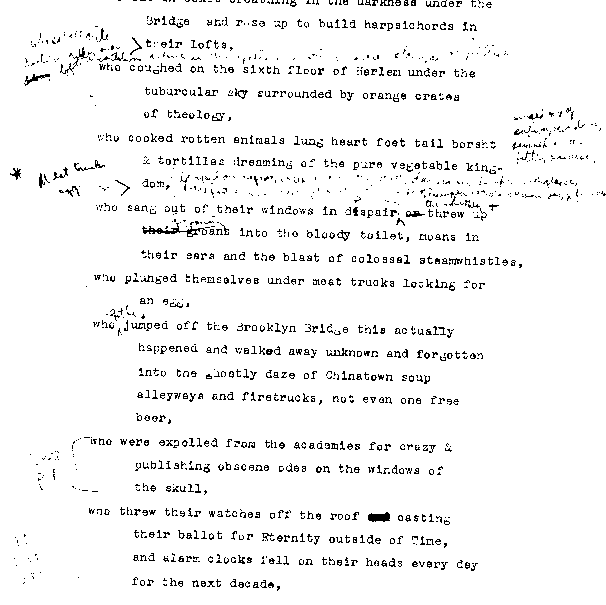
[inserted between lines 1 and 2] who sat all nite rocking & rolling over lofty incantations which in the yellow morning were stanzas of gibberish
[inserted in the left margin near line 9] * Meat truck egg
[inserted by line 10] lunged out of subway windows, jumped in the filthy Passaic, leaped on negroes, Cried al over the street, danced on broken wineglasses barefoot smashed their phonograph records of European 1930's German jazz finished the whisky &
[inserted in line 11] groaning
[inserted in line 15] got hi [canceled]
[inserted in left margin by lines 20-21] See p 1 [Ginsberg is proposing a shift here to page 1]
[inserted in left margin by lines 23-26] After free Beer [Ginsberg is proposing to move this so that it follows "not ever one free beer" above]


 "I teach horizontally, meaning that while I might begin with a fixed idea of what I'm going to teach that day, I let it drift rhizomatically way off topic, often pulling it back when it gets too far. I rely on non-fixed materials to teach this way; the whole world is at my fingertips. Should I go off on a tangent about John and Rauschenberg and their love relationship as expressed in Rauschenberg's bed, an image of that bed is always a click away. From there, we can head anywhere into the non-fixed universe, be it film, text or sound. And of course, that always takes us elsewhere. As Cage says, 'We are getting nowhere fast.'"

 that anyone has yet got the imaginative measure of that terrifying day six years ago. Certainly our Tolstoy has not crawled out of the rubble. The closest we have, Don DeLillo, succeeded as an essayist-journalist ("In the Ruins of the Future: Reflections on Terror and Loss in the Shadow of September,” Harper’s, December 2001) but, to my mind, failed as a novelist ("Falling Man"). One reason, perhaps, is that the remembered emotion was instantly buried under a pile of cultural junk.' - Tod Gitlin in his review of Susan Faludi's The Terror Dream (written for