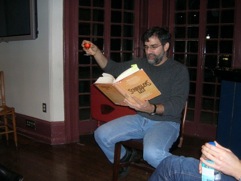
I invite you to join experimental novelist Robert Coover and me in a conversation on Tuesday morning, February 24, starting at exactly 10:30 AM (eastern time). We will be at the Kelly Writers House in Philadelphia, but the session will be available as a live video. Our internet audience will be able to pose questions to Mr. Coover by email or by telephone.
If you would like to watch - and/or participate - please RSVP to this address
whfellow@writing.upenn.edu
Once we've registered you for the event, we'll send you detailed instructions, including the web address for linking to the live video stream.
If you would like to test KWH-TV's streaming video, please click here.
- - -
ABOUT ROBERT COOVER
Robert Coover is an avant-garde novelist, critic and playwright lauded for experimental forms and techniques that mix reality and illusion, frequently creating otherworldly or surreal situations and effects. A leading proponent of hypertext fiction and metafiction, Mr. Coover is known as a true revolutionary in contemporary American literature and language.
 Mr. Coover's first novel, The Origin of the Brunists, won the William Faulkner Award in 1966. He is also the recipient of the Brandeis University, American Academy of Arts and Letters, National Endowment of the Arts, Rhode Island Governor's Arts, Pell, and Clifton Fadiman Awards, as well as Rockefeller, Guggenheim, Lannan Foundation, and DAAD fellowships. His latest honor is the Dugannon Foundation's REA award for his lifetime contribution to the short story.
His most recent books are The Adventures of Lucky Pierre: Directors' Cut, Stepmother, and A Child Again. Other works include the collection of short fiction, Pricksongs and Descants, a collection of plays, A Theological Position, such novels as The Public Burning, Spanking the Maid, Gerald's Party, Pinocchio in Venice, John's Wife, Ghost Town and Briar Rose.


 "I teach horizontally, meaning that while I might begin with a fixed idea of what I'm going to teach that day, I let it drift rhizomatically way off topic, often pulling it back when it gets too far. I rely on non-fixed materials to teach this way; the whole world is at my fingertips. Should I go off on a tangent about John and Rauschenberg and their love relationship as expressed in Rauschenberg's bed, an image of that bed is always a click away. From there, we can head anywhere into the non-fixed universe, be it film, text or sound. And of course, that always takes us elsewhere. As Cage says, 'We are getting nowhere fast.'"

 that anyone has yet got the imaginative measure of that terrifying day six years ago. Certainly our Tolstoy has not crawled out of the rubble. The closest we have, Don DeLillo, succeeded as an essayist-journalist ("In the Ruins of the Future: Reflections on Terror and Loss in the Shadow of September,” Harper’s, December 2001) but, to my mind, failed as a novelist ("Falling Man"). One reason, perhaps, is that the remembered emotion was instantly buried under a pile of cultural junk.' - Tod Gitlin in his review of Susan Faludi's The Terror Dream (written for