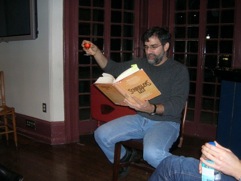
On Tuesday morning I interviewed novelist Mary Gordon during her second day here as our final Writers House Fellow for '09. The recording of what was a live video feed is ready. There is also a downloadable audio recording as well.
I told her that the stories I admired most were her meta-stories - stories in which narrrative problems are foregrounded, in which the narrator's problem is part of the story, in which a Gordonian figure appears to talk about how the story got constructed or nearly prevented. The most upbeat of these is called "Storytelling." The most compelling is one called "Intertexuality," where the narrator's (indeed, and Mary's) embarrassing and sometimes hateful stolid grandmother angrily responds to her house having been completely made over while she was sent away for a vacation in Florida, and then gets treated to a finale in which she enters a scene in Proust, whom the narrator/Mary has been reading. The second intertext is this story itself.
After chatting about such meta-stories, and about "Intertexuality," I asked M.G. to read the end of that story. This is near the beginning of the recording. At the end, I ask her to read from the memoir she wrote in the mid-90s about the awful father whom she nonetheless adored (and somewhat still adores). In the passage she reads, from a preface directed "To the Reader," she is just about to ask the reader's indulgence--that conventional gesture--but then realizes that she's not writing for readers, but for her father, and so, she says, the writing is an undying. Powerful, compelling and not just a little creepy.


 "I teach horizontally, meaning that while I might begin with a fixed idea of what I'm going to teach that day, I let it drift rhizomatically way off topic, often pulling it back when it gets too far. I rely on non-fixed materials to teach this way; the whole world is at my fingertips. Should I go off on a tangent about John and Rauschenberg and their love relationship as expressed in Rauschenberg's bed, an image of that bed is always a click away. From there, we can head anywhere into the non-fixed universe, be it film, text or sound. And of course, that always takes us elsewhere. As Cage says, 'We are getting nowhere fast.'"

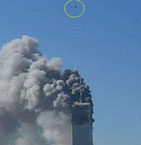 that anyone has yet got the imaginative measure of that terrifying day six years ago. Certainly our Tolstoy has not crawled out of the rubble. The closest we have, Don DeLillo, succeeded as an essayist-journalist ("In the Ruins of the Future: Reflections on Terror and Loss in the Shadow of September,” Harper’s, December 2001) but, to my mind, failed as a novelist ("Falling Man"). One reason, perhaps, is that the remembered emotion was instantly buried under a pile of cultural junk.' - Tod Gitlin in his review of Susan Faludi's The Terror Dream (written for