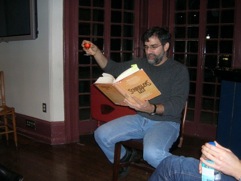
The chamber group pictured here a decade ago decided to name itself "The Eighth Blackbird," having rejected several other poetic references such as "Red Wheelbarrow." There are thirteen blackbirds, of course. So why the eighth? Is it the music's unavoidable, inexorable meter? Is it the focused circular knowing of the musician in the midst of his or her playing? Well, anyway:
VIII
I know noble accents
And lucid, inescapable rhythms;
But I know, too,
That the blackbird is involved
In what I know.
It's good to know that in the mid-90s someone at Oberlin College was apparently teaching Wallace Stevens.
Aw, but enough lucidity. For my part, I want to listen to the music of a group named "First Blackbird," making sounds based on this:
II
I was of three minds,
Like a tree
In which there are three blackbirds.
And on some days, "Tenth Blackbird" would do very aptly:
X
At the sight of blackbirds
Flying in a green light,
Even the bawds of euphony
Would cry out sharply.


 "I teach horizontally, meaning that while I might begin with a fixed idea of what I'm going to teach that day, I let it drift rhizomatically way off topic, often pulling it back when it gets too far. I rely on non-fixed materials to teach this way; the whole world is at my fingertips. Should I go off on a tangent about John and Rauschenberg and their love relationship as expressed in Rauschenberg's bed, an image of that bed is always a click away. From there, we can head anywhere into the non-fixed universe, be it film, text or sound. And of course, that always takes us elsewhere. As Cage says, 'We are getting nowhere fast.'"

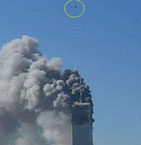 that anyone has yet got the imaginative measure of that terrifying day six years ago. Certainly our Tolstoy has not crawled out of the rubble. The closest we have, Don DeLillo, succeeded as an essayist-journalist ("In the Ruins of the Future: Reflections on Terror and Loss in the Shadow of September,” Harper’s, December 2001) but, to my mind, failed as a novelist ("Falling Man"). One reason, perhaps, is that the remembered emotion was instantly buried under a pile of cultural junk.' - Tod Gitlin in his review of Susan Faludi's The Terror Dream (written for