From his book Turn Left in Order to Go Right, Here is a poem I greatly admire: "I'd Like to See It." The refrain--"I'd like to see it that way"--is offered every four or five lines. It seems to me the perfect meditative and yet arbitrary structure to frame an otherwise random series of hoped-for conditions, which range from intensely and obscurely personal to geo-political. "So I could relax, put on my enormous suit / And ring your doorbell holding my breath and flowers." And also: "For the good of the nation behind bars" and "In order to be able to end war..." The refrain itself, rather than closing off possibilities in the serial quality of the remarks and thoughts, doubles the meaning each time: (1) It would be nice if it were so; I would like to make it so; and (2) This is how I would like to see or perceive or understand this or that part of my world. There's both agency and fatedness.
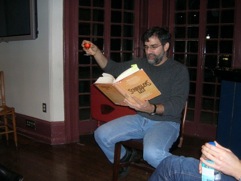
We at PennSound have a recording of Fischer reading this poem aloud--beautifully. I urge readers of this blog to read the text while hearing Fischer's Zen-ish performance. Charles Bernstein describes Fischer as "incandescently tranquil" and I cannot think of a better example of this hard-to-achieve tone than this poem.


 "I teach horizontally, meaning that while I might begin with a fixed idea of what I'm going to teach that day, I let it drift rhizomatically way off topic, often pulling it back when it gets too far. I rely on non-fixed materials to teach this way; the whole world is at my fingertips. Should I go off on a tangent about John and Rauschenberg and their love relationship as expressed in Rauschenberg's bed, an image of that bed is always a click away. From there, we can head anywhere into the non-fixed universe, be it film, text or sound. And of course, that always takes us elsewhere. As Cage says, 'We are getting nowhere fast.'"

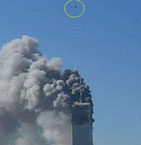 that anyone has yet got the imaginative measure of that terrifying day six years ago. Certainly our Tolstoy has not crawled out of the rubble. The closest we have, Don DeLillo, succeeded as an essayist-journalist ("In the Ruins of the Future: Reflections on Terror and Loss in the Shadow of September,” Harper’s, December 2001) but, to my mind, failed as a novelist ("Falling Man"). One reason, perhaps, is that the remembered emotion was instantly buried under a pile of cultural junk.' - Tod Gitlin in his review of Susan Faludi's The Terror Dream (written for