A magazine called SAS Frontiers features PennSound in its latest issue. I'm very pleased because it means, for one thing, that some of the thousands of Penn-affiliated people, mostly alumni, who will read this will have a listen to the archive. We want to extend our reach far beyond the poetics community.
Wednesday, April 30, 2008
new listeners
A magazine called SAS Frontiers features PennSound in its latest issue. I'm very pleased because it means, for one thing, that some of the thousands of Penn-affiliated people, mostly alumni, who will read this will have a listen to the archive. We want to extend our reach far beyond the poetics community.


now on art radio
 This week WPS1.org Art Radio airs my interview with Charles Bernstein as part of his "Close Listening" series.
Tuesday, April 29, 2008
he's our guy
 There will be other, better photos of Jerome Rothenberg at the Writers House last night, but here's the one I have at hand--appearing with the article about JR's visit that appears this morning in Penn's student newspaper, The Daily Pennsylvanian. Here's a bit from that article:
KWH Faculty Director and Professor of English Al Filreis teaches the Writers House Fellows Seminar, which is the program that brings prominent authors to campus. The goal of this class is to give students the opportunity to study the work of an author in-depth and then interact with the authors themselves during the course of the semester.
In his introduction, Filreis commented on the profound effect that Rothenberg has had on the poetry world.
He emphasized that the attitude Rothenberg embodies as a poet is exactly the spirit KWH tries to create with its programs. Filreis hopes to continue to preserve this atmosphere at the Writers House by keeping its events free and open to both students and community members.
"Rothenberg is our guy. We would like to fill the space with this spirit," said Filreis.
Saturday, April 26, 2008
down with would-be sincerists
 A little more than a year ago, back in February 2007, we hosted a "Flarf Festival," featuring--you guessed it--several Flarf poets. Nada Gordon, Mel Nichols, Rod Smith, Sharon Mesmer, and Gary Sullivan. Sullivan was the first to use the term Flarf to describe this kind of poetry, or, perhaps better put, this anti-poetic attitude. Audio recordings of the whole event and of each poem read by each poet are available on PennSound. I also did a podcast about this event.
What's Flarf? Easy enough to define, harder for some to appreciate, harder still perhaps for some of the flarfists to stay with it (in any particular sense) after the months or years of excitement about the mode has worn off. Then again, a number have managed to keep the excitement up.
Surely a flarfist himself or herself wrote the Wikipedia entry on "flarf poetry"; it's quite a good little essay on all this. "Its first practitioners practiced an aesthetic dedicated to the exploration of 'the inappropriate' in all of its guises. Their method was to mine the Internet with odd search terms then distill the results into often hilarious and sometimes disturbing poems, plays, and other texts." Joyelle McSweeney expressed my own relief and delight: "This is utterly tonic in a poetry field crowded by would-be sincerists unwilling to own up to their poems."
Flarf is alive and well, even as its definitions widen. I read Gary Sullivan's blog called "Elsewhere." This very weekend there's a conference being held in lower Manhattan. The title seems to be "2008 Holistic Expo & Peace Conference" but the poster announces "FLARF IS LIFE." Go to flarffestival.blogspot.com.
 And flarf is all over YouTube. Drew Gardner's performance of "Chicks Dig War" has been viewed 3,027 times - not bad for a poem.
And Michael Gottlieb has written well about flarf for Jacket.
At left: Drew Gardner performing "Chicks Dig War" at the 2006 Flarf Festival.
Thursday, April 24, 2008
on the verge of chaos at Bread Loaf
 No, this--above--is not the chaos I have in mind. The photo here was taken in 1984 at Bennington, at a summer writing workshop: there's Richard Ford at left, and Alan Cheuse at right. If you are an NPR listener, you will know Cheuse for his good radio reviews and other All Things Considered literary contributions. No, the chaos I have in mind goes back to 1960, when Cheuse was a quasi-bohemian figure who'd gotten to attend the Bread Loaf end-of-summer writers' workshop as a waiter, and caused some trouble, at least from the point of view of those who wanted the Old Ways at Bread Loaf to be restored. I've written about this today on my 1960 blog, so please go there and get more.
Tuesday, April 22, 2008
Share shares
 Don Share's blog is "Squandermania and other foibles." Last month he wrote an entry about my book. He begins:
Like a number of folks I've been in touch with lately, I've been reading Al Filreis's fascinating new book, Counter-Revolution of the Word: the Conservative Attack on Modern Poetry, 1945-1960, which shows that there was what we now call a right wing conspiracy against modernist poetry.
And ends:

the greenest month
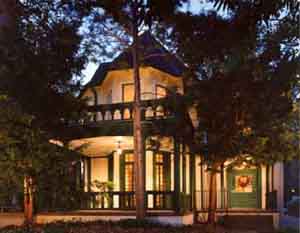
 It's been a cool April in the mid-Atlantic - not much in bloom when this photo was taken a few weeks ago - but the Writers House, set back from Locust Walk in the mode of the Victorian "nostalgia cottage," always seems verdant. Come on in.
Monday, April 21, 2008
the rose is obsolete
 Whenever I discuss with my students William Carlos Williams' poem "the rose is obsolete" (from Spring and All (1923), we begin with our sense of the rose as it is. Is it just a rose? No, the students say, it's become a huge commercialized symbol. WCW wanted a new rose, the rose that is the rose, the non- or pre-symbolic rose, "Sharper, neater, more cutting..." He wanted an infinite, endless rose, a rose that was somehow not really soft--made of "copper" or "steel." A wonderful adult student in one of my all-online versions of English 88 - a businessman who lives in China and does his business all around east Asia - took some time to create the Hallmark Card image of the poem's position. Here it is, above. And here, below, is the opening of the poem:
The rose is obsolete
but each petal ends in
an edge, the double facet
cementing the grooved
columns of air--The edge
cuts without cutting
meets--nothing--renews
itself in metal or porcelain--
whither? It ends--
But if it ends
the start is begun
so that to engage roses
becomes a geometry--
Sunday, April 20, 2008
I want a ditty with heat in it
 Pins and Needles was a hit musical revue in 1937, performed by rank-and-file members of the ILGWU (International Ladies Garment Workers Union) who worked all day and then practiced the show three hours at night; it took a year of practice before the show was ready to open.
Until Oklahoma came along, Pins and Needles was Broadway's longest-running show ever. Harold Rome's song - a meta-song if ever there was one - "Sing Me a Song with Social Significance" was a favorite of audiences. Don't keep singing me silly songs; after all, now is a time which "history's making" and "nations are quaking," so why doesn't the popular song try something serious and significant? "Sing me of wars, sing me of breadlines." Editorialize "in syncopation" - sure, go ahead.
Sing me of crime and conferences martial,
Tell me of mills and of mines,
Sing me of courts that aren't impartial,
What's to be done with 'em? Tell me in rhythm.
Most of all, songs should be about "new things." This was a new Broadway song about what's wrong with the old kinds of songs. Here's another verse:
Sing me a song with social significance,
All other tunes are taboo.
I want a ditty with heat in it,
Appealing with feeling and meat in it.
Sing me a song with social significance,
Or you can sing till you're blue,
Let meaning shine from every line
Or I won't love you.
"I didn't realize," Harold Rome said, "that the big attraction was that the garment workers themselves were doing the show and singing to the audience, creating a rapport which is very rare in the theater."
All the lyrics are here.
Friday, April 18, 2008
qwerty top row only
 Nick Montfort decided to write by constraint, limiting himself to the use of the top row of his keyboard: q w e r t y u i o p, and no other letters. He wrote a poem and called it "Top Row Retort." It was published in 2000 in Word Ways: The Journal of Recreational Linguistics.
- - - -
Top Row Retort
I tore out type ere I wrote, to type up top:
upper typewriter row, pert repertoire.
Reporter, I quote to you: To write, pop type out.
Retire typewriter row two. Your tri-row?
Rip it out, too. Tour your top row territory.
Queer tip, you retort? I worry your poor typewriter?
To torque it out -- typewriter terror?
You require row two, your tri-row prop?
You pout, try to quip. (Poor etiquette.) You titter.
(Poorer propriety.) You utter uppity output?
Quiet, you! Quit it! You purport to write.
I tire to peer to your rot, your petty writ,
to eye your wire report. You write pyrite,
terrier to torpor. I pity you, preppie yuppie.
I tutor you, tyro, to uproot your trite tree,
put type to pyre. Rupture type. Write to write.
I erupt. I riot. I prototype pure power
to write. I, upper typewriter requiter.
I outwit you, too. To perpetuity, I write poetry.
You, to put it true, putter out rote poop.
Thursday, April 17, 2008
computers & genocide
 Edwin Black's book about how IBM helped automate the Nazi death machine in Poland is stunning, even though most people who think about the European genocide of the 1940s won't be surprised by the overall fact of it. It being - to say it plainly again - IBM's connection to the Nazi final solution. It was a strategic business alliance. Perhaps more frighteningly, it was the dawn of the era - ours - in which what we now call "information technology" tended to help destroyers and mass murderers more than advocates of democratic values. It's all about the real dangers of human taxonomies - identifying a person in a fixed (1's and 0's) sort of way.
Here's a link to a summary article Black himself wrote for the Village Voice in 2002, around the time his book was published. And here's a link to Black's home page. The book is called IBM and the Holocaust.
Tuesday, April 15, 2008
revolution of the word, right here
 "The significance of Jerome Rothenberg's animating spirit looms larger every year. ... [He] is the ultimate 'hyphenated' poet: critic - anthropologist - editor - anthologist - performer - teacher - translator, to each of which he brings an unbridled exuberance and an innovator's insistence on transforming a given state of affairs." - Charles Bernstein
the Kelly Writers House Fellows program
presents
Jerome Rothenberg
Monday evening, April 28, 6:30 PM: reading/performance
Tuesday morning, April 29, 10 AM: brunch & interview/discussion
at the Kelly Writers House, 3805 Locust Walk, Philadelphia
Seating is limited. RSVP: whfellow@writing.upenn.edu or (215) 573-9749.
Jerome Rothenberg is the author of over seventy books of poetry including Poland/1931 (1974), That Dada Strain (1983), New Selected Poems 1970-1985 (1986), Khurbn (1989), and most recently, The Case for Memory (2001) and A Book of Witness (2003) and Triptych, a book that takes the poet back to the issue of the Holocaust. Describing his poetry career as "an ongoing attempt to reinterpret the poetic past from the point of view of the present," he has also edited seven major assemblages of traditional and contemporary poetry, including Technicians of the Sacred (1985), comprised of tribal and oral poetry from Africa, America, Asia, Europe, and Oceania, Revolution of the Word (1974), a collection of American experimental poetry between the two world wars and two volumes of Poems for the Millennium (1995, 1998), which won the Josephine Miles Award in 1996. In 1999 and again in 2001 he was a co-organizer of the People's Poetry Gathering, a three-day festival, under joint sponsorship by City Lore and Poet's House in New York City. Rothenberg was elected to the World Academy of Poetry (UNESCO) in 2001.
For more about Writers House Fellows: http://writing.upenn.edu/~whfellow/.
Kelly Writers House Fellows is made possible by a generous grant from Paul Kelly.
Monday, April 14, 2008
JFK at the end of ideology
 Solutions to our national problems are not political but technical. Not great, but fine.
On May 21, 1962, John Kennedy said: "I would like to say a word about the difference between myth and reality. Most of us are conditioned for many years to have a political viewpoint, Republican or Democrat--liberal, conservative, moderate. The fact of the matter is that most of the problems, or at least many of them that we now face, are technical problems, are administrative problems. They are very sophisticated judgments which do not lend themselves to the great sort of 'passionate movements' which have stirred this country so often in the past. Now they deal with questions which are beyond the comprehension of most men."
What we need, in other words, are technically trained people - experts in solving fine-tunable administrative problems - to take over our political life. We don't need people with political ideologies, the "great" (big, capacious, comprehensive) types whose "passionate movements" should worry us. Let's not get "stirred" by political disagreements. We've progressed past that now. The real problems (real as opposed to mythic) are so complex and nuanced that their solutions are beyond our knowing. We need experts.
I see white-lab-coated, horn-rimmed bespectacled men calibrating our political differences by turning dials on room-sized computers in the basement of the White House. Modern politics circa early 60s.*
This isn't the only time JFK made this point. At the 1962 Yale commencement, he said the following:
Today...the central domestic problems of our time are more subtle and less simple. They do not relate to basic clashes of philosophy and ideology, but to ways and means of recasting common goals--to research for sophisticated solutions to complex and obstinate issues.
What is at stake in our economic decisions today is not some grand warfare of rival ideologies which will sweep the country with passion but the practical management of a modern economy. What we need are not labels and cliche's but more basic discussion of the sophisticated and technical questions involved in keeping a great economic machinery moving ahead.
...[P]olitical beliefs and ideological approaches are irrelevant to the solutions.
...[T]he problems of...the Sixties as opposed to the kinds of problems we faced in the Thirties demand subtle challenges for which technical answers--not political answers--must be provided.
* And oh my, wouldn't the two candidates in the '64 election challenge this view! It's a view that, I'd say, had its heyday in the years between 1957 and 1963.
Friday, April 11, 2008
the odious machine
 Ron Silliman, who knew Mario Savio fairly well in Berkeley, tells me that Savio did not seek out his leadership role in the Berkeley Free Speech Movement - that he was shy; that he would rather, finally, have been studying his Philosophy. Anyway, his FSM work certainly distorted his life. He had a history of heart trouble and (since this blog is not official biography, nor history, etc.) let's just speculate that the heroic role and its aftermath shortened his life as well. He died at 53 in 1996.
In my own top ten list of great speeches, somewhere up around 5th is Savio's brilliant, stirring, apparently improvised speech on Dec. 2, 1964, spoken from Sproul Plaza in front of Berkeley's main administration building. I have always been stunned by the aptness of his analogy between the big research university (the way it used to treat its undergrads--and to some degree still does) and the factory machine.
I admired this because Savio is turning around the metaphor Berkeley chancellor Clark Kerr already used to describe postwar higher education: it was, said Kerr proudly and patriotically, a "knowledge factory."
I admired the speech even more when I learned that Savio's father was a machine punch operator.
"There is a time," he said, "when the operation of the machine becomes so odious, makes you so sick at heart, that you can't take part; and you've got to put your bodies upon the gears and upon the wheels, upon the levers, upon all the apparatus and you've got to make it stop. And you've got to indicate to the people who run it, to the people who own it, that unless you're free, the machine will be prevented from working at all."
In my 1950s site, I've reproduced the New York Times obituary.
Thursday, April 10, 2008
writers without borders
 Today the Philadelphia City Paper is running an article about our new series, "Writers without Borders".
Our first WWB event features Cecilia Vicuña, acclaimed Chilean poet, filmmaker and performance artist, who weaves time, space and sound to evoke ancient sensory memories.
From the article:
Since the beginning Kelly has hosted international artists, but until now the Writers House has never before had an official international series. Al Filreis, Writers House faculty director, English professor and director of Penn's Center for Programs in Contemporary Writing, explains, "If you have a place like the Writers House and you leave it to its own devices, pretty much anything will come through the door. The one thing that won't naturally come ... will be people from New Zealand and China and Nigeria and Chile. It's expensive [and] administratively time-consuming to arrange for the visit of an international writer. There's not an ideological problem, there's no vision problem; the problem is practical."
Oppen at 100
 The other night we celebrated George Oppen's 100th birthday. Tom Devaney and Rachel Blau DuPlessis organized the proceedings. Ten of us spoke for ten minutes each. Fifty minutes, a break for food and wine, and then another fifty minutes. It went fast. I could have listened to people to Tom Mandel and Ann Lauterbach and the others for hours more. You can have a look at the program printed for the occasion. And you can already go to the PennSound page with links to audio recordings of each of the 10-minute talks.
My own talk was about the poem "Myth of the Blaze." Here is the recording of that talk. And here is the poem read aloud by Rachel Blau DuPlessis. Here is the text of the poem.
In the previous entry I've presented a slightly revised version of that talk, entitled "Oppen's Antifascism: Guilt in 'Myth of the Blaze.'"
myth of the blaze
 The blaze in George Oppen's “Myth of the Blaze”, a great poem of war and political ethics and guilt, is the burning bright of Blake's “tyger” in the poem (and spelled that way).
Blake’s “forests of the night”: the woods of the so-called Bulge in the horrendous battle of that name, the Rhineland campaign of winter 1944, through France to the Rhine.
“Did he who made the Lamb make thee?” This is a story of tiger and lamb.
The tiger of antifascism beyond theory: In November 1942 George suddenly moves to Detroit, thus triggering the lifting of his draft exemption, and off he goes to fight in, as it turns out, some of the war’s more horrific battles. To fight – in spite of fear, and an inner pacifism (George the lamb here) – and, most startingly at the time, perhaps most dangerously – in spite of the state policy of the Communist Party of the United States.
“Myth of the Blaze” is the most sensitive poetic expression I know of the impossible moment for the communist left of the time, between September 1939 and June 1941, when the party asked its members to support the Nazi-Soviet Pact by favoring peace over war, nonaggression over rapid armament, to turn against the united front against fascism.
We know that George and Mary were most active in the party between 1936 and 1941, and that of course includes two years of suppressing their political impulses. Already feeling guilt over his failure to go to Spain in 1936 and ’37, George goes to war in ’42, now his politics once again aligned, tiger and lamb lying down together, fearful symmetry between Soviet Union and United States struck.
The “myth” in “Myth of the Blaze”: First, the imagination’s burning bright, the folklore of the alluring forest, just a myth. Bunk. Not real. “This crime” – in the poem – “This crime I will not recover / from” or “I will not recover / from that landscape it will be in my mind / it will fill my mind and this is horrible / dead bed.” Second, on the contrary, the myth is real. The imagination is the only thing. As one lies in a foxhole. He is bombarded by mortar fire, and wounded – all those he’s with are killed. More guilt. All he has, his mind and heart racing, are a lyric of Wyatt and “Rezi’s” (Reznikoff) “running thru my mind / in the destroyed (and guilty) Theatre of the War.”
The blaze is real, the fire this time. The blaze is real and not a myth.
The blaze – in Rezi’s poem about the blaze of the real in the imagination – is the myth. Guilt about thinking poems when the world is coming to an end, while one’s friends are dead and one is alive. (“[W]hy had they not / killed me – why did they fire that warning?”)
Guilt about surviving. Guilt about suppressing one’s political instinct for the two years of the party line. Coming to help Europe, to stop the slaughter of the Jews, too late. Where were we when they needed us?
Guilt about (now that the war is over) the awarded Purple Heart awarded, about leaving the party for the return to poetry, to the beautiful quiet peaceful “shack on the coast” of Maine (looking back out across the Atlantic), doing nothing much but smelling the scent of the pine needles. A scent that, anyway, reminds him of the French forest.
The knife at the end of the poem is perfectly opaque: the knife of the lamb – merely to butter one’s daily abundant American? Or the sharp killing knife-likeness of the war, the war-like imagination.
George Oppen at 100 bespeaks the reason to – and also the reason not to – affirm the reality of the political act outside the poem. The best thing about the problem is that, here, it is inside it, as follows:
I believe
in the world
because it is
Or:
I believe
in the world
because it is
impossible.
To hear a recording of the above, and to get some context for my interpretation of this poem, see the entry just above.
Tuesday, April 08, 2008
not enough

The fifth episode of PoemTalk has been released - a 25-minute discussion of Ted Berrigan's list poem, "3 Pages." Joining me this time are Linh Dinh, Randall Couch, and erica kaufman. The program notes (on the PoemTalk blog) are here. The link to the Poetry Foundation site is here; you'll find a listing of all five PoemTalks there as well.
Friday, April 04, 2008
measure for measure
 Suzanne Vega at the Writers House last night. We talked a bit about her New York Times blog, "Measure for Measure." With Anthony DeCurtis leading the conversation, she discussed - and played a few songs from - her new album, Beauty & Crime. She also performed a fabulous a capella "Tom's Diner." It's the Blutt Singer-Songwriter Symposium at the Kelly Writers House, in its second year; the inaugural event last spring feature Rosanne Cash. Hear our recording of Rosanne.
photo by John Carroll
Thursday, April 03, 2008
teaching artificial simplicity
 I've been reading the blog of a former student and now someone prominent in marketing (his field is "persuasion"). The blog is called Artificial Simplicity. Here's an advertising guy who quotes George Oppen: "Clarity for my sake. That I may understand my life..." and commends Jane Jacobs.
Scott's entry today is called "Innovation in the classroom: an homage," and it's, in part, about my teaching. "He taught and taught me that the point of the humanities classroom was not to communicate a particular idea but rather to get students excited to think in a new way. (It's still my goal for early meetings with a new client). What his methods--now widely adopted--created was an ongoing discussion and debate which went on all week."
...and Shelley was six feet tall

Working in a pickle factory made Theodore Roethke - oh, call him Ted - a regular guy and a poet apt for Americans' appreciation, since they appreciate big, strapping regular guys and poets are big, strapping regular guys.
Okay, so I exaggerate. But only a little. Click here for my account of a Cosmospolitan essay about poetry that pretty much makes this argument.
Tuesday, April 01, 2008
form(ulas) can be democratic
Gerald Graff is now arguing for a pedagogical formalism. What is apparently a counter-intuitive argument is--to my mind anyway--consistent with his advocacy of meta-pedagogy, a teaching of subject matter that is always in some sense about the teaching (the form of the teaching), such that "content" matters less than one might think under the liberal rubric of "teach the conflicts." In a recent Chronicle of Higher Education article, Graff and a colleague argue in favor of "formulaic" teaching. Here's a paragraph:
Here's a link to the whole article.
And here's a link to an earlier entry here on Graff's early 1990's proposal that we teach the conflicts.
Thanks to Val Ross for sending me in the direction of this piece.
Unfortunately, bad formulas have been so pervasive in American schooling that it has become easy to dismiss formulas altogether. In attacking formulas, we feel we are being democratic, striking a blow against top-down oppression and defending the diversity of student voices. If it is true, however, that certain formulas can help students engage in true democratic dialogue, then it's time to rethink that logic and stop using "formulaic" as if it were a four-letter word.
Here's a link to the whole article.
And here's a link to an earlier entry here on Graff's early 1990's proposal that we teach the conflicts.
Thanks to Val Ross for sending me in the direction of this piece.
Sunday, March 30, 2008
Bruce v. Bill
 A while back Bruce Andrews went on Bill O'Reilly's conservative TV talk/news show and went toe to toe with Bill. Mike Hennessey links the YouTube recording of the encounter and has a few good words to say about it.
After viewing this again I went to my bookshelf to pull down some Andrews and re-read, and I listened to several of his more overtly political poems on his deep PennSound author page. One of my favorites there is "You Made This World, We Didn't", which is the final section (of 100 sections) of I Don't Have Any Paper So Shut Up (or, Social Romanticism), a book published by Sun & Moon in 1992. Listen to this marvelous poem (Andrews reads well) and imagine how Bill O'Reilly would have--could have--responded had he asked Bruce to read a poem on the air and Bruce had read this. There's a politics in which one person tries to force another to speak the common already-corrupted language, a point at which we still believe the common language hasn't entirely broken down, although one has to deal with evasions and dodges on both sides; and then there's the politics of a Bruce Andrews poem, in which it becomes clear that the poet bespeaks the breakdown, which has already occurred before the poem began, and in which that breakdown is a sign of confidence and health, and an openness to other possibilities. Bruce is willing to talk in both worlds, thank goodness, so I am intrigued to hear him in both at once. What are the differences? Yes, but what are the similarities?
Saturday, March 29, 2008
Google goes black
 I read Grand Text Auto as often as I can. It's a "group blog about computer narrative, games, poetry and art." In a new entry, Nick Montfort satirizes Google by showing a black Google home page along with this note: "It warms my heart to see that a major Internet company has turned its Web page black, joining the protest against the Communications Decency Act only 4433 days late."
Charles Bernstein points me (and us) toward Google's blackle which Google claims has saved (at the moment I went there) 536,868.931 Watt hours. Given this rhetoric, I suppose Nick is wrong in thinking Google belatedly red or pink; they're trying to be green.
classroom as kiva
During the era since the emergence of digital media and, now or very soon, of ubiquitous connectivity—-and as the effect of these advents on the delivery of materials to the classroom but also their storage outside such a space becomes profound—-the irony of the classroom lecture on modernism has become more obvious than before and increasingly disabling.
I want to explore that irony and lament the disability.
I've written this here before, and I've noted that the main problem is not diagnosing the ill. It's easy to mock someone lecturing on modernism as a failure to admit any measure of the form of its innovation into the room. Which is to say: the problem will be to define or at least describe an alternative.
So I've turned to ideas about noise as a possible model - I mean, poetry as noise or what Bruce Andrews has called "athematic ‘informal music’”. Aligned with the spirit of this, I've been wondering here from time to time if the poetry classroom might be filled with such noise.
One working assumption is that the “use” of new technologies to abet the teaching of poetry is not going to make a bit of difference unless some sort of fundamental pedagogical change accompanies it.
Is it possible that quality of that changed environment might indeed sound something like Andrews’s athematic informal music? If it is true that “An onomatopoetic expression automatically entails the specification of what is being described,” then the teacher of that expression who wishes to describe specifically must to some extent reproduce sound-sense.
Because of the difficulty of effecting such reproduction, most advocates of an historically capacious modernism — I mean, the radical modernism that embraces archaic, pre-literate forms, the non-Eliotic mode that defies New Critical analysis — have argued that such poetry does not belong in the classroom. If one accepts such a contention, such as that put forward by Jerome Rothenberg in 1975 in his “Dialogue on Oral Poetry,” then one must either remove this poetics from the curriculum or rebuild the space and the role of the teacher. Rothenberg:
“As for poetry ‘belonging’ in the classroom, it’s like the way they taught us sex in those old hygiene classes: not performance but semiotics. If it I had taken Hygiene 71 seriously, I would have become a monk; & if I had taken college English seriously, I would have become an accountant.”
Yet Rothenberg did and does teach, and so admits to the realization that “the classroom becomes a substitute for those places (coffee shop or kiva) where poetry actually happens & where it can be ‘learned’ (not ‘taught’) in action.”
Friday, March 28, 2008
slipped into an evidence bag
 Twelve hours of reading aloud Lolita, to mark her 50th yesterday. The "program" prepared for the event (by Thomson Guster, Kaegan Sparks, and others) was a dossier of pages typewritten on a portable manual Olivetti slipped inside a clear plastic "evidence bag." Writers House staffers walked around all day in orange or green t-shirts emblazoned with alluring or boldly declarative ("HUMBERT HUMBERT") words.
This morning's Daily Pennsylvanian, in part:
Audience members were treated to a lunch taken straight from the pages of the novel, featuring treats like cherry pie, candy, ham and eggs, figs, bananas and ice cream sundaes. Each plate was accompanied by a bright pink slip of paper with a quote from the book related to the snack.
College sophomore Thomson Guster, who works at the Writers House, explained that sweet food is symbolic in the novel because the character of Lolita, a bratty little girl, can be bribed with candy and lollipops.
Food is "part of the whole seduction" of the book, said Jessica Lowenthal, director of KWH.
Here is the whole article.
Thursday, March 27, 2008
drive, she said
 The novelist and essayist Lynne Sharon Schwartz visited the Writers House recently as a "Writers House Fellow." She read from her 9/11 novel The Writing on the Wall on Monday evening; an mp3 is available, and so is streaming QuickTime video. The next morning she was back, and this time I interviewed her and led a discussion with an audience of about 50 people gathered at the House. This to can be heard and also viewed as video.
During the interview we talked in part about her essay called "Drive, She Said," which is a mostly implicit rejoinder to Robert Creeley's "I Know a Man":
drive, he sd, for
christ's sake, look
out where yr going.
Lynne is somewhat afraid of driving recklessly or fast; her father was the master of the road and she wants his inheritance, but she drives cautiously and slow and cannot get over the fear that a cop will pull her over, ask her to roll down the window and will say, "You're not your father's daughter." She seeks counsel from her therapist, but she neglects to say the most important thing about her driving anxiety--that it's founded entirely on a fear of her father's driving and her incapacity at the thought of being disconnected from him as a timid driver. The therapist preaches the therapeutic gospel of a communalist road, where we share interests even while driving our separate ways. Lynne would like to believe that, but she can't. Nor can she end the essay. She is after all her father's daughter. She's more Creeley-like than not, in the end, because her essay-memoir talks on and on and meanders until finally she's driving the essay forward in the mode of which she thinks she's afraid. To me it constitutes an interesting feminist response to the Creeley of that early Guy Talk/On the Road poem.
Wednesday, March 26, 2008
poetry would survive a post-literate situation
"I'm saying that the domain of poetry includes both oral & written forms, that poetry goes back to a pre-literate situation & would survive a post-literate situation, that human speech is a near-endless source of poetic forms, that there has always been more oral than written poetry, & that we can no longer pretend to a knowledge of poetry if we deny its oral dimension."--Jerome Rothenberg, from a dialogue on oral poetry with William Spanos, 1975*
* in Pre-Faces, p. 11.
* in Pre-Faces, p. 11.
Monday, March 24, 2008

poem as news, news as poem
 I've had a lot to say - too much, for most people, I'm sure - about the cardboard caricaturing of American communist poets, an invention of the 1940s and 1950s after the apparent/alleged dominance of such poets in the 1930s. I don't mean their politics, which often can be aptly caricatured (or at least predicted); I mean their aesthetics.
To take an instance: Collage, one would think, would be anathema to a communist poet at the height of the anti-fascist movement.
Responding to the death of Franklin Roosevelt in the spring of 1945, the communist Aaron Kramer constructed an elegy of words he found in the New York newspapers of April 13th and 14th. The result is a poem that is most certainly not an effort to respond coherently to a major political event - maybe emotionally, but not ideologically. It's not, in my view, a great instance of collage, but it is a newspaper collage and it was published in the American communists' official newspaper. The whole text is available in my modern American poetry site/English 88. Here are a few parts:
QUESTION: What did President Roosevelt mean to you
personally?
Place: Times Square...
A black crepe bowknot
either with or without streamers...
They came up out of the subways to put the question...
the flag is flown at half-staff, it was pointed out,
but never with the blue field down,
as that signifies a signal of distress...
Sunday, March 23, 2008
domesticating aura
Sometimes the magic is not in the looked-at but among the onlookers. As in this 1952 cartoon (published in the Saturday Review of Literature):
 There's also here, of course, a related 1950s narrative about the Americanization of the Other, his transformation from status as the Real Thing to that of mere member of the Lonely Crowd craving the domestication of the non-rational. MORE >>>
 There's also here, of course, a related 1950s narrative about the Americanization of the Other, his transformation from status as the Real Thing to that of mere member of the Lonely Crowd craving the domestication of the non-rational. MORE >>>
Thursday, March 20, 2008
open-book prof
 In today's NYT "ThursdayStyles" section the lead story, under a huge photo of a famous crusty TV law prof, is a story about "the professor as open book." Wow! News! Now students and others can discover their professors' red wine preferences, their favorite films, their social-networking profiles, "friend" them. Or not - or not - if the academic in question does not choose to put such stuff up, which is most often the case, even at this late date into the internet age. So what really is the story here? The key perhaps is where the story runs: the "Style" section, not the higher-ed page/half-page in the main first section. This story befits the My Space/You Tube/no-one-is-private-anymore craze and has nothing to do with academics or education or the professoriat per se.
"It is not necessary for a student studying multivariable calculus, medieval literature or Roman archaeology to know that the professor on the podium shoots pool, has donned a bunny costume or can’t get enough of Chaka Khan.
Yet professors of all ranks and disciplines are revealing such information on public, national platforms: blogs, Web pages, social networking sites, even campus television....
While many professors have rushed to meet the age of social networking, there are some who think it is symptomatic of an unfortunate trend, that a professor’s job today is not just to impart knowledge, but to be an entertainer."
Now ponder this last part. The professor's "job" seemed to be in part to create an aura of personal impenetrability and solitariness and remoteness only when, as it happens, the technologies of personal knowing were what they were. Now that they are what they are, the "job" seems to be changing. These things are not innate. And as for entertainment, it's the Times that's asserting this by putting the "story" on its Style page. There's nothing more or less entertaining about a teacher who is known as distinct from unknown. It all depends on the teaching.
Sunday, March 16, 2008

Saturday, March 15, 2008
great start

Did you know that in the early national period of the U.S. a didactic poem was really not a poem - and is not to be considered (in the long view) a poem? Rhetoric and poetry, often in history merged categories, were distinctly separate as the American poetry tradition got started. Or so says a scholar named Gordon Bigelow. MORE>>>
Friday, March 14, 2008
history or psychology?
 I hadn't known until today that a book I consider to be one of the most interesting ever written about Freud - Philip Rieff's The Mind of the Moralist - was quietly quasi-coauthored by Rieff's then-wife Susan Sontag, who was at the time (1959) an instructor in religion at Columbia. I should say that this is just something I've heard; I myself have no evidence. But I have found some textual or indirect evidence...in the one thing the young Sontag published in 1960, which was a review of a book about Greek and Shakespearean drama that somehow permits the reviewer to summarize the end-of-ideology critique of politics as a form of change-suppressing ahistorical psychologizing. I've got more to say about this 1960 piece on my 1960 blog here.
I had the honor of hosting Sontag - and of interviewing her - in 2003, soon after she published Regarding the Pain of Others. Here is a link to video recordings of her talk and of that interview.
Thursday, March 13, 2008
noise vs. books
 Students in a writing seminar taught in the spring of 2008 by poet Julia Bloch were assigned to listen to recordings of several poems by Amiri Baraka archived in PennSound. One, “In Walked Bud”, was not available to the students in print. Halfway through the discussion, a student, Michael, offered a reading of the poem that successfully associated Baraka’s jazz-metrical scatting with the narrative of the speaker’s physical movement (I caught his response verbatim):
"So I try to listen and see if the sound tells me the story. Why is this guy saying DO DO DEE [he imitates the scat]? And then I realize that it’s the way he’s walking into the scene that summer night. He’s an African in the West with European harmonies. And then he says, 'In walked us.' Later the DO DO DEE comes back but it’s changed by then. I heard it as a story and then [in a writing assignment] did a close reading based on the sound of the [scatting]. I never bothered to image how it would look as language on a page."
From there the discussion among the students was all about the form of the poem, very little directly about its social content. Bloch had not pointed out the lit-class anomaly: students assigned to write about a poem they had not seen as writing. She patiently waited for a student to do so. “We haven’t even seen this written down,” Amy had exclaimed (and her remark precipitated Michael's capable reading); then she threw up her arms and asked, “How do we read this poem?”
What more fundamental question could there be? The noise of Baraka instigated it. To those who worry, as the conservative Georges Duhamel once did in an anti-modernist tirade against the radio, that “people who really need education are beginning to prefer noise to books,” such student response is a powerful rejoinder.
The book has long been a medium for arriving at the teacher’s goal, which is to teach young people to understand form as an extension of content; “noise,” as either separate from the book or parallel to it, can similarly be the medium.
Wednesday, March 12, 2008
censorship and fear-mongering
 Every day there's a new PennSound Daily entry. Today's features me! If you're coming to this entry a little later, though, you'll doubtless find something new when you click on the link.
Tuesday, March 11, 2008

the end of the lecture (redux)
 At Stanford University in the fall of 2007, Greg Niemeyer taught a lecture course on the history of computing. Stanford is the most aggressive member of a consortium of American universities contributing digital audio (and some video) recordings to an “academic” space reserved by Apple through the easy interface with its media servers, ITunes; the educational project is called “ITunesU.” Niemeyer has taught courses on digital art in public spaces, computer animation, and one called “The Illusion of Life” (on CG animation and web development using Flash). He has self-consciously formulated techniques for instruction; his lectures are full of charming, defamiliarizing analogies between computing and life lived everyday in Real Time. That fall he lectured on open souce, the potential of the web, and “The History and Invention of Computers.” Here is how the latter lecture began:
Can you hear me now? We’re all clear? So before we were trying to untangle our cables here, and that worked out all right, so now we have the microphone ready in case you do have questions, so it’s all open. And, we were talking about how nice it would be if the microphones were wireless, then you wouldn’t have the need to untangle them. But the problem is, if you have wireless connections everywhere they have other ways of tangling up that are far more complex, and then you can’t look at the tangled mess and untangle it with your bodies. So there we have a problem of serious abstraction. Today we will talk about the conditions that give rise to the invention – sorry – of computers in the past 100 years or so – 200 years – actually we’re going to go way back to see where the origins of abstractions lie and [pause] we’re going to have several talks about – [5 second pause, fiddles with computer] – the origins of computers, the conditions the needed to be in place for the computer to work…and it doesn’t always work [fiddles with computer], as in this case right here [pause, silence, fiddles with computer] … and we’ll know more about how complex the system really is… [pause, silence, fiddles with computer, inaudible talk with assistant] .. um, [to assistant], this one is still starting up here, very funny. Huh? [inaudible remark by teaching assistant] I think it’s nonsense, nonsense here. So do we get a picture? [to class] Okay, just ignore that image that says “Starting Mac OS” there for some reason, and we’ll see if we can get what we need to get. [20 seconds of silence] Wow! This thing is really confused. [30 more seconds of silence] Can we find anything? [20 more seconds of silence] So weird. A minute ago it was fine. [10 seconds of silence] Hope it works! [5 seconds of silence] Oh this doesn’t look good at all. [5 seconds of silence] So I made this beautiful application for you guys [pause] and [pause] it’s not working so well. Let’s try it on your computer…. What’s going on? Guess what? One computer doesn’t start up and the other doesn’t want to connect. Well, the topic of today is abstraction. And this is important because you can’t do anything with the computer unless you have a symbolic system in place. Language is a classic symbolic system….
On that day, at least, this was a course about new media but its mode did not at all participate; as a form it might have occurred somewhere in the middle of the history of the development of the computer, rather than at its current endpoint – which is to say, there was nothing new here. As the lecturer struggled to use a computer in narrating its history, he made almost nothing of the juxtaposition and yet that was what every student was thinking about – in fact, I would guess, could not help from working through.
 The necessary multi-tasking, of which, one easily imagines, Niemeyer normally excels, did not penetrate the form of the lecture; the narrative goal was straight, history was teaching. No adaptation was made to perform the failure of the history of computers; it was simply presented after some delay, diagrams and symbols hand drawn on a blackboard (Stanford lecture halls still have blackboards), and a PowerPoint presentation, enabled by Flash, was reverse-engineered back into handwriting, with the effect being, so far as I (a later listener) could tell, no difference at all. Nonetheless, “[t]he topic of today is abstraction,” a lesson oblivious to the unabstract failures all around.
Saturday, March 08, 2008
little pop ditties
 Mike Hennessey responds to PoemTalk #4 - our show about Ginsberg singing Blake. "The Blake songs [as AG sung them] were like perfect little pop ditties — radio-ready, catchy and always surprising." And: "it seems appropriate that Ginsberg would provide direct link to one of his greatest influences by re-imagining Blake’s work in a contemporary setting."
Here is more.
Subscribe to:
Posts (Atom)


 "I teach horizontally, meaning that while I might begin with a fixed idea of what I'm going to teach that day, I let it drift rhizomatically way off topic, often pulling it back when it gets too far. I rely on non-fixed materials to teach this way; the whole world is at my fingertips. Should I go off on a tangent about John and Rauschenberg and their love relationship as expressed in Rauschenberg's bed, an image of that bed is always a click away. From there, we can head anywhere into the non-fixed universe, be it film, text or sound. And of course, that always takes us elsewhere. As Cage says, 'We are getting nowhere fast.'"


 that anyone has yet got the imaginative measure of that terrifying day six years ago. Certainly our Tolstoy has not crawled out of the rubble. The closest we have, Don DeLillo, succeeded as an essayist-journalist ("In the Ruins of the Future: Reflections on Terror and Loss in the Shadow of September,” Harper’s, December 2001) but, to my mind, failed as a novelist ("Falling Man"). One reason, perhaps, is that the remembered emotion was instantly buried under a pile of cultural junk.' - Tod Gitlin in his review of Susan Faludi's The Terror Dream (written for