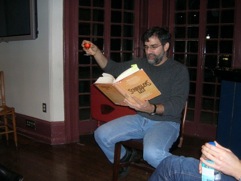
Each May, as the families of undergrad seniors come to Philly for their kids' commencement, we hold a celebration to honor a group of students who have been closely--sometimes very closely--affiliated with the Writers House. This year's "senior capstone event" honored 12 seniors. We recorded all of these emotional farewells, but there's one I recommend for starters--that of Anna Levett (in the center of the photo here. She read poem called "California", meant to turn the honor around at her father, who was of course sitting in the audience. I'm the dad of a daughter myself, and so I couldn't help but imagining what such a tribute would feel like--more specifically that gracious gesture of redirecting the gratitude--would feel like. Anna's father, Kit, whom I've known a bit for a few years, received the poem as a kind of graduation gift. The poem is in a sense a parallel list of differences between daughter and father (she likes beaches, he mountains) but it's also about their common home (the California landscape that can encompass both), and so, while the poem was read aloud emotionally on this occasion, its words are not merely sentimental (though they certainly are that): they create or rather maintain a distance between these two people who love each other, revering the distance and making it part of affection.
Sunday, July 08, 2007
daughter is to dad as beach is to mountains
Each May, as the families of undergrad seniors come to Philly for their kids' commencement, we hold a celebration to honor a group of students who have been closely--sometimes very closely--affiliated with the Writers House. This year's "senior capstone event" honored 12 seniors. We recorded all of these emotional farewells, but there's one I recommend for starters--that of Anna Levett (in the center of the photo here. She read poem called "California", meant to turn the honor around at her father, who was of course sitting in the audience. I'm the dad of a daughter myself, and so I couldn't help but imagining what such a tribute would feel like--more specifically that gracious gesture of redirecting the gratitude--would feel like. Anna's father, Kit, whom I've known a bit for a few years, received the poem as a kind of graduation gift. The poem is in a sense a parallel list of differences between daughter and father (she likes beaches, he mountains) but it's also about their common home (the California landscape that can encompass both), and so, while the poem was read aloud emotionally on this occasion, its words are not merely sentimental (though they certainly are that): they create or rather maintain a distance between these two people who love each other, revering the distance and making it part of affection.


 "I teach horizontally, meaning that while I might begin with a fixed idea of what I'm going to teach that day, I let it drift rhizomatically way off topic, often pulling it back when it gets too far. I rely on non-fixed materials to teach this way; the whole world is at my fingertips. Should I go off on a tangent about John and Rauschenberg and their love relationship as expressed in Rauschenberg's bed, an image of that bed is always a click away. From there, we can head anywhere into the non-fixed universe, be it film, text or sound. And of course, that always takes us elsewhere. As Cage says, 'We are getting nowhere fast.'"

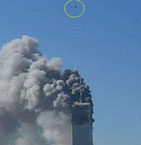 that anyone has yet got the imaginative measure of that terrifying day six years ago. Certainly our Tolstoy has not crawled out of the rubble. The closest we have, Don DeLillo, succeeded as an essayist-journalist ("In the Ruins of the Future: Reflections on Terror and Loss in the Shadow of September,” Harper’s, December 2001) but, to my mind, failed as a novelist ("Falling Man"). One reason, perhaps, is that the remembered emotion was instantly buried under a pile of cultural junk.' - Tod Gitlin in his review of Susan Faludi's The Terror Dream (written for