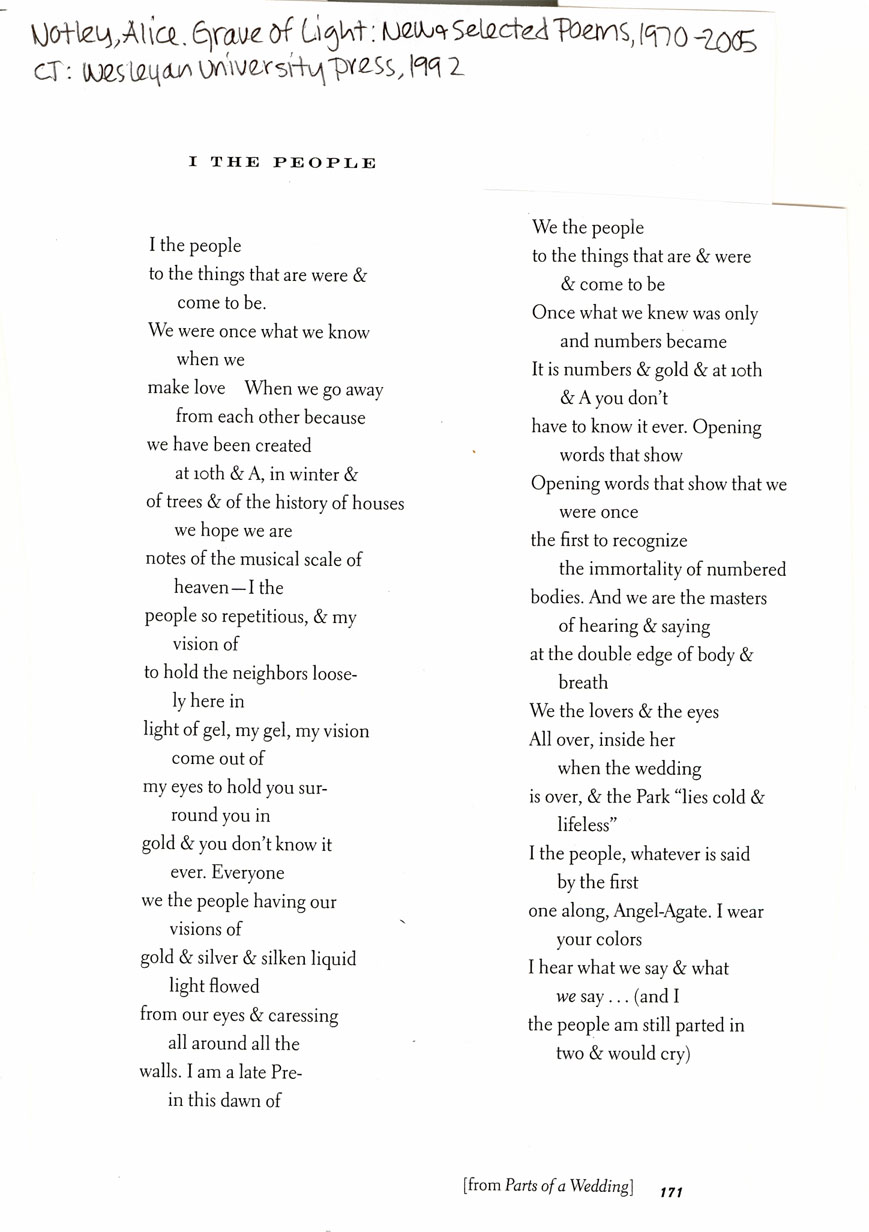
 In her 1986 book Parts of a Wedding, Alice Notley published a poem I especially admire, called "I the People." (It was republished in Grave of Light: New & Selected Poems, 1970-2005.) The text of the poem is here. When Notley came to the Writers House to read in the fall of '06, she read this poem and we have a recording of it (mp3). In its sense of political-is-personal, it is very much like John Ashbery's poem, "The One Thing That Can Save America": a lyrical digressive response, in its very meandering and promotion of urban specificity, to the fundamental democratic idea of the people. Somewhat predictably the poem turns the phrase "we, the people" every which way so that the republic seems to depend on modest and shifting as opposed to hyper-confident presumptuous first-person statements. Notley's "I" is one that becomes "we" by way of (actual) love experience, an actual sense of place. There are broad but only momentarily hints of satire here, e.g. at/against Frost's "The Gift Outright," with its notion of what America "was" and "would become." Notley: "I the people / to the things that are were & come to be. / We were once what we know when we / make love...."
Tuesday, August 07, 2007
I, the people
In her 1986 book Parts of a Wedding, Alice Notley published a poem I especially admire, called "I the People." (It was republished in Grave of Light: New & Selected Poems, 1970-2005.) The text of the poem is here. When Notley came to the Writers House to read in the fall of '06, she read this poem and we have a recording of it (mp3). In its sense of political-is-personal, it is very much like John Ashbery's poem, "The One Thing That Can Save America": a lyrical digressive response, in its very meandering and promotion of urban specificity, to the fundamental democratic idea of the people. Somewhat predictably the poem turns the phrase "we, the people" every which way so that the republic seems to depend on modest and shifting as opposed to hyper-confident presumptuous first-person statements. Notley's "I" is one that becomes "we" by way of (actual) love experience, an actual sense of place. There are broad but only momentarily hints of satire here, e.g. at/against Frost's "The Gift Outright," with its notion of what America "was" and "would become." Notley: "I the people / to the things that are were & come to be. / We were once what we know when we / make love...."


 "I teach horizontally, meaning that while I might begin with a fixed idea of what I'm going to teach that day, I let it drift rhizomatically way off topic, often pulling it back when it gets too far. I rely on non-fixed materials to teach this way; the whole world is at my fingertips. Should I go off on a tangent about John and Rauschenberg and their love relationship as expressed in Rauschenberg's bed, an image of that bed is always a click away. From there, we can head anywhere into the non-fixed universe, be it film, text or sound. And of course, that always takes us elsewhere. As Cage says, 'We are getting nowhere fast.'"

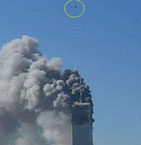 that anyone has yet got the imaginative measure of that terrifying day six years ago. Certainly our Tolstoy has not crawled out of the rubble. The closest we have, Don DeLillo, succeeded as an essayist-journalist ("In the Ruins of the Future: Reflections on Terror and Loss in the Shadow of September,” Harper’s, December 2001) but, to my mind, failed as a novelist ("Falling Man"). One reason, perhaps, is that the remembered emotion was instantly buried under a pile of cultural junk.' - Tod Gitlin in his review of Susan Faludi's The Terror Dream (written for