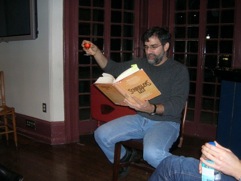
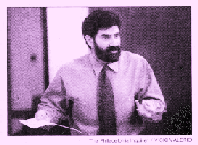
 I love teaching English 88, my modern & contemporary American poetry course, in part because the thing has evolved in such a way that it is something of a three-ring circus. It's created a life of its own, and certainly the vitality of the poetry hasn't hurt any. As the century ended and a new one began, of course I added new contemporary materials; as online technology improved, I added more e-features; as my disinclination to lecture deepened I abandoned even the 5-minute set-piece, no matter how instructive. So unlike my Holocaust course, which is, alas, inert in several respects, this course is dynamic, a moving target, as digressive as some of my favorite verse.
Anyway, the first time I really felt I was in the sway of this course, it was 1995 and I was teaching it to 90 students in a large cavernous space in unrenovated Bennett Hall on Penn's Campus, and the thing just went wildly off the rails, which of course was just what made it so terrific. The Philadelphia Inquirer somehow got word of this, and sent Lily Eng, who was then covering higher ed for them, to see what was going on. She made a "trend piece" of it, consulting with others about how and why poetry was "making a comeback." But the article nonetheless gives a sense of what fun we were having.
And anyway, how often does one read about the Baroness Elsa von Freytag Loringhoven in your local daily newspaper?


 "I teach horizontally, meaning that while I might begin with a fixed idea of what I'm going to teach that day, I let it drift rhizomatically way off topic, often pulling it back when it gets too far. I rely on non-fixed materials to teach this way; the whole world is at my fingertips. Should I go off on a tangent about John and Rauschenberg and their love relationship as expressed in Rauschenberg's bed, an image of that bed is always a click away. From there, we can head anywhere into the non-fixed universe, be it film, text or sound. And of course, that always takes us elsewhere. As Cage says, 'We are getting nowhere fast.'"

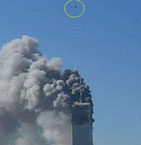 that anyone has yet got the imaginative measure of that terrifying day six years ago. Certainly our Tolstoy has not crawled out of the rubble. The closest we have, Don DeLillo, succeeded as an essayist-journalist ("In the Ruins of the Future: Reflections on Terror and Loss in the Shadow of September,” Harper’s, December 2001) but, to my mind, failed as a novelist ("Falling Man"). One reason, perhaps, is that the remembered emotion was instantly buried under a pile of cultural junk.' - Tod Gitlin in his review of Susan Faludi's The Terror Dream (written for